ENG1503
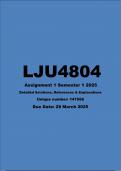
Assignment 1
(COMPLETE ANSWERS)
Semester 1 2025
(769162)
DUE 24 March 2025
, ACTIVITIES
Teaching Information Literacy in an Age of Misinformation Krista Black, EdD February 28, 2024 The
first time I encountered a student who “just didn’t believe” the data I was using in my sociology class,
it caught me off guard. I don’t recall exactly how I responded in the moment, but with the benefit of
hindsight I now know it was a tremor in what would become a seismic shift in our educational
landscape. Students who are in their late teens or early twenties have spent their educational
experiences navigating misinformation, fake news, and alternative facts. I didn’t realize until my
student made the comment above on how the broader shift in our society toward scientific
skepticism would bear out in the classroom. This unexpected moment in the classroom alerted me to
an opportunity to explore and expand the scope of information literacy skills I incorporate in my
courses. I had started integrating information literacy skills into my sociology classes with a narrow
focus that built on research method topics that were appropriate for an introductory course. We
talked about interpreting statistics like percent change, visual representations of data, survey design,
and sampling. My goal was to support both students’ learning of sociology in the course and their
broader consumption of information outside of the classroom. As we worked through information
literacy lessons in class, I gained insights into how students access and process information in their
day-to-day lives. My students reported getting their news from social media, news apps, television
news, and friends and family members. They are aware of mis- and disinformation, the fact that social
media is designed to be attention-grabbing, and that not all sources are reliable. This, from my
perspective, is a good thing. What I see as a challenge that we as educators must grapple with, is our
students’ selective desire to apply these misgivings towards not just all information, but particularly
those sources of information that clash with their preferred vision for how things “should” be (i.e.,
motivated reasoning). Through this process of teaching, getting student feedback, and revising my
materials, I learned that my initial information literacy focus was too narrow. Yes, students need to
know how to interpret statistics—but first they need to know whether they can trust the source in the
first place. In response to this, my focus in teaching information literacy has broadened to include
evaluating credibility and point of view in sources. I want to help them move beyond skepticism and
distrust of sources to critical thinking. Rather than approaching every source with, “This might be
wrong,” my goal is to help them practice evaluating, “How can I verify the credibility of this?” When I
teach information literacy now, I focus my efforts on developing student skills in three areas. Black, K.
2024. Teaching information literacy in an age of misinformation.
https://www.facultyfocus.com/articles/effective-classroom-management/teaching-information-
literacy-in-an-age-of-
misinformation/?st=FFdaily;sc=FF240228;utm_term=FF240228&mailingID=6165&utm_source=Active
Campaign&utm_medium=email&utm_content=Teaching+Information+Literacy+in+an+Age+of+Mis
information&utm_campaign=FF240131. [Accessed 29 February 2024]. QUESTION 1 1.1 Discuss the
target audience of this text and justify your response on your choice of the target audience. [5 Marks]
Identification of the target audience = 1 mark Reason = 2 marks Language and structure = 2 marks
1.2. In your opinion, what are the four (4) ways in which teaching literacy can lead to misinformation?
(150 words) [10 Marks] Four ways teaching literacy has led to misinformation (4 x 2 = 8 marks)
Language and structure = 2 marks 1.3. In your own words, summarise the text in four (4) discussion
points. (150 words) [10 Marks] Discussion points (4 X 2 = 8 marks) Language and structure = 2 marks
1.4. Indicate THREE (3) unique examples of informal language in the text. Justify why each example is
informal. [10 Marks] Each example = 3 marks Marks for justification = 3 marks Language and
structure = 4 marks 1.5. Explain THREE (3) effects of misinformation from the given text? In addition,
reflect on your personal experiences with fake news, discussing how it has impacted you or those
around you. [15 Marks]
Assignment 1
(COMPLETE ANSWERS)
Semester 1 2025
(769162)
DUE 24 March 2025
, ACTIVITIES
Teaching Information Literacy in an Age of Misinformation Krista Black, EdD February 28, 2024 The
first time I encountered a student who “just didn’t believe” the data I was using in my sociology class,
it caught me off guard. I don’t recall exactly how I responded in the moment, but with the benefit of
hindsight I now know it was a tremor in what would become a seismic shift in our educational
landscape. Students who are in their late teens or early twenties have spent their educational
experiences navigating misinformation, fake news, and alternative facts. I didn’t realize until my
student made the comment above on how the broader shift in our society toward scientific
skepticism would bear out in the classroom. This unexpected moment in the classroom alerted me to
an opportunity to explore and expand the scope of information literacy skills I incorporate in my
courses. I had started integrating information literacy skills into my sociology classes with a narrow
focus that built on research method topics that were appropriate for an introductory course. We
talked about interpreting statistics like percent change, visual representations of data, survey design,
and sampling. My goal was to support both students’ learning of sociology in the course and their
broader consumption of information outside of the classroom. As we worked through information
literacy lessons in class, I gained insights into how students access and process information in their
day-to-day lives. My students reported getting their news from social media, news apps, television
news, and friends and family members. They are aware of mis- and disinformation, the fact that social
media is designed to be attention-grabbing, and that not all sources are reliable. This, from my
perspective, is a good thing. What I see as a challenge that we as educators must grapple with, is our
students’ selective desire to apply these misgivings towards not just all information, but particularly
those sources of information that clash with their preferred vision for how things “should” be (i.e.,
motivated reasoning). Through this process of teaching, getting student feedback, and revising my
materials, I learned that my initial information literacy focus was too narrow. Yes, students need to
know how to interpret statistics—but first they need to know whether they can trust the source in the
first place. In response to this, my focus in teaching information literacy has broadened to include
evaluating credibility and point of view in sources. I want to help them move beyond skepticism and
distrust of sources to critical thinking. Rather than approaching every source with, “This might be
wrong,” my goal is to help them practice evaluating, “How can I verify the credibility of this?” When I
teach information literacy now, I focus my efforts on developing student skills in three areas. Black, K.
2024. Teaching information literacy in an age of misinformation.
https://www.facultyfocus.com/articles/effective-classroom-management/teaching-information-
literacy-in-an-age-of-
misinformation/?st=FFdaily;sc=FF240228;utm_term=FF240228&mailingID=6165&utm_source=Active
Campaign&utm_medium=email&utm_content=Teaching+Information+Literacy+in+an+Age+of+Mis
information&utm_campaign=FF240131. [Accessed 29 February 2024]. QUESTION 1 1.1 Discuss the
target audience of this text and justify your response on your choice of the target audience. [5 Marks]
Identification of the target audience = 1 mark Reason = 2 marks Language and structure = 2 marks
1.2. In your opinion, what are the four (4) ways in which teaching literacy can lead to misinformation?
(150 words) [10 Marks] Four ways teaching literacy has led to misinformation (4 x 2 = 8 marks)
Language and structure = 2 marks 1.3. In your own words, summarise the text in four (4) discussion
points. (150 words) [10 Marks] Discussion points (4 X 2 = 8 marks) Language and structure = 2 marks
1.4. Indicate THREE (3) unique examples of informal language in the text. Justify why each example is
informal. [10 Marks] Each example = 3 marks Marks for justification = 3 marks Language and
structure = 4 marks 1.5. Explain THREE (3) effects of misinformation from the given text? In addition,
reflect on your personal experiences with fake news, discussing how it has impacted you or those
around you. [15 Marks]