TRANSFORMERS Exam Questions And Answers 2025.
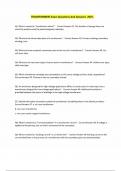
TRANSFORMERS Exam Questions And Answers 2025. Q1. What is meant by "transformer action?" - Correct Answer A1. The transfer of energy from one circuit to another circuit by electromagnetic induction. Q2. What are the three basic parts of a transformer? - Correct Answer A2. Primary winding; secondary winding; core. Q3. What are three materials commonly used as the core of a transformer? - Correct Answer A3. Air; soft iron; steel. Q4. What are the two main types of cores used in transformers? - Correct Answer A4. Hollow-core type; shell-core type. Q5. Which transformer windings are connected to an AC source voltage and to a load, respectively? - Correct Answer A5. Primary to source; secondary to load. Q6. A transformer designed for high-voltage applications differs in construction in what way from a transformer designed for low-voltage applications? - Correct Answer A6. Additional insulation is provided between the layers of windings in the high-voltage transformer. Q7. Identify the below schematic symbols of transformers by labeling them in the blanks provided. - Correct Answer A7. a. air-core transformer b. iron-core transformer c. iron-core center tapped transformer Q8. What is meant by a "no-load condition" in a transformer circuit? - Correct Answer A8. A voltage is applied to the primary, but no load is connected to the secondary. Q9. What is meant by "exciting current" in a transformer? - Correct Answer A9. Exciting current is the current that flows in the primary of a transformer with the secondary open (no load attached). Q10. What is the name of the emf generated in the primary that opposes the flow of current in the primary? - Correct Answer A10. Self-induced or counter emf. Q11. What causes a voltage to be developed across the secondary winding of a transformer? - Correct Answer A11. The magnetic lines generated by the current in the primary cut the secondary windings and induce a voltage into them. Q12. What is the phase relationship between the voltage induced in the secondary of an unlike-wound transformer and the counter emf of the primary winding? - Correct Answer A12. In phase. Remember, the cemf of the primary is 180 degrees out of phase with the applied voltage. The induced voltage of the secondary of an unlike-wound transformer is also 180 degrees out of phase with the primary voltage.
Written for
- Institution
- Transformers
- Course
- Transformers
Document information
- Uploaded on
- March 14, 2025
- Number of pages
- 5
- Written in
- 2024/2025
- Type
- Exam (elaborations)
- Contains
- Questions & answers
Subjects
-
q1 what is meant by transformer action
-
q2 what are the three basic parts of a transforme
-
q3 what are three materials commonly used as the
-
q5 which transformer windings are connected to an

Document also available in package deal