Inhoud
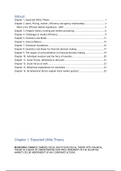
Chapter 1. Expected Utility Theory ...................................................................1
Chapter 2. Asset, Pricing, market, efficiency and agency relationships .........................4
What is the 'Efficient Market Hypothesis - EMH' ..................................................5
Chapter 3. Prospect theory, framing and mental accounting......................................6
Chapter 4. Challenges to market efficiency .........................................................9
Chapter 5. Heuristics and Biases .....................................................................11
Chapter 6. Overconfidence ............................................................................14
Chapter 7. Emotional foundations....................................................................16
Chapter 8. Heuristics and biases for financial decision-making .................................17
Chapter 9. The impact of overconfidence on financial decision making .......................19
Chapter 10. Individual investors and the force of emotion ......................................20
Chapter 11. Social Forces, selfishness or altruism? ................................................21
Chapter 12. Social forces at work ....................................................................23
Chapter 13. Behavioral explanations for anomalies ...............................................23
Chapter 14. Do behavioral factors explain stock market puzzles? ..............................25
Chapter 1. Expected Utility Theory
BEHAVIORAL FINANCE COMBINES SOCIAL AND PSYCHOLOGICAL THEORY WITH FINANCIAL
THEORY AS A MEANS OF UNDERSTANDING HOW PRICE MOVEMENTS IN THE SECURITIES
MARKETS OCCUR INDEPENDENT OF ANY CORPORATE ACTIONS.
,Neoclassical economics
1. PEOPLE HAVE RATIONAL PREFERENCES ACROSS POSSIBLE OUTCOMES OR STATES OF
NATURE.
2. PEOPLE MAXIMIZE UTILITY AND FIRMS MAXIMIZE PROFITS.
3. PEOPLE MAKE INDEPENDENT DECISIONS BASED ON ALL RELEVANT INFORMATION.
TWO KEY ASSUMPTIONS ABOUT PREFERENCES:
1. Comparability (Completeness/Ordering)
For the entire set of uncertain alternatives, an individual can say either that x is preferred
to outcome y (x > y) or y is preferred to x (y > x) or indifferent between x and y (x ~ y).
2. Transitivity (Consistency)
If an individual prefers x to y and y to z, then x is preferred to z. If (x > y and y > z, then x
> z). Similarly, if an individual is indifferent between x and y and is also indifferent
between y and z, then the individual is indifferent between x and z.
UTILITY OVER GOODS:
U(2 BREAD, 1 WATER) > U(1 BREAD, 2 WATER)
UTILITY OVER MONEY:
U(W2) > U(W1) IF W2 > W1
Expected Utility Theory:
THEORY IS REALLY SET UP TO DEAL WITH RISK, NOT UNCERTAINTY:
RISK IS WHEN YOU KNOW WHAT THE OUTCOMES COULD BE, AND CAN ASSIGN PROBABILITIES
UNCERTAINTY IS WHEN YOU CAN’T ASSIGN PROBABILITIES, you don’t know what is going to
happen.
Expected Utility theory defines rational behavior when people face uncertainty. The
theory is used to describe how people should act in making decisions when there is
, uncertainty and risk. That’s why it is normative. Expected Utility, individuals should
maximize utility (happiness) based on their preferences and the information they have.
A prospect is a series of wealth or income level outcomes, each of which is associated with
a probability.
EXAMPLE:
$500 WITH PROBABILITY .8
$2,000 WITH PROBABILITY .2
P1(.8, 500, 2,000)
WHEN 2nd OPTION IS ZERO, LET’S WRITE:
P2(.8, 500)… i.e P2(.8,500,0) = (0.8 x 500) + (0.2 x 0)
EXPECTED UTILITY THEORY COMES FROM A SERIES OF ASSUMPTIONS
(AXIOMS) ON THESE PROSPECTS.
CONSIDER TWO MORE PROSPECTS P3 AND P4:
P3(.7, 300, 2,100)
P4(.5, 600, 2,000)
AN ORDERING OF P1 VS. P3 AND P1 VS. P4 COULD BE:
P1>P3 AND P4>P1
TRANSITIVITY SAYS: P4>P3
BASED ON ASSUMPTIONS SUCH AS ORDERING AND TRANSITIVITY (AND OTHERS), IT CAN BE
SHOWN THAT WHEN SUCH CHOICES OVER RISKY PROSPECTS ARE TO BE MADE, PEOPLE
SHOULD ACT AS IF THEY ARE MAXIMIZING EXPECTED UTILITY:
Example:
U(W) = W.5
PROSPECTS:
P5(.5, 1000, 500)
P6(.6, 1200, 300)
FOR P5: U(P5) = .5 * 1000.5 + .5 * 500.5 = 26.99
FOR P6: U(P6) = .6 * 1200.5 + .4 * 300.5 = 27.71
SO P6 > P5.
Risk averse, people tend to be risk averse from nature instead of risk seeking.
THIS COMES FROM FREQUENT OBSERVATION THAT MOST PEOPLE MOST OF THE TIME ARE NOT
WILLING TO ACCEPT A FAIR GAMBLE:
WOULD YOU BE WILLING TO BET ME $100 THAT YOU CAN PREDICT A COIN FLIP?
MOST WOULD SAY NO. AND IF ONE OF YOU SAYS YES, I WILL SAY NO, SINCE I AM RISK AVERSE.
RISK AVERSION IMPLIES CONCAVITY.
Certainty Equivalents
CERTAINTY EQUIVALENT IS DEFINED AS THAT WEALTH LEVEL WHICH LEADS DECISION-MAKER
TO BE INDIFFERENT BETWEEN A PARTICULAR PROSPECT AND A CERTAIN WEALTH LEVEL.
Chapter 1. Expected Utility Theory ...................................................................1
Chapter 2. Asset, Pricing, market, efficiency and agency relationships .........................4
What is the 'Efficient Market Hypothesis - EMH' ..................................................5
Chapter 3. Prospect theory, framing and mental accounting......................................6
Chapter 4. Challenges to market efficiency .........................................................9
Chapter 5. Heuristics and Biases .....................................................................11
Chapter 6. Overconfidence ............................................................................14
Chapter 7. Emotional foundations....................................................................16
Chapter 8. Heuristics and biases for financial decision-making .................................17
Chapter 9. The impact of overconfidence on financial decision making .......................19
Chapter 10. Individual investors and the force of emotion ......................................20
Chapter 11. Social Forces, selfishness or altruism? ................................................21
Chapter 12. Social forces at work ....................................................................23
Chapter 13. Behavioral explanations for anomalies ...............................................23
Chapter 14. Do behavioral factors explain stock market puzzles? ..............................25
Chapter 1. Expected Utility Theory
BEHAVIORAL FINANCE COMBINES SOCIAL AND PSYCHOLOGICAL THEORY WITH FINANCIAL
THEORY AS A MEANS OF UNDERSTANDING HOW PRICE MOVEMENTS IN THE SECURITIES
MARKETS OCCUR INDEPENDENT OF ANY CORPORATE ACTIONS.
,Neoclassical economics
1. PEOPLE HAVE RATIONAL PREFERENCES ACROSS POSSIBLE OUTCOMES OR STATES OF
NATURE.
2. PEOPLE MAXIMIZE UTILITY AND FIRMS MAXIMIZE PROFITS.
3. PEOPLE MAKE INDEPENDENT DECISIONS BASED ON ALL RELEVANT INFORMATION.
TWO KEY ASSUMPTIONS ABOUT PREFERENCES:
1. Comparability (Completeness/Ordering)
For the entire set of uncertain alternatives, an individual can say either that x is preferred
to outcome y (x > y) or y is preferred to x (y > x) or indifferent between x and y (x ~ y).
2. Transitivity (Consistency)
If an individual prefers x to y and y to z, then x is preferred to z. If (x > y and y > z, then x
> z). Similarly, if an individual is indifferent between x and y and is also indifferent
between y and z, then the individual is indifferent between x and z.
UTILITY OVER GOODS:
U(2 BREAD, 1 WATER) > U(1 BREAD, 2 WATER)
UTILITY OVER MONEY:
U(W2) > U(W1) IF W2 > W1
Expected Utility Theory:
THEORY IS REALLY SET UP TO DEAL WITH RISK, NOT UNCERTAINTY:
RISK IS WHEN YOU KNOW WHAT THE OUTCOMES COULD BE, AND CAN ASSIGN PROBABILITIES
UNCERTAINTY IS WHEN YOU CAN’T ASSIGN PROBABILITIES, you don’t know what is going to
happen.
Expected Utility theory defines rational behavior when people face uncertainty. The
theory is used to describe how people should act in making decisions when there is
, uncertainty and risk. That’s why it is normative. Expected Utility, individuals should
maximize utility (happiness) based on their preferences and the information they have.
A prospect is a series of wealth or income level outcomes, each of which is associated with
a probability.
EXAMPLE:
$500 WITH PROBABILITY .8
$2,000 WITH PROBABILITY .2
P1(.8, 500, 2,000)
WHEN 2nd OPTION IS ZERO, LET’S WRITE:
P2(.8, 500)… i.e P2(.8,500,0) = (0.8 x 500) + (0.2 x 0)
EXPECTED UTILITY THEORY COMES FROM A SERIES OF ASSUMPTIONS
(AXIOMS) ON THESE PROSPECTS.
CONSIDER TWO MORE PROSPECTS P3 AND P4:
P3(.7, 300, 2,100)
P4(.5, 600, 2,000)
AN ORDERING OF P1 VS. P3 AND P1 VS. P4 COULD BE:
P1>P3 AND P4>P1
TRANSITIVITY SAYS: P4>P3
BASED ON ASSUMPTIONS SUCH AS ORDERING AND TRANSITIVITY (AND OTHERS), IT CAN BE
SHOWN THAT WHEN SUCH CHOICES OVER RISKY PROSPECTS ARE TO BE MADE, PEOPLE
SHOULD ACT AS IF THEY ARE MAXIMIZING EXPECTED UTILITY:
Example:
U(W) = W.5
PROSPECTS:
P5(.5, 1000, 500)
P6(.6, 1200, 300)
FOR P5: U(P5) = .5 * 1000.5 + .5 * 500.5 = 26.99
FOR P6: U(P6) = .6 * 1200.5 + .4 * 300.5 = 27.71
SO P6 > P5.
Risk averse, people tend to be risk averse from nature instead of risk seeking.
THIS COMES FROM FREQUENT OBSERVATION THAT MOST PEOPLE MOST OF THE TIME ARE NOT
WILLING TO ACCEPT A FAIR GAMBLE:
WOULD YOU BE WILLING TO BET ME $100 THAT YOU CAN PREDICT A COIN FLIP?
MOST WOULD SAY NO. AND IF ONE OF YOU SAYS YES, I WILL SAY NO, SINCE I AM RISK AVERSE.
RISK AVERSION IMPLIES CONCAVITY.
Certainty Equivalents
CERTAINTY EQUIVALENT IS DEFINED AS THAT WEALTH LEVEL WHICH LEADS DECISION-MAKER
TO BE INDIFFERENT BETWEEN A PARTICULAR PROSPECT AND A CERTAIN WEALTH LEVEL.