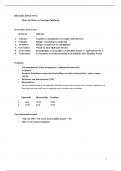
Chemistry of solutions equations (NYB)
Properties of Solutions
mole of solute
molarity (M) = = mol/L
liter of solution
equivalent of solute
normality (N) = = Eq/L (mostly used for acid-base or redox reaction)
liter of solution
Concentrations
The equivalence unit (Eq) depends both on the reactant and the type of reaction present.
The solute Ex: H2SO4 is used in an acid-base reaction (neutralization); when 1 mole of H2SO4 is used, it
(called A):
is the generates 2 equivalents of H+. Therefore, 1 M H2SO4 = 2 N H+ (correctly, it should be
compound written H3O+) .
dissolved in
the solvent.
The solvent: mole of solute
is the molality (m) = = mol/kg
compound kg of solvent
dissolving the
solute A
The solution: mass of A
is the mass percent (A%) = x 100% = %
combination of total mass of solution
both A and the
solvent.
mole of A
mole fraction (χA) = no unit.
total mole of the solution
mole of solute ionized
%dissociation = x 100% = %
mole of formula unit added
Solubility of gases
Cgas = kgas Pgas
Henry's law
where Cgas : gas solubility (mol/L), kgas : Henry's constant for the solubility of the gas
(M/atm)
, Ptotal = PA + PB + PC + ... + Pn
Dalton's law of PA
partial pressure χA(gas phase) =
PTot
Colligative properties
Raoult's law (vapor
pressure of two Ptotal = χA⋅P°A + χB⋅P°B
volatile chemicals)
Raoult's law (solvent Psolution = χsolvent ⋅ P°solvent
+ non volatile solute)
Boiling point ΔTb = Kb⋅msolute (for an electrolyte: ΔTb = i Kb⋅msolute)
elevation
Freezing point
voirlab
ΔTf = Kf⋅msolute (for an electrolyte: ΔTf = i Kf⋅msolute) colligative
depression properties
Osmotic pressure Π=MRT (for an electrolyte: Π = i M R T)
mole of particle in solution
van't Hoff factor i= no unit.
mole of formula unit added
Equilibrium
Equilibrium constant
For the [C]c [D]d
equilibrium: K= note: K = Kc (based on molarity)
aA + bB ⇌ [A]a [B]b
cC + dD
[C]oc [D]od
Reaction quotient (Q) Q= note: [ ]o = initial concentration (not at equilibrium)
a b
[A]o [B]o
Relation between Kc
and Kp
Kp: pressures
in atmosphere
Properties of Solutions
mole of solute
molarity (M) = = mol/L
liter of solution
equivalent of solute
normality (N) = = Eq/L (mostly used for acid-base or redox reaction)
liter of solution
Concentrations
The equivalence unit (Eq) depends both on the reactant and the type of reaction present.
The solute Ex: H2SO4 is used in an acid-base reaction (neutralization); when 1 mole of H2SO4 is used, it
(called A):
is the generates 2 equivalents of H+. Therefore, 1 M H2SO4 = 2 N H+ (correctly, it should be
compound written H3O+) .
dissolved in
the solvent.
The solvent: mole of solute
is the molality (m) = = mol/kg
compound kg of solvent
dissolving the
solute A
The solution: mass of A
is the mass percent (A%) = x 100% = %
combination of total mass of solution
both A and the
solvent.
mole of A
mole fraction (χA) = no unit.
total mole of the solution
mole of solute ionized
%dissociation = x 100% = %
mole of formula unit added
Solubility of gases
Cgas = kgas Pgas
Henry's law
where Cgas : gas solubility (mol/L), kgas : Henry's constant for the solubility of the gas
(M/atm)
, Ptotal = PA + PB + PC + ... + Pn
Dalton's law of PA
partial pressure χA(gas phase) =
PTot
Colligative properties
Raoult's law (vapor
pressure of two Ptotal = χA⋅P°A + χB⋅P°B
volatile chemicals)
Raoult's law (solvent Psolution = χsolvent ⋅ P°solvent
+ non volatile solute)
Boiling point ΔTb = Kb⋅msolute (for an electrolyte: ΔTb = i Kb⋅msolute)
elevation
Freezing point
voirlab
ΔTf = Kf⋅msolute (for an electrolyte: ΔTf = i Kf⋅msolute) colligative
depression properties
Osmotic pressure Π=MRT (for an electrolyte: Π = i M R T)
mole of particle in solution
van't Hoff factor i= no unit.
mole of formula unit added
Equilibrium
Equilibrium constant
For the [C]c [D]d
equilibrium: K= note: K = Kc (based on molarity)
aA + bB ⇌ [A]a [B]b
cC + dD
[C]oc [D]od
Reaction quotient (Q) Q= note: [ ]o = initial concentration (not at equilibrium)
a b
[A]o [B]o
Relation between Kc
and Kp
Kp: pressures
in atmosphere