PHYSICAL SCIENCE:
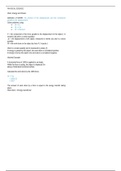
Work, Energy and Power:
Definition of WORK: the product of the displacement and the component
parallel to the displacement.
Solve problems using:
W = Fs
W = Fx
W = Fxcos
F = the component of the force parallel to the displacement of the object ( in
newtons (N) and is a vector quantity)
x = the displacement of the object, measured in metres (m) and is a vector
quantity.
W = the work done on the object by force F ( in joules )
Work is a scalar quantity and is measured in joules (J).
If energy is gained by the object, the work done is considered positive.
If energy is lost by the object, the work done is considered negative.
Worked Example:
A horizontal force of 100N is applied to an object.
While the force is acting, the object is displaced 3m
along a frictionless horizonal surface.
Calculate the work done by the 100N force.
W = Fx
= (100) (3)
= 300J
The amount of work done by a force is equal to the energy transfer taking
place.
Work done = Energy transferred
, Definition of GRAVITATIONAL POTENTIAL ENERGY: the energy an object
possesses due to its position relative to a reference point.
Solve problems using:
Ep = mgh
m = the mass of the object in kg’s
g = the acceleration due to gravity (on Earth = 9.8m. s−2
h = the vertical height of the object above a reference point in m’s
Gravitational Potential Energy is a scalar quantity.
Worked Example:
A man lifts a 1,8kg box onto a 2m high shelf.
Calculate the gravitational potential energy of the box.
Ep = mgh = (1,8) (9,8) (2) = 35,28J
Definition of KINETIC ENERGY: the energy an object has as a result of the
object’s motion.
Solve problems using:
1 2
Ek = mv
2
m = the mass of the object in kg’s
v = the speed of the object in m. s−1
Kinetic Energy is a scalar quantity.
Worked Example:
During the 100m sprint, Usain Bolt (mass 86kg) reaches a top speed of 13m.
s−1 .
A 60kg cheetah can reach a top speed of 103km.h−1.
a) Convert 103km.h−1 to a speed in m. s−1 .
( to convert, simply divide by 3,6 )
Work, Energy and Power:
Definition of WORK: the product of the displacement and the component
parallel to the displacement.
Solve problems using:
W = Fs
W = Fx
W = Fxcos
F = the component of the force parallel to the displacement of the object ( in
newtons (N) and is a vector quantity)
x = the displacement of the object, measured in metres (m) and is a vector
quantity.
W = the work done on the object by force F ( in joules )
Work is a scalar quantity and is measured in joules (J).
If energy is gained by the object, the work done is considered positive.
If energy is lost by the object, the work done is considered negative.
Worked Example:
A horizontal force of 100N is applied to an object.
While the force is acting, the object is displaced 3m
along a frictionless horizonal surface.
Calculate the work done by the 100N force.
W = Fx
= (100) (3)
= 300J
The amount of work done by a force is equal to the energy transfer taking
place.
Work done = Energy transferred
, Definition of GRAVITATIONAL POTENTIAL ENERGY: the energy an object
possesses due to its position relative to a reference point.
Solve problems using:
Ep = mgh
m = the mass of the object in kg’s
g = the acceleration due to gravity (on Earth = 9.8m. s−2
h = the vertical height of the object above a reference point in m’s
Gravitational Potential Energy is a scalar quantity.
Worked Example:
A man lifts a 1,8kg box onto a 2m high shelf.
Calculate the gravitational potential energy of the box.
Ep = mgh = (1,8) (9,8) (2) = 35,28J
Definition of KINETIC ENERGY: the energy an object has as a result of the
object’s motion.
Solve problems using:
1 2
Ek = mv
2
m = the mass of the object in kg’s
v = the speed of the object in m. s−1
Kinetic Energy is a scalar quantity.
Worked Example:
During the 100m sprint, Usain Bolt (mass 86kg) reaches a top speed of 13m.
s−1 .
A 60kg cheetah can reach a top speed of 103km.h−1.
a) Convert 103km.h−1 to a speed in m. s−1 .
( to convert, simply divide by 3,6 )