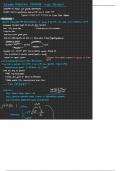
TOPIC 7: DISMISSAL: INCAPACITY
Prescribed:
Palace Engineering (Pty) Ltd v Ngcobo & Others (2014) 35 ILJ 1971 (LAC)
•
• General Motors SA (Pty) Ltd v National Union of Metalworkers of SA & Others (2018) 39
ILJ 1316 (LC)
Approach:
First potentially fair reason for dismissal to be considered.
•
Topics:
• Distinguish from misconduct and operational requirements.
◦ Areas: negligence, alcohol abuse, absenteeism.
Two Types -> poor work performance and medical
incapacity
a) Poor work performance:
• distinguish from negligence (misconduct)
• General principles (Code of Good Practice)
• Issues: Employees on probation / senior employees
• Issues: Incompatibility / demand by a third party / supervening impossibility of
performance (incarceration or loss of qualifications - no automatic termination)
b) Medical Incapacity
• General principles -> POD: it can be temporary and permanent.
• Look out for alcohol abuse / absenteeism / overlap with disability -> Incapacity is a
possibly fair reason, but disability will be automatically unfair in terms of S187(1)(f)
Incapacity - background
• ILO Convention 158 of 1982: Termination of Employment at the Initiative of the Employer -
> must be valid reason (3 types) and opportunity to be heard.
• LRA S188 -> a dismissal that is not automatically unfair, will be unfair if the employer fails
to prove a valid reason (conduct, capacity, and operational requirements) and fair
procedure. Person determining whether dismissal is fair must take Code of Good Practice
into account.
• Different requirements for 3 reasons to be fair (substance and procedure)
• In principle, incapacity is a 'no fault' dismissal.
• Sometimes difficult to distinguish incapacity and misconduct.
◦ Negligence (misconduct)
, ▪ Blameworthy conduct -> not because of incapacity
▪ NB to distinguish negligence and incapacity because employer cannot fairly
dismiss a genuine poor performer under the guise of misconduct. When
employees' levels of performance are at stake, incapacity and misconduct look the
same in that there is a deviation from the standard the employer expects ->
blamed for deviation or not?
◦ Alcohol and drug abuse -> typically regarded as misconduct
▪ Where an employee abuses drugs or alcohol because of an addiction, the employer
should deal with this as medical incapacity and endeavour to assist the employee
from a process of rehabilitation.
◦ Absenteeism -> typically regarded as misconduct
◦ Misconduct -> 'can but won't' VS Incapacity -> 'want to but cannot'
◦ Misconduct has a fault requirement and incapacity has no fault requirement
Poor Performance: General Principles
Overlap of substantive and procedural fairness
• Substantive -> have a good reason
• Procedure -> follow a procedure to ensure that there is a serious poor work performance
problem (gather ammo)
Substantive fairness of dismissal
a) Compliance with (reasonable) performance standard?
• Presumes:
◦ Must have a performance standard
◦ It must be reasonable
◦ Employer in a position to assess the employee in terms of the standard and make a
determination
b) Aware of standard?
• Whether the employee could reasonably be expected to be aware of the standard
c) Fair opportunity to improve
• See procedure -> investigation of reasons for non-compliance;
◦ reasonable evaluation
◦ instruction
◦ training
◦ guidance counselling
◦ reasonable time for meeting standard
• Once fair opportunity given then the employer can consider dismissal.
d) Dismissal appropriate sanction
• Alternative considered such as demotion
2
Prescribed:
Palace Engineering (Pty) Ltd v Ngcobo & Others (2014) 35 ILJ 1971 (LAC)
•
• General Motors SA (Pty) Ltd v National Union of Metalworkers of SA & Others (2018) 39
ILJ 1316 (LC)
Approach:
First potentially fair reason for dismissal to be considered.
•
Topics:
• Distinguish from misconduct and operational requirements.
◦ Areas: negligence, alcohol abuse, absenteeism.
Two Types -> poor work performance and medical
incapacity
a) Poor work performance:
• distinguish from negligence (misconduct)
• General principles (Code of Good Practice)
• Issues: Employees on probation / senior employees
• Issues: Incompatibility / demand by a third party / supervening impossibility of
performance (incarceration or loss of qualifications - no automatic termination)
b) Medical Incapacity
• General principles -> POD: it can be temporary and permanent.
• Look out for alcohol abuse / absenteeism / overlap with disability -> Incapacity is a
possibly fair reason, but disability will be automatically unfair in terms of S187(1)(f)
Incapacity - background
• ILO Convention 158 of 1982: Termination of Employment at the Initiative of the Employer -
> must be valid reason (3 types) and opportunity to be heard.
• LRA S188 -> a dismissal that is not automatically unfair, will be unfair if the employer fails
to prove a valid reason (conduct, capacity, and operational requirements) and fair
procedure. Person determining whether dismissal is fair must take Code of Good Practice
into account.
• Different requirements for 3 reasons to be fair (substance and procedure)
• In principle, incapacity is a 'no fault' dismissal.
• Sometimes difficult to distinguish incapacity and misconduct.
◦ Negligence (misconduct)
, ▪ Blameworthy conduct -> not because of incapacity
▪ NB to distinguish negligence and incapacity because employer cannot fairly
dismiss a genuine poor performer under the guise of misconduct. When
employees' levels of performance are at stake, incapacity and misconduct look the
same in that there is a deviation from the standard the employer expects ->
blamed for deviation or not?
◦ Alcohol and drug abuse -> typically regarded as misconduct
▪ Where an employee abuses drugs or alcohol because of an addiction, the employer
should deal with this as medical incapacity and endeavour to assist the employee
from a process of rehabilitation.
◦ Absenteeism -> typically regarded as misconduct
◦ Misconduct -> 'can but won't' VS Incapacity -> 'want to but cannot'
◦ Misconduct has a fault requirement and incapacity has no fault requirement
Poor Performance: General Principles
Overlap of substantive and procedural fairness
• Substantive -> have a good reason
• Procedure -> follow a procedure to ensure that there is a serious poor work performance
problem (gather ammo)
Substantive fairness of dismissal
a) Compliance with (reasonable) performance standard?
• Presumes:
◦ Must have a performance standard
◦ It must be reasonable
◦ Employer in a position to assess the employee in terms of the standard and make a
determination
b) Aware of standard?
• Whether the employee could reasonably be expected to be aware of the standard
c) Fair opportunity to improve
• See procedure -> investigation of reasons for non-compliance;
◦ reasonable evaluation
◦ instruction
◦ training
◦ guidance counselling
◦ reasonable time for meeting standard
• Once fair opportunity given then the employer can consider dismissal.
d) Dismissal appropriate sanction
• Alternative considered such as demotion
2