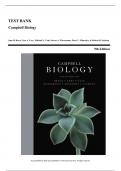
TEST BANK
Campbell Biology
Jane B. Reece, Lisa A. Urry, Michael L. Cain, Steven A. Wasserman, Peter V. Minorsky, & Robert B. Jackson
9th Edition
SuccessShelf2 © 2025 SuccessShelf2. For Personal Use Only. All rights reserved.
Downloaded by: faouzimouad | Want to earn $1.236
Distribution of this document is illegal extra per year?
,Table of Contents
Chapter 1 Introduction: Themes in the Study of Life 1
Chapter 2 The Chemical Context of Life 19
Chapter 3 Water and Life 44
Chapter 4 Carbon and the Molecular Diversity of Life 68
Chapter 5 The Structure and Function of Large Biological Molecules 91
Chapter 6 A Tour of the Cell 120
Chapter 7 Membrane Structure and Function 141
Chapter 8 An Introduction to Metabolism 165
Chapter 9 Cellular Respiration and Fermentation 188
Chapter 10 Photosynthesis 217
Chapter 11 Cell Communication 240
Chapter 12 The Cell Cycle 259
Chapter 13 Meiosis and Sexual Life Cycles 281
Chapter 14 Mendel and the Gene Idea 301
Chapter 15 The Chromosomal Basis of Inheritance 324
Chapter 16 The Molecular Basis of Inheritance 343
Chapter 17 From Gene to Protein 359
Chapter 18 Regulation of Gene Expression 382
Chapter 19 Viruses 408
Chapter 20 Biotechnology 424
Chapter 21 Genomes and Their Evolution 445
Chapter 22 Descent with Modification: A Darwinian View of Life 458
Chapter 23 The Evolution of Populations 475
Chapter 24 The Origin of Species 500
Chapter 25 The History of Life on Earth 521
Chapter 26 Phylogeny and the Tree of Life 546
Chapter 27 Bacteria and Archaea 570
Chapter 28 Protists 596
Chapter 29 Plant Diversity I: How Plants Colonized Land 618
Chapter 30 Plant Diversity II: The Evolution of Seed Plants 641
Chapter 31 Fungi 669
Chapter 32 An Overview of Animal Diversity 697
Chapter 33 An Introduction to Invertebrates 723
Chapter 34 The Origin and Evolution of Vertebrates 750
Chapter 35 Plant Structure, Growth, and Development 783
Chapter 36 Resource Acquisition and Transport in Vascular Plants 800
Chapter 37 Soil and Plant Nutrition 821
Chapter 38 Angiosperm Reproduction and Biotechnology 843
SuccessShelf2 © 2025 SuccessShelf2. For Personal Use Only. All rights reserved.
Downloaded by: faouzimouad | Want to earn $1.236
Distribution of this document is illegal extra per year?
,Chapter 39 Plant Responses to Internal and External Signals 864
Chapter 40 Basic Principles of Animal Form and Function 892
Chapter 41 Animal Nutrition 911
Chapter 42 Circulation and Gas Exchange 928
Chapter 43 The Immune System 951
Chapter 44 Osmoregulation and Excretion 977
Chapter 45 Hormones and the Endocrine System 993
Chapter 46 Animal Reproduction 1011
Chapter 47 Animal Development 1034
Chapter 48 Neurons, Synapses, and Signaling 1055
Chapter 49 Nervous Systems 1073
Chapter 50 Sensory and Motor Mechanisms 1089
Chapter 51 Animal Behavior 1110
Chapter 52 An Introduction to Ecology and the Biosphere 1130
Chapter 53 Population Ecology 1153
Chapter 54 Community Ecology 1181
Chapter 55 Ecosystems and Restoration Ecology 1203
Chapter 56 Conservation Biology and Global Change 1224
https://www.stuvia.com/en-us/user/AllStudyGuides
SuccessShelf2 © 2025 SuccessShelf2. For Personal Use Only. All rights reserved.
Downloaded by: faouzimouad | Want to earn $1.236
Distribution of this document is illegal extra per year?
, ______________________________________________________________________________________________
Test Bank - Campbell Biology, 9th Edition (Reece 2012)
Chapter 1 Introduction: Themes in the Study of Life
This introductory chapter explores the basic themes and concepts of biology, with emphasis on the
core theme of evolution. It also introduces students to the thinking of scientists. Questions are
therefore general; however, an effort has been made to include some from each skill level. As in the
rest of this test bank, questions that feature art or those for which several questions follow upon some
data or a scenario are placed together at the end of the chapter.
Multiple-Choice Questions
1) A localized group of organisms that belong to the same species is called a
A) biosystem.
B) community.
C) population.
D) ecosystem.
E) family.
Answer: C
Topic: Concept 1.1
Skill: Knowledge/Comprehension
2) Organisms interact with their environments, exchanging matter and energy. For
example, plant chloroplasts convert the energy of sunlight into
A) the energy of motion.
B) carbon dioxide and water.
C) the potential energy of chemical bonds.
D) oxygen.
E) kinetic energy.
Answer: C
Topic: Concept 1.1
Skill: Knowledge/Comprehension
3) The main source of energy for producers in an ecosystem is
A) light energy.
B) kinetic energy.
C) thermal energy.
D) chemical energy.
E) ATP.
Answer: A
Topic: Concept 1.1
Skill: Knowledge/Comprehension
______________________________________________________________________________________________
1|Page
https://www.stuvia.com/en-us/user/AllStudyGuides
SuccessShelf2 © 2025 SuccessShelf2. For Personal Use Only. All rights reserved.
Downloaded by: faouzimouad | Want to earn $1.236
Distribution of this document is illegal extra per year?
Campbell Biology
Jane B. Reece, Lisa A. Urry, Michael L. Cain, Steven A. Wasserman, Peter V. Minorsky, & Robert B. Jackson
9th Edition
SuccessShelf2 © 2025 SuccessShelf2. For Personal Use Only. All rights reserved.
Downloaded by: faouzimouad | Want to earn $1.236
Distribution of this document is illegal extra per year?
,Table of Contents
Chapter 1 Introduction: Themes in the Study of Life 1
Chapter 2 The Chemical Context of Life 19
Chapter 3 Water and Life 44
Chapter 4 Carbon and the Molecular Diversity of Life 68
Chapter 5 The Structure and Function of Large Biological Molecules 91
Chapter 6 A Tour of the Cell 120
Chapter 7 Membrane Structure and Function 141
Chapter 8 An Introduction to Metabolism 165
Chapter 9 Cellular Respiration and Fermentation 188
Chapter 10 Photosynthesis 217
Chapter 11 Cell Communication 240
Chapter 12 The Cell Cycle 259
Chapter 13 Meiosis and Sexual Life Cycles 281
Chapter 14 Mendel and the Gene Idea 301
Chapter 15 The Chromosomal Basis of Inheritance 324
Chapter 16 The Molecular Basis of Inheritance 343
Chapter 17 From Gene to Protein 359
Chapter 18 Regulation of Gene Expression 382
Chapter 19 Viruses 408
Chapter 20 Biotechnology 424
Chapter 21 Genomes and Their Evolution 445
Chapter 22 Descent with Modification: A Darwinian View of Life 458
Chapter 23 The Evolution of Populations 475
Chapter 24 The Origin of Species 500
Chapter 25 The History of Life on Earth 521
Chapter 26 Phylogeny and the Tree of Life 546
Chapter 27 Bacteria and Archaea 570
Chapter 28 Protists 596
Chapter 29 Plant Diversity I: How Plants Colonized Land 618
Chapter 30 Plant Diversity II: The Evolution of Seed Plants 641
Chapter 31 Fungi 669
Chapter 32 An Overview of Animal Diversity 697
Chapter 33 An Introduction to Invertebrates 723
Chapter 34 The Origin and Evolution of Vertebrates 750
Chapter 35 Plant Structure, Growth, and Development 783
Chapter 36 Resource Acquisition and Transport in Vascular Plants 800
Chapter 37 Soil and Plant Nutrition 821
Chapter 38 Angiosperm Reproduction and Biotechnology 843
SuccessShelf2 © 2025 SuccessShelf2. For Personal Use Only. All rights reserved.
Downloaded by: faouzimouad | Want to earn $1.236
Distribution of this document is illegal extra per year?
,Chapter 39 Plant Responses to Internal and External Signals 864
Chapter 40 Basic Principles of Animal Form and Function 892
Chapter 41 Animal Nutrition 911
Chapter 42 Circulation and Gas Exchange 928
Chapter 43 The Immune System 951
Chapter 44 Osmoregulation and Excretion 977
Chapter 45 Hormones and the Endocrine System 993
Chapter 46 Animal Reproduction 1011
Chapter 47 Animal Development 1034
Chapter 48 Neurons, Synapses, and Signaling 1055
Chapter 49 Nervous Systems 1073
Chapter 50 Sensory and Motor Mechanisms 1089
Chapter 51 Animal Behavior 1110
Chapter 52 An Introduction to Ecology and the Biosphere 1130
Chapter 53 Population Ecology 1153
Chapter 54 Community Ecology 1181
Chapter 55 Ecosystems and Restoration Ecology 1203
Chapter 56 Conservation Biology and Global Change 1224
https://www.stuvia.com/en-us/user/AllStudyGuides
SuccessShelf2 © 2025 SuccessShelf2. For Personal Use Only. All rights reserved.
Downloaded by: faouzimouad | Want to earn $1.236
Distribution of this document is illegal extra per year?
, ______________________________________________________________________________________________
Test Bank - Campbell Biology, 9th Edition (Reece 2012)
Chapter 1 Introduction: Themes in the Study of Life
This introductory chapter explores the basic themes and concepts of biology, with emphasis on the
core theme of evolution. It also introduces students to the thinking of scientists. Questions are
therefore general; however, an effort has been made to include some from each skill level. As in the
rest of this test bank, questions that feature art or those for which several questions follow upon some
data or a scenario are placed together at the end of the chapter.
Multiple-Choice Questions
1) A localized group of organisms that belong to the same species is called a
A) biosystem.
B) community.
C) population.
D) ecosystem.
E) family.
Answer: C
Topic: Concept 1.1
Skill: Knowledge/Comprehension
2) Organisms interact with their environments, exchanging matter and energy. For
example, plant chloroplasts convert the energy of sunlight into
A) the energy of motion.
B) carbon dioxide and water.
C) the potential energy of chemical bonds.
D) oxygen.
E) kinetic energy.
Answer: C
Topic: Concept 1.1
Skill: Knowledge/Comprehension
3) The main source of energy for producers in an ecosystem is
A) light energy.
B) kinetic energy.
C) thermal energy.
D) chemical energy.
E) ATP.
Answer: A
Topic: Concept 1.1
Skill: Knowledge/Comprehension
______________________________________________________________________________________________
1|Page
https://www.stuvia.com/en-us/user/AllStudyGuides
SuccessShelf2 © 2025 SuccessShelf2. For Personal Use Only. All rights reserved.
Downloaded by: faouzimouad | Want to earn $1.236
Distribution of this document is illegal extra per year?