

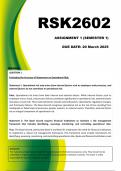
RSK2602
ASSIGNMENT 1 (SEMESTER 1)..
DUE DATE: 20 March 2025..
PREVIEW:
QUESTION 1
Evaluating the Accuracy of Statements on Operational Risk:
Statement 1: Operational risk only arises from internal factors such as employees and processes, and
external factors do not contribute to operational risk.
False. Operational risk arises from both internal and external factors. While internal factors such as
employee errors, fraud, and process failures contribute significantly to operational risk, external factors
also play a crucial role. These external factors include natural disasters, cyberattacks, regulatory changes,
and third-party failures. The Basel Accord recognizes operational risk as the risk of loss resulting from
inadequate or failed internal processes, people, systems, or external events. Therefore, external factors
are an integral component of operational risk.
Statement 2: The Basel Accord requires financial institutions to maintain a risk management
framework that includes identifying, assessing, monitoring, and controlling operational risks.
True. The Basel Accord, particularly Basel II and Basel III, emphasizes the need for financial institutions
to implement a robust risk management framework. This framework must include mechanisms for
identifying, assessing, monitoring, and controlling operational risks. Banks and financial institutions must
establish governance structures, maintain internal controls, and implement policies that mitigate
operational risks. The Basel framework also provides different approaches, such as the Basic Indicator
Approach, Standardized Approach, and Advanced Measurement Approach, for measuring and managing
operational
Disclaimer: risks.
The materials provided are intended for educational and informational purposes only. They should not be
submitted as original work or used in violation of any academic institution's policies. The buyer is solely
responsible 3:
Statement forBusiness
how the materials areplanning
continuity used. (BCP) is not necessary for managing operational risk since
most risks can be controlled through internal policies.
ASSIGNMENT 1 (SEMESTER 1)..
DUE DATE: 20 March 2025..
PREVIEW:
QUESTION 1
Evaluating the Accuracy of Statements on Operational Risk:
Statement 1: Operational risk only arises from internal factors such as employees and processes, and
external factors do not contribute to operational risk.
False. Operational risk arises from both internal and external factors. While internal factors such as
employee errors, fraud, and process failures contribute significantly to operational risk, external factors
also play a crucial role. These external factors include natural disasters, cyberattacks, regulatory changes,
and third-party failures. The Basel Accord recognizes operational risk as the risk of loss resulting from
inadequate or failed internal processes, people, systems, or external events. Therefore, external factors
are an integral component of operational risk.
Statement 2: The Basel Accord requires financial institutions to maintain a risk management
framework that includes identifying, assessing, monitoring, and controlling operational risks.
True. The Basel Accord, particularly Basel II and Basel III, emphasizes the need for financial institutions
to implement a robust risk management framework. This framework must include mechanisms for
identifying, assessing, monitoring, and controlling operational risks. Banks and financial institutions must
establish governance structures, maintain internal controls, and implement policies that mitigate
operational risks. The Basel framework also provides different approaches, such as the Basic Indicator
Approach, Standardized Approach, and Advanced Measurement Approach, for measuring and managing
operational
Disclaimer: risks.
The materials provided are intended for educational and informational purposes only. They should not be
submitted as original work or used in violation of any academic institution's policies. The buyer is solely
responsible 3:
Statement forBusiness
how the materials areplanning
continuity used. (BCP) is not necessary for managing operational risk since
most risks can be controlled through internal policies.


