

Management accounting – strategy
SAICA views strategy, risk management and governance within the same competency and we
will discover why this makes sense later. What is important to note, is that strategy and risk can
form part of the same scenario/question
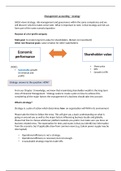
Purpose of a for-profit company
Main goal: to create long term value for shareholders. (Return on investment)
Other non-financial goals: value creation for other stakeholders
Economic
Shareholder value
performance
(ROIC): • Share price
• Sustainable growth • EPS
(in revenue and • Growth in EPS
profit)
Strategy: answer to the question: HOW?
From our Chapter 1 knowledge, we know that maximizing shareholder wealth is the long-term
view of Financial Management. Strategy seeks to create a plan on how to achieve this,
considering all the major factors the management of a business should take into account.
What is strategy?
Strategy is: a plan of action which determines how an organisation will WIN in its environment
Please take the time to follow the news. This will give you a basic understanding on what is
going on around you as well as the major factors influencing business locally and globally.
Please feel free to choose whichever platform/website you prefer, but make sure you focus on
business related news. The expectation for tests and exams is that you identify key information
from the scenario, but if applicable draw from common news (e.g. Eskom power supply may be
interrupted)
• Operational efficiency is not a strategy.
• Operational efficiency is necessary but not enough.
• A sustainable strategy requires trade-offs.
,A strategy must:
1. Be Consistent and not lead to conflict
2. Represent an actual reaction to challenges and changes
3. Enable the company to maintain or acquire sustainable competitive advantage
4. Be Realistic: the company must have the capacity or ability to acquire capacity in order
to execute the strategy
Strategic planning
1. Long-term planning
2. Considers the organisation as a whole
3. Provides direction to the whole organisation
4. Takes all stakeholder groups into account
5. Purpose is to create/maintain competitive advantage
6. Relates to how an organisation will utilise its resources
Model for formulating strategies: Rational
Defined as a “strategy whose objectives have been defined in advance and whose main
elements were developed before the strategy commenced. It is a formal, planned systematic
approach to strategy formulation.
When a deliberate strategy is realised, the result matches the intended course of action.
Benefits:
Structured means of analysis
Encourages longer-term view
Can be used as means of control
Useful means of coordination
Effective communication of intended strategy
Means of inclusive strategy formulation- creates sense of ownership
Rational
Top down and centralised
Time horizon 2-10 years
Formal planning
Complex and costly
Stable and certain environment
Inflexible
, Formulating a strategy:
Questions that must be answered in formulating a strategy (rational model):
1. Where do we want to go?
◦ Vision and mission
◦ Organisation with profit making intent: critical to obtain competitive advantage
2. Where are we now?
◦ Evaluation of current position (Financial position: financial statement analysis)
◦ Evaluation of current performance (Compared to competitors/ industry)
◦ Current capabilities ( SW or SWOT, “6 Capitals”: internal environmental analysis)
◦ External environment (OT or SWOT, PESTE(L))
3. How are we going to get there?
Answer to this question is the STRATEGY.
STRATEGY IS THE HOW….
Rational model: strategy development
Mission/
vision and
objectives
Corporate
analysis:
internal &
external
Developmen
t of strategic Review and
alternatives control
Choice of
strategic
alternatives
Strategy
implementation
SAICA views strategy, risk management and governance within the same competency and we
will discover why this makes sense later. What is important to note, is that strategy and risk can
form part of the same scenario/question
Purpose of a for-profit company
Main goal: to create long term value for shareholders. (Return on investment)
Other non-financial goals: value creation for other stakeholders
Economic
Shareholder value
performance
(ROIC): • Share price
• Sustainable growth • EPS
(in revenue and • Growth in EPS
profit)
Strategy: answer to the question: HOW?
From our Chapter 1 knowledge, we know that maximizing shareholder wealth is the long-term
view of Financial Management. Strategy seeks to create a plan on how to achieve this,
considering all the major factors the management of a business should take into account.
What is strategy?
Strategy is: a plan of action which determines how an organisation will WIN in its environment
Please take the time to follow the news. This will give you a basic understanding on what is
going on around you as well as the major factors influencing business locally and globally.
Please feel free to choose whichever platform/website you prefer, but make sure you focus on
business related news. The expectation for tests and exams is that you identify key information
from the scenario, but if applicable draw from common news (e.g. Eskom power supply may be
interrupted)
• Operational efficiency is not a strategy.
• Operational efficiency is necessary but not enough.
• A sustainable strategy requires trade-offs.
,A strategy must:
1. Be Consistent and not lead to conflict
2. Represent an actual reaction to challenges and changes
3. Enable the company to maintain or acquire sustainable competitive advantage
4. Be Realistic: the company must have the capacity or ability to acquire capacity in order
to execute the strategy
Strategic planning
1. Long-term planning
2. Considers the organisation as a whole
3. Provides direction to the whole organisation
4. Takes all stakeholder groups into account
5. Purpose is to create/maintain competitive advantage
6. Relates to how an organisation will utilise its resources
Model for formulating strategies: Rational
Defined as a “strategy whose objectives have been defined in advance and whose main
elements were developed before the strategy commenced. It is a formal, planned systematic
approach to strategy formulation.
When a deliberate strategy is realised, the result matches the intended course of action.
Benefits:
Structured means of analysis
Encourages longer-term view
Can be used as means of control
Useful means of coordination
Effective communication of intended strategy
Means of inclusive strategy formulation- creates sense of ownership
Rational
Top down and centralised
Time horizon 2-10 years
Formal planning
Complex and costly
Stable and certain environment
Inflexible
, Formulating a strategy:
Questions that must be answered in formulating a strategy (rational model):
1. Where do we want to go?
◦ Vision and mission
◦ Organisation with profit making intent: critical to obtain competitive advantage
2. Where are we now?
◦ Evaluation of current position (Financial position: financial statement analysis)
◦ Evaluation of current performance (Compared to competitors/ industry)
◦ Current capabilities ( SW or SWOT, “6 Capitals”: internal environmental analysis)
◦ External environment (OT or SWOT, PESTE(L))
3. How are we going to get there?
Answer to this question is the STRATEGY.
STRATEGY IS THE HOW….
Rational model: strategy development
Mission/
vision and
objectives
Corporate
analysis:
internal &
external
Developmen
t of strategic Review and
alternatives control
Choice of
strategic
alternatives
Strategy
implementation


