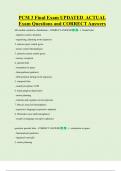
PCM 3 Final Exam UPDATED ACTUAL
Exam Questions and CORRECT Answers
left medial cerebral a. distribution - CORRECT ANSWER - 1. frontal lobe:
- impulse control, attention
- organizing, planning mvmt (apraxis)
2. anterior (pre) central gyrus
- motor control (hemiplegia)
3. posterior (post) central gyrus
- sensory reception
4. parietal lobe
- orientation in space
- lateropulsion (pushers)
- limb position during mvmt (apraxia)
5. temporal lobe
- sound perception, LTM
6. basal ganglia (deep brain)
- motor planning
- controls and regulates mvmt (apraxia)
7. Broca's area (left hemisphere)
- expressive language (expressive aphasia)
8. Wernicke's area (left hemisphere)
- receptive language (receptive aphasia)
posterior parietal lobe - CORRECT ANSWER - 1. orientation in space:
- lateropulsion (pushers)
- impaired vertically
2. motor planning
,- impaired limb positioning during mvmt
- apraxia
left hemisphere damage - CORRECT ANSWER - - almost always has speech and
swallowing impairments
1. aphasia:
- mostly right handers
- about 50% of left handers
- expressive
- receptive
2. dysarthria
3. apraxia
4. dysphagia
renal system and kidney function - CORRECT ANSWER - 1. kidneys serve as:
- endocrine organ
- target of endocrine action
- to control mineral and water balance
2. functions:
- filter waster products
- remove excess fluid
chronic kidney disease (CKD) - CORRECT ANSWER - - alteration of kidney function > 3
mths
- common causes:
1. diabetes
2. HTN
3. glomerulonephritis
,end stage renal disease (ESRD) - CORRECT ANSWER - - final stage of CKD
- loss of kidney function
- requiring dialysis or kidney transplant
uremia - CORRECT ANSWER - - cluster of sx
- kidneys unable to:
1. excrete toxins
2. maintain fluid, pH, electrolyte balances
3. secrete important hormones (renin, vit D, erythorpoietin)
uremia characteristics - CORRECT ANSWER - - n/v
- anorexia
- lethargy
- pruritus (itching)
- sensory and motor neuropathy
- asterixis
asterixis - CORRECT ANSWER - - characteristic of uremia
- intermittent ability to sustain a posture
- flapping like motion when lifts hand
pathogenesis of kidney failure - CORRECT ANSWER - - reduced glomerular filtration
rate (GTR):
1. < 15 mL/min (normal= 90 mL/min)
2. damaged and decreased kidney surface area
- increased phosphate levels
- decreased calcium levels
1. increased PTH secretion
, 2. increased calcium resorption from bone
3. osteomalacia (demineralization of bone)
cardivascular manifestations of kidney failure - CORRECT ANSWER - - coronary artery
disease
- HTN
- CHF
- pulmonary edema
- dyspnea
- pericarditis
leading cause of death in ESRD - CORRECT ANSWER - - chest pain
- nausea
- shortness of breath
- sweating
MSK manifestations of kidney failure - CORRECT ANSWER - 1. renal osteodystrophy
- renal rickets
- osteomalacia
- osteitis fibrosis
2. bone pain
- spine and LE jts
- worse /c exercise and WB activities
3. fx's
- spine and long bones
CNS manifestations of kidney failure - CORRECT ANSWER - - sleep disturbances
- recent memory loss
Exam Questions and CORRECT Answers
left medial cerebral a. distribution - CORRECT ANSWER - 1. frontal lobe:
- impulse control, attention
- organizing, planning mvmt (apraxis)
2. anterior (pre) central gyrus
- motor control (hemiplegia)
3. posterior (post) central gyrus
- sensory reception
4. parietal lobe
- orientation in space
- lateropulsion (pushers)
- limb position during mvmt (apraxia)
5. temporal lobe
- sound perception, LTM
6. basal ganglia (deep brain)
- motor planning
- controls and regulates mvmt (apraxia)
7. Broca's area (left hemisphere)
- expressive language (expressive aphasia)
8. Wernicke's area (left hemisphere)
- receptive language (receptive aphasia)
posterior parietal lobe - CORRECT ANSWER - 1. orientation in space:
- lateropulsion (pushers)
- impaired vertically
2. motor planning
,- impaired limb positioning during mvmt
- apraxia
left hemisphere damage - CORRECT ANSWER - - almost always has speech and
swallowing impairments
1. aphasia:
- mostly right handers
- about 50% of left handers
- expressive
- receptive
2. dysarthria
3. apraxia
4. dysphagia
renal system and kidney function - CORRECT ANSWER - 1. kidneys serve as:
- endocrine organ
- target of endocrine action
- to control mineral and water balance
2. functions:
- filter waster products
- remove excess fluid
chronic kidney disease (CKD) - CORRECT ANSWER - - alteration of kidney function > 3
mths
- common causes:
1. diabetes
2. HTN
3. glomerulonephritis
,end stage renal disease (ESRD) - CORRECT ANSWER - - final stage of CKD
- loss of kidney function
- requiring dialysis or kidney transplant
uremia - CORRECT ANSWER - - cluster of sx
- kidneys unable to:
1. excrete toxins
2. maintain fluid, pH, electrolyte balances
3. secrete important hormones (renin, vit D, erythorpoietin)
uremia characteristics - CORRECT ANSWER - - n/v
- anorexia
- lethargy
- pruritus (itching)
- sensory and motor neuropathy
- asterixis
asterixis - CORRECT ANSWER - - characteristic of uremia
- intermittent ability to sustain a posture
- flapping like motion when lifts hand
pathogenesis of kidney failure - CORRECT ANSWER - - reduced glomerular filtration
rate (GTR):
1. < 15 mL/min (normal= 90 mL/min)
2. damaged and decreased kidney surface area
- increased phosphate levels
- decreased calcium levels
1. increased PTH secretion
, 2. increased calcium resorption from bone
3. osteomalacia (demineralization of bone)
cardivascular manifestations of kidney failure - CORRECT ANSWER - - coronary artery
disease
- HTN
- CHF
- pulmonary edema
- dyspnea
- pericarditis
leading cause of death in ESRD - CORRECT ANSWER - - chest pain
- nausea
- shortness of breath
- sweating
MSK manifestations of kidney failure - CORRECT ANSWER - 1. renal osteodystrophy
- renal rickets
- osteomalacia
- osteitis fibrosis
2. bone pain
- spine and LE jts
- worse /c exercise and WB activities
3. fx's
- spine and long bones
CNS manifestations of kidney failure - CORRECT ANSWER - - sleep disturbances
- recent memory loss