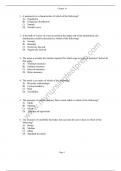
Chapter 14
1. A parameter is a characteristic of which of the following?
A) Population
B) Frequency distribution
C) Sample
D) Normal curve
2. If the bulk of scores on a test occurred at the upper end of the distribution, the
distribution could be described as which of the following?
A) Normal
B) Bimodal
m
C) Positively skewed
D) Negatively skewed
. co
3. The mean is usually the statistic reported for which type or types of measure? Select all
ep
that apply.
A) Nominal measures
pr
B) Ordinal measures
C) Interval measures
D) Ratio measures st
te
ng
4. The mode is an index of which of the following?
A) Bivariate relationships
B) Central tendency
si
C) Risk
ur
D) Variability
yn
5. The measure of central tendency that is most stable is which of the following?
.m
A) Mode
B) Median
w
C) Mean
D) They are all equivalent
w
w
6. The measure of variability that takes into account all score values is which of the
following?
A) Range
B) Median
C) Mean
D) Standard deviation
Page 1
, 7. A group of 100 students took a test. The mean was 85, the standard deviation was 5, and
the scores were normally distributed. About how many of the 100 scores fell between 80
and 90?
A) 34
B) 68
C) 95
D) Impossible to determine
8. One of the characteristics of a normal distribution is which of the following?
A) It is bimodal
m
B) 95% of the values are within two standard deviations above and below the mean
C) The values are positively skewed
co
D) The mean is 100
.
ep
9. Which of the following signifies the strongest relationship?
A) r = -.64
pr
B) M = .99
C) t = 1.44
D) r = .57 st
te
ng
10. The symbol X represents which of the following?
A) An effect size
si
B) A mean
C) Total sample size
ur
D) An individual score
yn
11. A widely used index of risk used among practitioners of evidence-based practice is
.m
which of the following?
A) The t statistic
w
B) The F ratio
C) The odds ratio
w
D) Pearson's r
w
12. The use of inferential statistics permits a researcher to do which of the following?
A) Draw conclusions about a population based on information gathered from a sample
B) Describe information obtained from empirical observation
C) Interpret descriptive statistics
D) Estimate risk and relative risk
Page 2
1. A parameter is a characteristic of which of the following?
A) Population
B) Frequency distribution
C) Sample
D) Normal curve
2. If the bulk of scores on a test occurred at the upper end of the distribution, the
distribution could be described as which of the following?
A) Normal
B) Bimodal
m
C) Positively skewed
D) Negatively skewed
. co
3. The mean is usually the statistic reported for which type or types of measure? Select all
ep
that apply.
A) Nominal measures
pr
B) Ordinal measures
C) Interval measures
D) Ratio measures st
te
ng
4. The mode is an index of which of the following?
A) Bivariate relationships
B) Central tendency
si
C) Risk
ur
D) Variability
yn
5. The measure of central tendency that is most stable is which of the following?
.m
A) Mode
B) Median
w
C) Mean
D) They are all equivalent
w
w
6. The measure of variability that takes into account all score values is which of the
following?
A) Range
B) Median
C) Mean
D) Standard deviation
Page 1
, 7. A group of 100 students took a test. The mean was 85, the standard deviation was 5, and
the scores were normally distributed. About how many of the 100 scores fell between 80
and 90?
A) 34
B) 68
C) 95
D) Impossible to determine
8. One of the characteristics of a normal distribution is which of the following?
A) It is bimodal
m
B) 95% of the values are within two standard deviations above and below the mean
C) The values are positively skewed
co
D) The mean is 100
.
ep
9. Which of the following signifies the strongest relationship?
A) r = -.64
pr
B) M = .99
C) t = 1.44
D) r = .57 st
te
ng
10. The symbol X represents which of the following?
A) An effect size
si
B) A mean
C) Total sample size
ur
D) An individual score
yn
11. A widely used index of risk used among practitioners of evidence-based practice is
.m
which of the following?
A) The t statistic
w
B) The F ratio
C) The odds ratio
w
D) Pearson's r
w
12. The use of inferential statistics permits a researcher to do which of the following?
A) Draw conclusions about a population based on information gathered from a sample
B) Describe information obtained from empirical observation
C) Interpret descriptive statistics
D) Estimate risk and relative risk
Page 2