, PLS1501 Assignment 1 (COMPLETE ANSWERS)
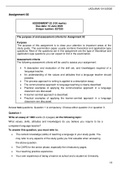
Semester 1 2025 - DUE March 2025; 100%
TRUSTED Complete, trusted solutions and
explanations.
MULTIPLE CHOICE,ASSURED EXCELLENCE
Instructions: You must answer ALL three (3) questions. EACH
question must be approximately 300 words. 1. In what sense
can the practice and teaching of philosophy in South Africa be
understood as colonial? 2. How and why were western
philosophy and education introduced into South Africa? 3. In
what ways can we speak about a “whiteness” of philosophy in
South Africa?
1. In what sense can the practice and teaching of philosophy in
South Africa be understood as colonial?
The practice and teaching of philosophy in South Africa can be
understood as colonial in that it has historically been
dominated by Eurocentric perspectives, methodologies, and
epistemologies. The colonial nature of philosophy in South
Africa stems from the imposition of European thought
systems, which marginalized and often erased indigenous
knowledge systems, languages, and ways of understanding the
world. During colonial rule and apartheid, South African
universities primarily taught philosophy as it was understood
in the Western canon, emphasizing figures such as Plato,
Descartes, Kant, and Hegel while neglecting African
philosophical traditions. This created an intellectual
Semester 1 2025 - DUE March 2025; 100%
TRUSTED Complete, trusted solutions and
explanations.
MULTIPLE CHOICE,ASSURED EXCELLENCE
Instructions: You must answer ALL three (3) questions. EACH
question must be approximately 300 words. 1. In what sense
can the practice and teaching of philosophy in South Africa be
understood as colonial? 2. How and why were western
philosophy and education introduced into South Africa? 3. In
what ways can we speak about a “whiteness” of philosophy in
South Africa?
1. In what sense can the practice and teaching of philosophy in
South Africa be understood as colonial?
The practice and teaching of philosophy in South Africa can be
understood as colonial in that it has historically been
dominated by Eurocentric perspectives, methodologies, and
epistemologies. The colonial nature of philosophy in South
Africa stems from the imposition of European thought
systems, which marginalized and often erased indigenous
knowledge systems, languages, and ways of understanding the
world. During colonial rule and apartheid, South African
universities primarily taught philosophy as it was understood
in the Western canon, emphasizing figures such as Plato,
Descartes, Kant, and Hegel while neglecting African
philosophical traditions. This created an intellectual