A+
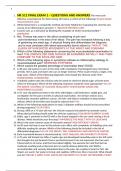
COM1513
ASSIGNMEMT 1 SEMESTER 1
ENIQUE NO
DUE march
This document contains
workings and solutions to
the question below
COMMISSIONER JAY
, COM1513 Assignment 1 (COMPLETE ANSWERS)
Semester 1 2025 - DUE March 2025; 100% TRUSTED
Complete, trusted solutions and explanations. For
assistance, Whats-App
1.1 In your personal opinion and with reference to Prof
Koschmann, how would you describe communication? In
approximately 30 words, briefly explain why you have described
communication in this way. (5)
In my opinion, and with reference to Prof. Koschmann, communication
is the foundation of social interaction and meaning-making in
organizations. Prof. Koschmann views communication not just as the
transfer of information but as a process that constructs reality. This
means that communication is not just about sending and receiving
messages but about shaping relationships, power structures, and
organizational culture.
I describe communication in this way because it is the mechanism
through which individuals and groups negotiate meaning, coordinate
actions, and create shared understandings. In an organizational context,
communication defines roles, influences decision-making, and fosters
collaboration. Without communication, organizations would struggle to
function, as there would be no shared purpose or direction.
COM1513
ASSIGNMEMT 1 SEMESTER 1
ENIQUE NO
DUE march
This document contains
workings and solutions to
the question below
COMMISSIONER JAY
, COM1513 Assignment 1 (COMPLETE ANSWERS)
Semester 1 2025 - DUE March 2025; 100% TRUSTED
Complete, trusted solutions and explanations. For
assistance, Whats-App
1.1 In your personal opinion and with reference to Prof
Koschmann, how would you describe communication? In
approximately 30 words, briefly explain why you have described
communication in this way. (5)
In my opinion, and with reference to Prof. Koschmann, communication
is the foundation of social interaction and meaning-making in
organizations. Prof. Koschmann views communication not just as the
transfer of information but as a process that constructs reality. This
means that communication is not just about sending and receiving
messages but about shaping relationships, power structures, and
organizational culture.
I describe communication in this way because it is the mechanism
through which individuals and groups negotiate meaning, coordinate
actions, and create shared understandings. In an organizational context,
communication defines roles, influences decision-making, and fosters
collaboration. Without communication, organizations would struggle to
function, as there would be no shared purpose or direction.