Lesson 3: Establishing a Business
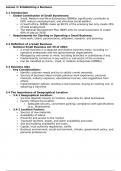
3.1 Introduction
Global Contribution of Small Businesses:
Small, Medium and Micro-Enterprises (SMMEs) significantly contribute to
GDP, reduce unemployment, and stimulate social welfare.
In South Africa, SMMEs make up 98.5% of the economy but only create 28%
of total employment.
The National Development Plan (NDP) aims for small businesses to create
90% of jobs by 2030.
Requirements for Starting or Operating a Small Business:
Hard work, talent, perseverance, willpower, research, and planning.
3.2 Definition of a Small Business
National Small Business Act 29 of 2004:
A small business is a separate and distinct business entity, including co-
operative enterprises and non-governmental organizations.
Managed by one owner or more, including branches or subsidiaries if any.
Predominantly carried on in any sector or sub-sector of the economy.
Can be classified as micro-, small, or medium enterprises (SMMEs).
3.3 Business Idea
Key Considerations:
Identify customer needs and try to satisfy unmet demands.
Sources of business ideas include previous work experience, personal
interests, industry exposure, educational courses, and suggestions from
others.
Implementation options: starting a new business, buying an existing one, or
obtaining a franchise.
3.4 The Importance of Geographical Location
3.4.1 Geographical Location:
Success depends heavily on location, especially for retail businesses.
Factors influencing location:
Adequate security, convenient parking, compliance with specifications
(e.g., Woolworths).
3.4.2 Location Factors:
Sources of raw materials.
Availability of labour.
Proximity and access to the market.
Transport facilities, power, and water availability and costs.
Site and building availability and costs.
Capital, local authority regulations, tariffs.
Business environment, social environment, climate, government policy, and
personal preferences.
,3.5 Advantages of a Small Business
Innovation:
More receptive to new ideas and concepts.
Customer Relations:
Better understanding of customer needs.
Agility:
Quick adaptation to changing environments.
Risk-Taking:
Willingness to take risks.
Resource Management:
Proficient at doing more with less.
Communication:
Easier sharing of ideas due to smaller size.
3.6 Failure of a Small Business
3.6.1 Types of Small Business Failures:
Owner death leading to cessation of business.
High opportunity cost when profits are lower elsewhere.
Losses resulting in termination to avoid creditor losses.
Bankruptcy.
3.6.2 Reasons Why Small Businesses Fail:
Managerial Inadequacy:
Failure in planning.
Inexperience in managing operations.
Ineffective staffing.
Poor communication skills.
Not seeking or responding to criticism.
Overlooking customer needs and competition.
Lack of innovation and ineffective marketing strategies.
Financial Inadequacy:
Cash-flow problems.
Insufficient initial capitalization.
Inadequate financial records.
Ignoring insights from qualified accountants.
Inadequate capital acquisition strategies.
Financial issues due to growth.
External Factors:
Economic recession.
Increasing unemployment.
Higher interest rates.
Lack of desirability for products/services.
Inability to compete with imports.
Fraud and natural disasters.
, 3.7 The Legal Forms of Ownership in South Africa
3.7.1 Choosing a Form of Ownership:
Consider legal and financial risks, financing needs, controlling interests,
nature of activities, size, tax implications, management structure, and
participation style.
3.7.2 Types of Ownership:
Sole Proprietorship:
Advantages:
Direct control over business.
All income earned by the business goes to the owner.
Easy and inexpensive to set up.
Freedom from government regulation.
Easy to dissolve.
Disadvantages:
Unlimited liability.
Depends on owner’s resources for financing.
Dissolves upon owner's death.
Requires all expertise from the owner.
Involves personal sacrifices.
Partnership:
Advantages:
Easy to form.
Diverse group of talented individuals.
Draws on financial resources of many individuals.
Partners actively involved in running the business.
Continuity not a problem.
Disadvantages:
Unlimited liability.
Sharing decision-making might cause discomfort.
Complex profit-sharing.
Difficulty in exiting or dissolving partnerships.
Potential for conflict between partners.
Close Corporation:
Advantages:
Limited liability.
Better access to financial resources.
Attracts skilled employees.
Continuity.
Disadvantages:
Possibility of agency problem.
More costly to set up.
Subject to regulation and oversight.
Limited membership to ten persons.
Company:
Profit Company:
Includes personal liability companies, private companies, public
companies, and state-owned companies.
Non-Profit Company:
Uses income for specific purposes, does not distribute profits to
members.
3.1 Introduction
Global Contribution of Small Businesses:
Small, Medium and Micro-Enterprises (SMMEs) significantly contribute to
GDP, reduce unemployment, and stimulate social welfare.
In South Africa, SMMEs make up 98.5% of the economy but only create 28%
of total employment.
The National Development Plan (NDP) aims for small businesses to create
90% of jobs by 2030.
Requirements for Starting or Operating a Small Business:
Hard work, talent, perseverance, willpower, research, and planning.
3.2 Definition of a Small Business
National Small Business Act 29 of 2004:
A small business is a separate and distinct business entity, including co-
operative enterprises and non-governmental organizations.
Managed by one owner or more, including branches or subsidiaries if any.
Predominantly carried on in any sector or sub-sector of the economy.
Can be classified as micro-, small, or medium enterprises (SMMEs).
3.3 Business Idea
Key Considerations:
Identify customer needs and try to satisfy unmet demands.
Sources of business ideas include previous work experience, personal
interests, industry exposure, educational courses, and suggestions from
others.
Implementation options: starting a new business, buying an existing one, or
obtaining a franchise.
3.4 The Importance of Geographical Location
3.4.1 Geographical Location:
Success depends heavily on location, especially for retail businesses.
Factors influencing location:
Adequate security, convenient parking, compliance with specifications
(e.g., Woolworths).
3.4.2 Location Factors:
Sources of raw materials.
Availability of labour.
Proximity and access to the market.
Transport facilities, power, and water availability and costs.
Site and building availability and costs.
Capital, local authority regulations, tariffs.
Business environment, social environment, climate, government policy, and
personal preferences.
,3.5 Advantages of a Small Business
Innovation:
More receptive to new ideas and concepts.
Customer Relations:
Better understanding of customer needs.
Agility:
Quick adaptation to changing environments.
Risk-Taking:
Willingness to take risks.
Resource Management:
Proficient at doing more with less.
Communication:
Easier sharing of ideas due to smaller size.
3.6 Failure of a Small Business
3.6.1 Types of Small Business Failures:
Owner death leading to cessation of business.
High opportunity cost when profits are lower elsewhere.
Losses resulting in termination to avoid creditor losses.
Bankruptcy.
3.6.2 Reasons Why Small Businesses Fail:
Managerial Inadequacy:
Failure in planning.
Inexperience in managing operations.
Ineffective staffing.
Poor communication skills.
Not seeking or responding to criticism.
Overlooking customer needs and competition.
Lack of innovation and ineffective marketing strategies.
Financial Inadequacy:
Cash-flow problems.
Insufficient initial capitalization.
Inadequate financial records.
Ignoring insights from qualified accountants.
Inadequate capital acquisition strategies.
Financial issues due to growth.
External Factors:
Economic recession.
Increasing unemployment.
Higher interest rates.
Lack of desirability for products/services.
Inability to compete with imports.
Fraud and natural disasters.
, 3.7 The Legal Forms of Ownership in South Africa
3.7.1 Choosing a Form of Ownership:
Consider legal and financial risks, financing needs, controlling interests,
nature of activities, size, tax implications, management structure, and
participation style.
3.7.2 Types of Ownership:
Sole Proprietorship:
Advantages:
Direct control over business.
All income earned by the business goes to the owner.
Easy and inexpensive to set up.
Freedom from government regulation.
Easy to dissolve.
Disadvantages:
Unlimited liability.
Depends on owner’s resources for financing.
Dissolves upon owner's death.
Requires all expertise from the owner.
Involves personal sacrifices.
Partnership:
Advantages:
Easy to form.
Diverse group of talented individuals.
Draws on financial resources of many individuals.
Partners actively involved in running the business.
Continuity not a problem.
Disadvantages:
Unlimited liability.
Sharing decision-making might cause discomfort.
Complex profit-sharing.
Difficulty in exiting or dissolving partnerships.
Potential for conflict between partners.
Close Corporation:
Advantages:
Limited liability.
Better access to financial resources.
Attracts skilled employees.
Continuity.
Disadvantages:
Possibility of agency problem.
More costly to set up.
Subject to regulation and oversight.
Limited membership to ten persons.
Company:
Profit Company:
Includes personal liability companies, private companies, public
companies, and state-owned companies.
Non-Profit Company:
Uses income for specific purposes, does not distribute profits to
members.