Deduction and Induction
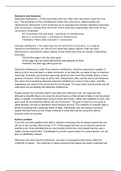
Deductive interference → If the premises are true, then the conclusion must be true
too. The premises of the interference entail the conclusion. What makes the
interference deductive is the existence of an appropriate relation between premises
and conclusion, namely that the truth of the premises guarantees the truth of the
conclusion. Example:
All Frenchmen like red wine → premises of interference
Pierre is a Frenchmen → premises of interference
Therefore, Pierre likes red wine → conclusion
Inductive interference → the premises do not entail the conclusion. In a typical
inductive interference, we move from premises about objects that we have
examined to conclusions about objets of the same sort that we haven't examined.
Example:
The first five eggs in the box were good
All the eggs have the same best-before date stamped on them
Therefore, the sixth egg will be good too
Deductive interference is safer than inductive interference. Inductive reasoning is capable of
taking us form true premises to a false conclusion. In our daily life, we seem to rely on inductive
reasoning. Scientists use inductive reasoning whenever they move from limited data to a more
general conclusion, which they do all the time. Researchers often use the word proof whenever
they have found something. Because inductive interference is used in most cases, scientific
hypotheses can rarely if ever be proved true by the data. The word 'proof' should strictly only be
used when we are dealing with deductive interference.
Popper argued that scientists need to use deductive inferences only. His argument was:
although a scientific theory can never be proved true by a finite amount of data, it can be proved
false, or refuted. If scientists were trying to refute their theory, rather than establish its truth, their
goal would be accomplished without the use of induction. The goal of science is not solely to
refute theories, but also to determine which theories are true. The collection of scientific data is
aimed at showing that a particular theory is false. Additionally, they are trying to convince
people that their theory is true. Poper's attempt to show that science can get by without
induction does not succeed.
Hume's problem
Over time, we have justified some faith in inductive reasoning, like we always assume the sun
will rise in the morning. David Hume (1711-1776) argued that the use of induction cannot be
justified at all. Hume admitted that we use induction all the time, but insisted that this was a
matter of brute animal habit. If challenged to provide a good reason for using induction, we can
give no satisfactory answer.
Whenever we make inductive inferences, we seem to presuppose what Hume called the
'uniformity of nature'. The uniformity of nature assumes that objects we haven't examined will
Deductive interference → If the premises are true, then the conclusion must be true
too. The premises of the interference entail the conclusion. What makes the
interference deductive is the existence of an appropriate relation between premises
and conclusion, namely that the truth of the premises guarantees the truth of the
conclusion. Example:
All Frenchmen like red wine → premises of interference
Pierre is a Frenchmen → premises of interference
Therefore, Pierre likes red wine → conclusion
Inductive interference → the premises do not entail the conclusion. In a typical
inductive interference, we move from premises about objects that we have
examined to conclusions about objets of the same sort that we haven't examined.
Example:
The first five eggs in the box were good
All the eggs have the same best-before date stamped on them
Therefore, the sixth egg will be good too
Deductive interference is safer than inductive interference. Inductive reasoning is capable of
taking us form true premises to a false conclusion. In our daily life, we seem to rely on inductive
reasoning. Scientists use inductive reasoning whenever they move from limited data to a more
general conclusion, which they do all the time. Researchers often use the word proof whenever
they have found something. Because inductive interference is used in most cases, scientific
hypotheses can rarely if ever be proved true by the data. The word 'proof' should strictly only be
used when we are dealing with deductive interference.
Popper argued that scientists need to use deductive inferences only. His argument was:
although a scientific theory can never be proved true by a finite amount of data, it can be proved
false, or refuted. If scientists were trying to refute their theory, rather than establish its truth, their
goal would be accomplished without the use of induction. The goal of science is not solely to
refute theories, but also to determine which theories are true. The collection of scientific data is
aimed at showing that a particular theory is false. Additionally, they are trying to convince
people that their theory is true. Poper's attempt to show that science can get by without
induction does not succeed.
Hume's problem
Over time, we have justified some faith in inductive reasoning, like we always assume the sun
will rise in the morning. David Hume (1711-1776) argued that the use of induction cannot be
justified at all. Hume admitted that we use induction all the time, but insisted that this was a
matter of brute animal habit. If challenged to provide a good reason for using induction, we can
give no satisfactory answer.
Whenever we make inductive inferences, we seem to presuppose what Hume called the
'uniformity of nature'. The uniformity of nature assumes that objects we haven't examined will