

Written by students who passed Immediately available after payment Read online or as PDF Wrong document? Swap it for free 4,6 TrustPilot
logo-home
Document preview thumbnail
Preview 1 out of 24 pages
Exam (elaborations)

CUS3701 Assignment 2 (COMPLETE ANSWERS) 2025

Document preview thumbnail
Preview 1 out of 24 pages

CUS3701 Assignment 2 (COMPLETE ANSWERS) 2025 - DUE 2025; 100% TRUSTED Complete, trusted solutions and explanations. For assistance, Whats-App 0.6.7-1.7.1-1.7.3.9. Ensure your success with us... QUESTION 1: Curriculum approaches Total Marks: 15 Task description: Different approaches to curriculum are crucial for sound curriculum implementation for several reasons. These approaches allow teachers to cater to learners' diverse learning needs, provide flexibility and adaptability in teaching methods and content delivery, and provide a comprehensive approach to education. Referring to the learner-centred approach of Lawrence Stenhouse and the behavioural approach of John Bobbitt, analyse and compare their ideas in terms of: 1.1 The theoretical foundations of the approaches. (5) sae3701 aed3701 1.2 The practical implications for teachers. (5) 1.3 The practical implications for learners. (5) NB: (i) Work copied directly from the handbook without citations will be penalized. (ii) You are encouraged to write in your own words to show your understanding of the approaches to the curriculum. inc3701 esc3701 isc3701 (iii) You are also encouraged to use other sources and cite these to give credit to the original authors. pdu3701 ped3701 (iv) Proofread your work for clarity, coherence, and grammatical accuracy. (v) Length: ONE-TWO PAGES. QUESTION 2: Designing a CAPS curriculum unit Total Marks: 20 Task Description: The unit should include clear learning outcomes, instructional strategies, assessment methods, and resources. Instructions: lsk3701 1. Select a subject and grade level: Choose a subject (e.g., Mathematics, Natural science, Languages) and a specific grade level (e.g., Grade 5, Grade 8). 2. Define learning outcomes: Clearly state the learning outcomes for the unit. Ensure they are specific, measurable, achievable, relevant, and time bound (The SMART principle). cmg3701 3. Design instructional strategies: Outline the instructional strategies you will use to achieve the learning outcomes. Include activities that promote competence and mastery learning. 4. Develop assessment methods: Create assessment methods that align with the learning outcomes and instructional strategies. Include both formative and summative assessments. 5. Identify resources: List the resources (e.g., textbooks, digital tools, etc.) needed to implement the unit. QUESTION 3: Context-responsive teaching and learning strategies Total marks: 35 Task description: Context can be described as the circumstances, background, environment, framework, setting, or situation surrounding an event or occurrence. In terms of the educational environment, the view of the child, the choice of teaching strategies, reflection on roles, and the broader socioeconomic and sociopolitical environment might influence the teaching and learning context and the way in which the teacher might interpret the curriculum (Du Plessis, Booyse & Maphalala, 2025:23). Write an essay (THREE PAGES STRICTLY) that critically analyses the South African classroom context and proposes context-responsive teaching and learning strategies. Instructions: Your essay should address the following points: 1. Introduction (5 marks) 1.1 Define context-responsive teaching and its importance. (2) 1.2 Briefly outline the main challenges in South African classrooms. (3) 2. Analysis of South African classroom context (12 marks) 2.1 Critically discuss the socioeconomic and sociopolitical factors affecting education. (8) 2.2 Identify four specific challenges such as language barriers, that hamper sound teaching practices in South African classrooms. (4) 3. Context-responsive teaching strategies (13 marks) 3.1 Propose strategies that teachers can use to address the identified challenges. (4) 3.2 Explain how each strategy can be implemented in the classroom. (4) 3.3 Provide examples of how these strategies can improve teaching and learning outcomes. (5) 4. Conclusion (5 marks) 4.1 Summarize the key points discussed in the essay. (3) 4.2 Reflect on the potential impact of context-responsive teaching on the South African education system. (2) 5. Additional guidelines: 5.1 Work copied directly from the handbook without citations will be penalized. 5.2 You are encouraged to write in your own words to show your understanding of context responsive teaching and learning. 5.3 You are also encouraged to use other sources and cite these to give credit to the original authors. 5.4 Ensure your essay is well-structured, with clear headings for each section. 5.5 Proofread your work for clarity, coherence, and grammatical accuracy. QUESTION 4: Critical interpretation of curriculum changes in South Africa () Total marks: 30

Content preview

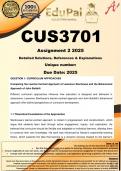
CUS3701
Assignment 2 2025
Detailed Solutions, References & Explanations

Unique number:

Due Date: 2025
QUESTION 1: CURRICULUM APPROACHES

Comparing the Learner-Centred Approach of Lawrence Stenhouse and the Behavioural
Approach of John Bobbitt

Different curriculum approaches influence how education is designed and delivered in
classrooms. Lawrence Stenhouse’s learner-centred approach and John Bobbitt’s behavioural
approach offer distinct perspectives on curriculum development.


1.1 Theoretical Foundations of the Approaches

Stenhouse’s learner-centred approach is rooted in progressivism and constructivism, which
argue that students learn best through active engagement, inquiry, and exploration. He
believed that curriculum should be flexible and adaptable to individual learners, allowing them
to construct their own knowledge. His work was influenced by Dewey’s experiential learning
theory, which supports the idea that learning is a dynamic process shaped by theTerms of use
learner’s
By making use of this document you agree to:
 Use this document as a guide for learning, comparison and reference purpose,
Terms of use
 Not to duplicate, reproduce and/or misrepresent the contents of this document as your own work,
By making use of this document you agree to:
 Use this document
Fully accept the consequences
solely as a guide forshould you plagiarise
learning, reference,or and
misuse this document.
comparison purposes,
 Ensure originality of your own work, and fully accept the consequences should you plagiarise or misuse this document.
 Comply with all relevant standards, guidelines, regulations, and legislation governing academic and written work.

Disclaimer
Great care has been taken in the preparation of this document; however, the contents are provided "as is" without any express or
implied representations or warranties. The author accepts no responsibility or liability for any actions taken based on the
information contained within this document. This document is intended solely for comparison, research, and reference purposes.
Reproduction, resale, or transmission of any part of this document, in any form or by any means, is strictly prohibited.


Connected book
 image
Josef de Beer Becoming a teacher
Publisher: 2020 ISBN: 9781928523352 Edition: Unknown

Document information

Uploaded on
February 17, 2025
Number of pages
24
Written in
2024/2025
Type
Exam (elaborations)
Contains
Questions & answers
R75,00
Purchased by 27 students

Wrong document? Swap it for free Within 14 days of purchase and before downloading, you can choose a different document. You can simply spend the amount again.
Written by students who passed
Immediately available after payment
Read online or as PDF

Seller avatar
Reputation scores are based on the amount of documents a seller has sold for a fee and the reviews they have received for those documents. There are three levels: Bronze, Silver and Gold. The better the reputation, the more your can rely on the quality of the sellers work.
EduPal
4,2
(14292)
Sold
153592
Followers
36023
Items
5058
Last sold
2 hours ago

Reviews from verified buyers


Why students choose Stuvia

Created by fellow students, verified by reviews

Quality you can trust: written by students who passed their exams and reviewed by others who've used these notes.

Didn't get what you expected? Choose another document

No worries! You can immediately select a different document that better matches what you need.

Pay how you prefer, start learning right away

No subscription, no commitments. Pay the way you're used to via credit card or EFT and download your PDF document instantly.

Student with book image

“Bought, downloaded, and aced it. It really can be that simple.”

Alisha Student

Working on your references?

Create accurate citations in APA, MLA and Harvard with our free citation generator.

Working on your references?

Frequently asked questions


