

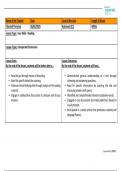
Name of the Teacher Date Level of the class Length of lesson
Chantell Pretorius 06/02/2025 Advanced (C1) 60Min
Lesson Type: Four Skills - Reading
Lesson Topic: Unexpected Encounters
Lesson Aims: Lesson Outcomes:
By the end of the lesson, students will be better able to… By the end of the lesson, students will have…
• Read for gist through means of skimming. • Demonstrated general understanding of a text through
• Read for specific details by scanning. skimming and answering questions.
• Enhance critical thinking skills through analysis of the reading • Read for specific information by scanning the text and
material. discussing answers with peers.
• Engage in collaborative discussions to compare and discuss • Identified and comprehended relevant vocabulary words.
answers • Engaged in class discussions and made predictions based on
visual prompts.
• Participated in a cooler activity that promotes creativity and
language fluency.
1 Lesson Plan 150823
, Anticipated difficulties: Suggested solutions:
Include one relating to L1/age/level of the students and one for the
subskills (reading for gist and for detail/specific information)
1. I will set boundaries to make it clear that only English
1. The students all share the same L1, which means they must be spoken during the class and group work.
might be inclined to speak this to each other instead of 2. Moving disruptive students away from each other and
English. placing them with more focused students will perhaps
2. The students are all fairly young adults very close in age motivate them to do better and be focused.
and may feel excited by each other’s company and want 3. Give enough reading time to allow students to read the
to have small talk or look at each other’s cell phones etc. article as many times as needed, and encourage them to
3. Students may not fully grasp the meaning of the article read for understanding, working on their comprehension
due to poor word recognition, especially with more skills. I will then revise sections that are particularly
complex words, terms, and phrases. difficult for students to help them with recognition and
4. When speaking English, Spanish speakers may drop inferring.
consonants at the end of words. For example, instead of 4. I will repeat the words that students struggle with and
saying ‘text’, Spanish speakers may say ‘tex’ or ‘brefas’ then drill the students by having them repeat after me. I
rather than ‘breakfast’. Instead of ‘mind’ you might say will use the phonemic chart further to explain the
‘mine’. pronunciation of the words and sounds. I will get them
to practice the words and phrases ending in consonants,
focusing on not over-articulating the final consonant by
counting a single syllable in each word (1 beat each).
2 Lesson Plan 150823
Chantell Pretorius 06/02/2025 Advanced (C1) 60Min
Lesson Type: Four Skills - Reading
Lesson Topic: Unexpected Encounters
Lesson Aims: Lesson Outcomes:
By the end of the lesson, students will be better able to… By the end of the lesson, students will have…
• Read for gist through means of skimming. • Demonstrated general understanding of a text through
• Read for specific details by scanning. skimming and answering questions.
• Enhance critical thinking skills through analysis of the reading • Read for specific information by scanning the text and
material. discussing answers with peers.
• Engage in collaborative discussions to compare and discuss • Identified and comprehended relevant vocabulary words.
answers • Engaged in class discussions and made predictions based on
visual prompts.
• Participated in a cooler activity that promotes creativity and
language fluency.
1 Lesson Plan 150823
, Anticipated difficulties: Suggested solutions:
Include one relating to L1/age/level of the students and one for the
subskills (reading for gist and for detail/specific information)
1. I will set boundaries to make it clear that only English
1. The students all share the same L1, which means they must be spoken during the class and group work.
might be inclined to speak this to each other instead of 2. Moving disruptive students away from each other and
English. placing them with more focused students will perhaps
2. The students are all fairly young adults very close in age motivate them to do better and be focused.
and may feel excited by each other’s company and want 3. Give enough reading time to allow students to read the
to have small talk or look at each other’s cell phones etc. article as many times as needed, and encourage them to
3. Students may not fully grasp the meaning of the article read for understanding, working on their comprehension
due to poor word recognition, especially with more skills. I will then revise sections that are particularly
complex words, terms, and phrases. difficult for students to help them with recognition and
4. When speaking English, Spanish speakers may drop inferring.
consonants at the end of words. For example, instead of 4. I will repeat the words that students struggle with and
saying ‘text’, Spanish speakers may say ‘tex’ or ‘brefas’ then drill the students by having them repeat after me. I
rather than ‘breakfast’. Instead of ‘mind’ you might say will use the phonemic chart further to explain the
‘mine’. pronunciation of the words and sounds. I will get them
to practice the words and phrases ending in consonants,
focusing on not over-articulating the final consonant by
counting a single syllable in each word (1 beat each).
2 Lesson Plan 150823


