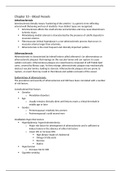
Chapter 10 – Blood Vessels
Arteriosclerosis
Arteriosclerosis literally means ‘hardening of the arteries’; is a generic term reflecting
arterial wall thickening and loss of elasticity. Four distinct types are recognized:
Arteriosclerosis affects the small arteries and arterioles and may cause downstream
ischemic injury
Mönckeberg medial sclerosis is characterized by the presence of calcific deposits in
muscular arteries.
Fibromuscular intimal hyperplasia is a non-atherosclerotic process that occurs in
muscular arteries larger than arterioles.
Atherosclerosis is the most frequent and clinically important pattern.
Atherosclerosis
Atherosclerosis is characterized by intimal lesions called atheroma’s (or atheromatous or
atherosclerotic plaques) that impinge on the vascular lumen and can rupture to cause
sudden occlusion. Atheromatous plaques are raised lesions composed of soft friable lipid
cores, covered by fibrous caps. As they enlarge, atherosclerotic plaques may mechanically
obstruct vascular lumina, leading to stenosis. Atherosclerotic plaques also are prone to
rupture, an event that may result in thrombosis and sudden occlusion of the vessel.
Epidemiology of atherosclerosis
The prevalence and severity of atherosclerosis and IHD have been correlated with a number
of risk factors.
Constitutional Risk Factors
Genetics
o Mendelian disorders
Age
o Usually remains clinically silent until lesions reach a critical threshold in
middle age or later
Gender
o Premenopausal: relatively less women
o Postmenopausal: could exceed men
Modifiable Major Risk Factors
Hyperlipidemia/ hypercholesterolemia
o Major risk factor for development of atherosclerosis and is sufficient to
induce lesions in the absence of other risk factors
o Lower LDL or increase HDL
High dietary intake of cholesterol
Omega-3 fatty acids
Exercise
Statins
Hypertension
o Increase risk for IHD
Cigarette smoking
Arteriosclerosis
Arteriosclerosis literally means ‘hardening of the arteries’; is a generic term reflecting
arterial wall thickening and loss of elasticity. Four distinct types are recognized:
Arteriosclerosis affects the small arteries and arterioles and may cause downstream
ischemic injury
Mönckeberg medial sclerosis is characterized by the presence of calcific deposits in
muscular arteries.
Fibromuscular intimal hyperplasia is a non-atherosclerotic process that occurs in
muscular arteries larger than arterioles.
Atherosclerosis is the most frequent and clinically important pattern.
Atherosclerosis
Atherosclerosis is characterized by intimal lesions called atheroma’s (or atheromatous or
atherosclerotic plaques) that impinge on the vascular lumen and can rupture to cause
sudden occlusion. Atheromatous plaques are raised lesions composed of soft friable lipid
cores, covered by fibrous caps. As they enlarge, atherosclerotic plaques may mechanically
obstruct vascular lumina, leading to stenosis. Atherosclerotic plaques also are prone to
rupture, an event that may result in thrombosis and sudden occlusion of the vessel.
Epidemiology of atherosclerosis
The prevalence and severity of atherosclerosis and IHD have been correlated with a number
of risk factors.
Constitutional Risk Factors
Genetics
o Mendelian disorders
Age
o Usually remains clinically silent until lesions reach a critical threshold in
middle age or later
Gender
o Premenopausal: relatively less women
o Postmenopausal: could exceed men
Modifiable Major Risk Factors
Hyperlipidemia/ hypercholesterolemia
o Major risk factor for development of atherosclerosis and is sufficient to
induce lesions in the absence of other risk factors
o Lower LDL or increase HDL
High dietary intake of cholesterol
Omega-3 fatty acids
Exercise
Statins
Hypertension
o Increase risk for IHD
Cigarette smoking