| OnlineExams | TestPrep | StudyResources | AcademicSuccess | ExamPreparation | QuizTime | LearningTools | Education | StudentSupport
In today's fast-paced educational landscape, students need reliable resources to excel in their studies.
5.0
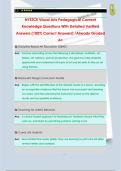
NYSTCE Visual Arts Pedagogical Content
Knowledge Questions With Detailed Verified
Answers (100% Correct Answers) /Already Graded
A+
Q: Discipline Based Art Education (DBAE)
Ans: Involves educating across the following 4 disciplines: aesthetic, art
history, art criticism, and art production. The goal is to help students
appreciate and understand all types of art and be able to discuss art
using themes.
Q: Backward Design Curriculum Model
Ans: Begins with the identification of the desired results of a lesson, deciding
on acceptable evidence that the lesson was successful and learning
occurred, and then planning the instruction based on the desired
results and acceptable evidence.
Q: Teaching for Artistic Behavior
Ans: A choice-based approach to teaching art. Students choose what they
work on, and learn by practicing problem solving in art.
Q: 5 year old students
Ans: Have limited fine motor ability. They are learning to print and will often
reverse letters and numbers.
, Q: 6 year old students
Ans: Their tracking ability makes reading much easier, but spacing and
staying on a line is still difficult. Activities should be chunked into short
sessions, with 15-20 minutes being the max for quiet sitting.
Q: 7 year old students
Ans: Students begin to work more tidily and focus on completing
assignments. Introducing self assessment can begin here.
Q: 8 year old students
Ans: Will be more social and full of energy, working to complete work
quickly, and socializing and talking while working. May overestimate
their abilities so shortening assignments or chunking them may be
helpful.
Q: 9 year old students
Ans: Increased coordination, which leads to a greater ability to show detail
and greater control over a pencil.
Q: 10 year old students
Ans: Enjoy tracing and copying. Cooperative and beginning to be satisfied
with their abilities as well as helping other students.
Q: 11 year old students
Ans: Ready to use their fine motor skills to explore more refined skills such as
calligraphy, block printing, and new painting techniques.
Examstudy - Stuvia US
In today's fast-paced educational landscape, students need reliable resources to excel in their studies.
5.0
NYSTCE Visual Arts Pedagogical Content
Knowledge Questions With Detailed Verified
Answers (100% Correct Answers) /Already Graded
A+
Q: Discipline Based Art Education (DBAE)
Ans: Involves educating across the following 4 disciplines: aesthetic, art
history, art criticism, and art production. The goal is to help students
appreciate and understand all types of art and be able to discuss art
using themes.
Q: Backward Design Curriculum Model
Ans: Begins with the identification of the desired results of a lesson, deciding
on acceptable evidence that the lesson was successful and learning
occurred, and then planning the instruction based on the desired
results and acceptable evidence.
Q: Teaching for Artistic Behavior
Ans: A choice-based approach to teaching art. Students choose what they
work on, and learn by practicing problem solving in art.
Q: 5 year old students
Ans: Have limited fine motor ability. They are learning to print and will often
reverse letters and numbers.
, Q: 6 year old students
Ans: Their tracking ability makes reading much easier, but spacing and
staying on a line is still difficult. Activities should be chunked into short
sessions, with 15-20 minutes being the max for quiet sitting.
Q: 7 year old students
Ans: Students begin to work more tidily and focus on completing
assignments. Introducing self assessment can begin here.
Q: 8 year old students
Ans: Will be more social and full of energy, working to complete work
quickly, and socializing and talking while working. May overestimate
their abilities so shortening assignments or chunking them may be
helpful.
Q: 9 year old students
Ans: Increased coordination, which leads to a greater ability to show detail
and greater control over a pencil.
Q: 10 year old students
Ans: Enjoy tracing and copying. Cooperative and beginning to be satisfied
with their abilities as well as helping other students.
Q: 11 year old students
Ans: Ready to use their fine motor skills to explore more refined skills such as
calligraphy, block printing, and new painting techniques.
Examstudy - Stuvia US