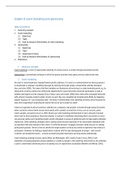
,Differentiation
change (03/0x)
Differentiation is all of Derivative notation *
the
* about *
2 types ·
f'(x)
dy /dx
A
E
ARC IRC
rate of Instaneous rate of
Average change change
·
Y2 -
,
Y
↳ also called 'marginal
x2 -
x ,
↳ find the derivative
slope of line
segment
gives a
the of tangent
gives slope a
·
* Example of ARC and IRC :
1) ARC
S
- f(16) =
3200 +
320(16) -
10(16)2 ARC = 5600 -
5760
20 -
16
= 5760
40
=
-
16 ST60
. x,
y
= =
.
↓
>
- f(20) =
3200 + 320(20) -
10(20)2 Interpretation :
= 5600 no .
of cones will decrease on
with 40 if price
: xz =
20 yz
= 5600 average
increases from RIG to R20
S
2) IRC (get derivative
f'(x)
orY of
=
320-o Interpretation : no . cones will decrease by 80
if price increases from R20 to R2I
sub in 20 : 320-20(20) = -So
, Kari
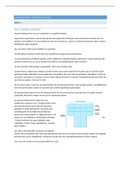
Rules of differenciation
1) Constant Rule 2) Power Rule
3) Combination of power rule
f(x) k f(x) 0
f(x) kx f(x) knxn + = h'(x)
h(x) f'(x)
g'(x)
+
f(x)
=
g(x) =
= -
: -> = = - =
4) Product Rule
h'()
f(x) =
g(x) xh(x) - f'(x) =
g'(x) .
h(x) +
g(x) .
5) Quotient Rule
c
.n(-g
9)
f(x) = 94() - 0
f' (x) =
6) Chain Rule (mom and baby
*
(g(x)]d 3 ax f'Gg(x)] g'()
=
f
y
= .
2) e-function Rule
5) In-function Rule
y
= e
f(x) =dy/dx =
ef(x) . f'(x)
y
= (n)f(x)
dy/dx =
e ady/dx =
e in(x) dy/dx = 1x
y
=
y
=
Differentiation Rules by Example
Rule 1 : f(x) = 4 f'(x) = 0 Rule 2 : f(e) : ech f'(e) = necht
, ,
variables
*
bring
1) f(x) = 5 2)g(x) =
2in(s) 1) f(x) = x6 2)g(x) = x 3) f(x) = "C from denom up
f'(x) 0 f'(x) 6xS 1x f(x) x
g'(x) g'(x)
=
= 0 = = = 1 =
2
f'(x) = -
1x
x
3) f(x) =
25yu) f(x) = = 1
*agen
f'(x) = 0 f'(x) = 0
4) y = 3 roots 5) f(x) = "
x23 f(x)
-2
y
=
=
y
dy/dx =
zx
-"
f'(x) = -zx
-
3/z
change (03/0x)
Differentiation is all of Derivative notation *
the
* about *
2 types ·
f'(x)
dy /dx
A
E
ARC IRC
rate of Instaneous rate of
Average change change
·
Y2 -
,
Y
↳ also called 'marginal
x2 -
x ,
↳ find the derivative
slope of line
segment
gives a
the of tangent
gives slope a
·
* Example of ARC and IRC :
1) ARC
S
- f(16) =
3200 +
320(16) -
10(16)2 ARC = 5600 -
5760
20 -
16
= 5760
40
=
-
16 ST60
. x,
y
= =
.
↓
>
- f(20) =
3200 + 320(20) -
10(20)2 Interpretation :
= 5600 no .
of cones will decrease on
with 40 if price
: xz =
20 yz
= 5600 average
increases from RIG to R20
S
2) IRC (get derivative
f'(x)
orY of
=
320-o Interpretation : no . cones will decrease by 80
if price increases from R20 to R2I
sub in 20 : 320-20(20) = -So
, Kari
Rules of differenciation
1) Constant Rule 2) Power Rule
3) Combination of power rule
f(x) k f(x) 0
f(x) kx f(x) knxn + = h'(x)
h(x) f'(x)
g'(x)
+
f(x)
=
g(x) =
= -
: -> = = - =
4) Product Rule
h'()
f(x) =
g(x) xh(x) - f'(x) =
g'(x) .
h(x) +
g(x) .
5) Quotient Rule
c
.n(-g
9)
f(x) = 94() - 0
f' (x) =
6) Chain Rule (mom and baby
*
(g(x)]d 3 ax f'Gg(x)] g'()
=
f
y
= .
2) e-function Rule
5) In-function Rule
y
= e
f(x) =dy/dx =
ef(x) . f'(x)
y
= (n)f(x)
dy/dx =
e ady/dx =
e in(x) dy/dx = 1x
y
=
y
=
Differentiation Rules by Example
Rule 1 : f(x) = 4 f'(x) = 0 Rule 2 : f(e) : ech f'(e) = necht
, ,
variables
*
bring
1) f(x) = 5 2)g(x) =
2in(s) 1) f(x) = x6 2)g(x) = x 3) f(x) = "C from denom up
f'(x) 0 f'(x) 6xS 1x f(x) x
g'(x) g'(x)
=
= 0 = = = 1 =
2
f'(x) = -
1x
x
3) f(x) =
25yu) f(x) = = 1
*agen
f'(x) = 0 f'(x) = 0
4) y = 3 roots 5) f(x) = "
x23 f(x)
-2
y
=
=
y
dy/dx =
zx
-"
f'(x) = -zx
-
3/z