AVES:
The unique feature that distinguishes birds from other animals is its feathers. All birds have forelimbs modified into
wings and hindlegs adapted for walking, swimming or perching. A birds entire anatomy is adapted for flight.
Characteristics of Aves:
Elongate s-shaped neck
Forelimbs modified as wings
Endothermic
Epidermal covering of feathers and leg scales
Thin epidermis and dermis sweat glands
Many bones with air cavities
Short tail
Caudal vertebrae reduced to pygostyle
Pelvic girdle is a synsacrum
Sternum large and keeled
No teeth. Each jaw covered with a keratinized sheath, forming a beak. Gizzard present.
Brain well-developed with large optic lobes and cerebellum. 12 pairs of cranial nerves
Large eyes with pecten. Middle ear with single bone
Separate sexes. Internal fertilisation with copulatory organ. Females with functional left ovary and oviduct only.
Sex determined by chromosomes
Foetal membranes of amnion, chorion and allantois
Oviparous. Egg with yolk. Calcareous shells. Extensive parental care
Kidneys and ureters that open into cloaca. Uric acid main nitrogenous waste
Lung of parabronchi with continuous air flow. Air sacs throughout body
Syrinx (voice box) present
Heart with 4 chambers. Separate pulmonary and systemic circuits . nucleated RBCs
, Origin and relationships:
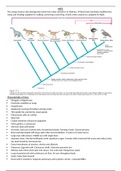
o 147 mya a flying animal died and settled at the bottom of a lagoon. It was covered with fine silt and fossilized. It
was named Archaeopteryx
o Living birds are divided into 2 groups: Paleognathae- the large flightless birds with flat sternums and poorly
developed pectoral muscles. Neognathae- flying birds with a keeled sternum for attachment of powerful flight
muscles
Similarities between birds and reptiles:
Skulls sit on the first neck vertebra by a single occipital condyle
Single middle ear bone, the stapes
Lower jaw consisting of 5-6 bones
Excrete nitrogenous waste as uric acid
Lay large yolked eggs
STRUCTURAL AND FUNCTIONAL ADAPTATIONS FOR FLIGHT:
Feathers:
Lightweight and tough
Types of feathers:
Contour feathers - give the bird its outward form. Vaned feathers that cover and streamline a bird’s body.
Consists of a hollow quill emerging from a skin follicle, a shaft and numerous barbs. Contour feathers that
extend beyond the body and are used in flight are called flight feathers.
Filoplume feathers- hair-like, degenerate feathers. Each is a weak shaft with a tuft of short barbs at the tip.
Down feathers- soft tufts without a prominent rachis, hidden beneath contour feathers. Soft because their
barbs lack hooks. Abundant on the breast and abdomen. Function to conserve heat
Powder-down feather- tips degenerate as they grow, releasing a talc-like powder that waterproofs them
and gives them a metallic lustre
Origin and development:
A feather develops from an epidermal thickening overlying a nourishing dermal core
A feather bud forms a hollow cylinder and partly sinks into the follicle
The hollow cylinder has 2 layers of epidermis: an outer layer that forms a protective sheath and an inner
layer that forms a ridge that will later become the rachis and barbs.
As a feather enlarges and
nears the end of its growth,
the soft rachis and barbs are
transformed into hard
substances by deposition of
keratin. The protective
sheath splits apart, allowing
the end of a feather to
protrude and barbs to
unfold
Molting:
When a feather is fully
grown, they molt
Feathers are discarded
gradually
Flight and tail feathers are
lost in exact pairs, one from
each side, maintaining
balance.
Replacements emerge
before the next pair is lost
The unique feature that distinguishes birds from other animals is its feathers. All birds have forelimbs modified into
wings and hindlegs adapted for walking, swimming or perching. A birds entire anatomy is adapted for flight.
Characteristics of Aves:
Elongate s-shaped neck
Forelimbs modified as wings
Endothermic
Epidermal covering of feathers and leg scales
Thin epidermis and dermis sweat glands
Many bones with air cavities
Short tail
Caudal vertebrae reduced to pygostyle
Pelvic girdle is a synsacrum
Sternum large and keeled
No teeth. Each jaw covered with a keratinized sheath, forming a beak. Gizzard present.
Brain well-developed with large optic lobes and cerebellum. 12 pairs of cranial nerves
Large eyes with pecten. Middle ear with single bone
Separate sexes. Internal fertilisation with copulatory organ. Females with functional left ovary and oviduct only.
Sex determined by chromosomes
Foetal membranes of amnion, chorion and allantois
Oviparous. Egg with yolk. Calcareous shells. Extensive parental care
Kidneys and ureters that open into cloaca. Uric acid main nitrogenous waste
Lung of parabronchi with continuous air flow. Air sacs throughout body
Syrinx (voice box) present
Heart with 4 chambers. Separate pulmonary and systemic circuits . nucleated RBCs
, Origin and relationships:
o 147 mya a flying animal died and settled at the bottom of a lagoon. It was covered with fine silt and fossilized. It
was named Archaeopteryx
o Living birds are divided into 2 groups: Paleognathae- the large flightless birds with flat sternums and poorly
developed pectoral muscles. Neognathae- flying birds with a keeled sternum for attachment of powerful flight
muscles
Similarities between birds and reptiles:
Skulls sit on the first neck vertebra by a single occipital condyle
Single middle ear bone, the stapes
Lower jaw consisting of 5-6 bones
Excrete nitrogenous waste as uric acid
Lay large yolked eggs
STRUCTURAL AND FUNCTIONAL ADAPTATIONS FOR FLIGHT:
Feathers:
Lightweight and tough
Types of feathers:
Contour feathers - give the bird its outward form. Vaned feathers that cover and streamline a bird’s body.
Consists of a hollow quill emerging from a skin follicle, a shaft and numerous barbs. Contour feathers that
extend beyond the body and are used in flight are called flight feathers.
Filoplume feathers- hair-like, degenerate feathers. Each is a weak shaft with a tuft of short barbs at the tip.
Down feathers- soft tufts without a prominent rachis, hidden beneath contour feathers. Soft because their
barbs lack hooks. Abundant on the breast and abdomen. Function to conserve heat
Powder-down feather- tips degenerate as they grow, releasing a talc-like powder that waterproofs them
and gives them a metallic lustre
Origin and development:
A feather develops from an epidermal thickening overlying a nourishing dermal core
A feather bud forms a hollow cylinder and partly sinks into the follicle
The hollow cylinder has 2 layers of epidermis: an outer layer that forms a protective sheath and an inner
layer that forms a ridge that will later become the rachis and barbs.
As a feather enlarges and
nears the end of its growth,
the soft rachis and barbs are
transformed into hard
substances by deposition of
keratin. The protective
sheath splits apart, allowing
the end of a feather to
protrude and barbs to
unfold
Molting:
When a feather is fully
grown, they molt
Feathers are discarded
gradually
Flight and tail feathers are
lost in exact pairs, one from
each side, maintaining
balance.
Replacements emerge
before the next pair is lost