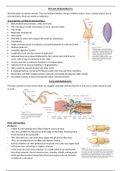
PHYLUM HEMICHORDATA:
Hemichordata are marine animals. They are bottom dwellers, living in shallow waters. Some colonial species live in
secreted tubes. Most are sessile or sedentary.
Characteristics of Phylum Hemichordata:
Body divided into proboscis, collar and trunk
Free-moving or sessile, burrowing, or live in secreted tubes
Free-living
Bilaterally symmetrical
Soft bodied
Wormlike or short and compact with stalk for attachment
Triploblastic
Single coelomic pouch in proboscis, but paired pouches in collar and trunk
Ciliated epidermis
Complete digestive system
Longitudinal and circular muscles in body wall
Subepidermal nerve plexus thickened to form dorsal and ventral nerve
cords, with a ring of connective in the collar
Sensory neurons in proboscis function in chemoreceptors
Colonies form by asexual budding or fragmentation
Sexes separate, gonads project into body cavity
A single glomerulus connected to blood vessels may have excretory functions
Respiratory and filter-feeding system of gill slits connecting the pharynx with outside
Circulatory system of dorsal and ventral vessels and dorsal heart
CLASS ENTEROPNEUSTA:
This class consists of acorn worm which are sluggish, wormlike animals that live in burrows or under stones in mud
or sand.
Form and Function:
Proboscis:
Probes its surroundings and collects food in mucus strands
Cilia carry particles to the groove at the edge of the collar, directing them
to the mouth to be swallowed
This class also uses a pre-oral ciliary organ and gill slits to filter-feed
They can simultaneously use filter and deposit feeding
Burrow dwellers use their proboscis to excavate and some may ingest sand
as they burrow, extracting its organic contents
In the posterior end of the proboscis is a small coelomic sac (protocoel)
into which extends a buccal diverticulum, a slender, blindly ending pouch
of the gut that reaches forward into the buccal region and was formerly
considered a notochord
Hemichordata are marine animals. They are bottom dwellers, living in shallow waters. Some colonial species live in
secreted tubes. Most are sessile or sedentary.
Characteristics of Phylum Hemichordata:
Body divided into proboscis, collar and trunk
Free-moving or sessile, burrowing, or live in secreted tubes
Free-living
Bilaterally symmetrical
Soft bodied
Wormlike or short and compact with stalk for attachment
Triploblastic
Single coelomic pouch in proboscis, but paired pouches in collar and trunk
Ciliated epidermis
Complete digestive system
Longitudinal and circular muscles in body wall
Subepidermal nerve plexus thickened to form dorsal and ventral nerve
cords, with a ring of connective in the collar
Sensory neurons in proboscis function in chemoreceptors
Colonies form by asexual budding or fragmentation
Sexes separate, gonads project into body cavity
A single glomerulus connected to blood vessels may have excretory functions
Respiratory and filter-feeding system of gill slits connecting the pharynx with outside
Circulatory system of dorsal and ventral vessels and dorsal heart
CLASS ENTEROPNEUSTA:
This class consists of acorn worm which are sluggish, wormlike animals that live in burrows or under stones in mud
or sand.
Form and Function:
Proboscis:
Probes its surroundings and collects food in mucus strands
Cilia carry particles to the groove at the edge of the collar, directing them
to the mouth to be swallowed
This class also uses a pre-oral ciliary organ and gill slits to filter-feed
They can simultaneously use filter and deposit feeding
Burrow dwellers use their proboscis to excavate and some may ingest sand
as they burrow, extracting its organic contents
In the posterior end of the proboscis is a small coelomic sac (protocoel)
into which extends a buccal diverticulum, a slender, blindly ending pouch
of the gut that reaches forward into the buccal region and was formerly
considered a notochord