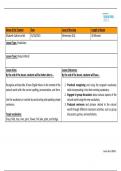
Name of the Teacher Date Level of the class Length of lesson
Elizabeth Catharina Nel 01/10/2023 Elementary (A1) 60 Minutes
Lesson Type: Vocabulary
Lesson Topic: Natural World
Lesson Aims: Lesson Outcomes:
By the end of the lesson, students will be better able to… By the end of the lesson, students will have…
Recognise and describe 10 new English Nouns in the context of the 1. Practiced recognizing and using the targeted vocabulary
natural world with the correct spelling, pronunciation, and form. while incorporating it into their existing vocabulary.
2. Engaged in group discussions about various aspects of the
Use the vocabulary in context by constructing and speaking simple natural world using the new vocabulary.
sentences. 3. Produced sentences and phrases related to the natural
world through different classroom activities, such as group
Target vocabulary: discussions, games, and worksheets.
Grass, field, tree, river, park , flower, hill, lake, plant, and bridge.
Lesson plan 130623
,Anticipated difficulties: Suggested solutions:
Include one relating to L1/age/level of the students and one for the
10 words (meaning, form, or pronunciation). 1. Use visual aids: I will show video aids like mouth diagrams or
videos demonstrating the correct pronunciation of
1. Chinese students at the elementary level, may encounter challenging sounds, emphasizing the difference between
challenges with English pronunciation and sounds that are English and Chinese sounds. The new vocabulary words will
not present in their native language. For instance, English has also be broken down into syllables where students will speak
certain vowel sounds and consonant combinations that do slowly and clearly, with exaggerated mouth motions. I will
not exist in Mandarin or other Chinese dialects. For example: conduct pronunciation drills and repetition exercises
"Bridge" might pose pronunciation challenges for some focusing on challenging sounds like “r” and “dg” until
students, especially if they have difficulties with the "r" and students become more comfortable with them. Students will
"dg" sounds, which are not as common in Chinese languages. be asked to repeat the words slowly and clearly if it is
necessary.
2. The age range of 18 to 38 may include adult learners who
have less exposure to learning new language, making it 2. Students will engage in group discussions and pair work to
harder for them to grasp unfamiliar sounds and ensure no one feels excluded. They will be shuffled around
pronunciation patterns. Students may use L1 during the class occasionally to ensure all students interact with each other.
and feel discouraged from participating in group activities. Students will be encouraged to use the new words in
conversations to solidify their comprehension and
3. One of the anticipated difficulties in the target vocabulary is application.
words are related to their varied forms and meanings. Some
of the words might have multiple meanings depending on 3. Before the start of each lesson I will remind students that the
the context in which they are used, students may find it class is in an “English-only zone”. This will allow better
challenging to identify the appropriate usage for each word. progress in the classroom. I will also make use of flashcards
For example: “Plant” can refer to living organisms or a verb
Lesson plan 130623
, meaning to place something in the ground. Students may to illustrate the different meanings and forms of the new
struggle with differentiating between a verb and a noun. vocabulary.
Language analysis:
Language Meaning of the How you will present Concept Checking Grammatical form Pronunciation
Item item the meaning Questions Use the IPA
translator if needed
Example: Example: Example: Example: Example: Example:
Huge very big, enormous using a picture of a mouse What’s the opposite of huge? Strong adjective / hjuːdʒ/
and an elephant to show Name a huge mountain.
large size
1. Grass Green plants that Present a flashcard of Is it a plant or an animal? Noun /græs/
grow on the ground. grass and show real What colour is it?
grass to students, Can you walk on it in a
explaining that grass is park?
the green, soft plant
that covers the ground
Lesson plan 130623
Elizabeth Catharina Nel 01/10/2023 Elementary (A1) 60 Minutes
Lesson Type: Vocabulary
Lesson Topic: Natural World
Lesson Aims: Lesson Outcomes:
By the end of the lesson, students will be better able to… By the end of the lesson, students will have…
Recognise and describe 10 new English Nouns in the context of the 1. Practiced recognizing and using the targeted vocabulary
natural world with the correct spelling, pronunciation, and form. while incorporating it into their existing vocabulary.
2. Engaged in group discussions about various aspects of the
Use the vocabulary in context by constructing and speaking simple natural world using the new vocabulary.
sentences. 3. Produced sentences and phrases related to the natural
world through different classroom activities, such as group
Target vocabulary: discussions, games, and worksheets.
Grass, field, tree, river, park , flower, hill, lake, plant, and bridge.
Lesson plan 130623
,Anticipated difficulties: Suggested solutions:
Include one relating to L1/age/level of the students and one for the
10 words (meaning, form, or pronunciation). 1. Use visual aids: I will show video aids like mouth diagrams or
videos demonstrating the correct pronunciation of
1. Chinese students at the elementary level, may encounter challenging sounds, emphasizing the difference between
challenges with English pronunciation and sounds that are English and Chinese sounds. The new vocabulary words will
not present in their native language. For instance, English has also be broken down into syllables where students will speak
certain vowel sounds and consonant combinations that do slowly and clearly, with exaggerated mouth motions. I will
not exist in Mandarin or other Chinese dialects. For example: conduct pronunciation drills and repetition exercises
"Bridge" might pose pronunciation challenges for some focusing on challenging sounds like “r” and “dg” until
students, especially if they have difficulties with the "r" and students become more comfortable with them. Students will
"dg" sounds, which are not as common in Chinese languages. be asked to repeat the words slowly and clearly if it is
necessary.
2. The age range of 18 to 38 may include adult learners who
have less exposure to learning new language, making it 2. Students will engage in group discussions and pair work to
harder for them to grasp unfamiliar sounds and ensure no one feels excluded. They will be shuffled around
pronunciation patterns. Students may use L1 during the class occasionally to ensure all students interact with each other.
and feel discouraged from participating in group activities. Students will be encouraged to use the new words in
conversations to solidify their comprehension and
3. One of the anticipated difficulties in the target vocabulary is application.
words are related to their varied forms and meanings. Some
of the words might have multiple meanings depending on 3. Before the start of each lesson I will remind students that the
the context in which they are used, students may find it class is in an “English-only zone”. This will allow better
challenging to identify the appropriate usage for each word. progress in the classroom. I will also make use of flashcards
For example: “Plant” can refer to living organisms or a verb
Lesson plan 130623
, meaning to place something in the ground. Students may to illustrate the different meanings and forms of the new
struggle with differentiating between a verb and a noun. vocabulary.
Language analysis:
Language Meaning of the How you will present Concept Checking Grammatical form Pronunciation
Item item the meaning Questions Use the IPA
translator if needed
Example: Example: Example: Example: Example: Example:
Huge very big, enormous using a picture of a mouse What’s the opposite of huge? Strong adjective / hjuːdʒ/
and an elephant to show Name a huge mountain.
large size
1. Grass Green plants that Present a flashcard of Is it a plant or an animal? Noun /græs/
grow on the ground. grass and show real What colour is it?
grass to students, Can you walk on it in a
explaining that grass is park?
the green, soft plant
that covers the ground
Lesson plan 130623