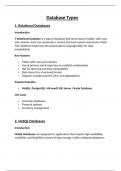
Database Types
1. Relational Databases
Introduction
A Relational Database is a type of database that stores data in tables, with rows
and columns. Each row represents a record, and each column represents a field.
The relational model uses Structured Query Language (SQL) for data
manipulation.
Key Features
Tables with rows and columns
Use of primary and foreign keys to establish relationships
SQL for querying and data manipulation
Data stored in a structured format
Supports complex queries, joins, and aggregations
Popular Examples
MySQL, PostgreSQL, Microsoft SQL Server, Oracle Database
Use Cases
Customer databases
Financial systems
Inventory management
2. NoSQL Databases
Introduction
NoSQL Databases are designed for applications that require high availability,
scalability, and flexibility in terms of data storage. Unlike relational databases,
, NoSQL databases do not use structured tables and are designed to handle large
volumes of unstructured or semi-structured data.
Key Features
Non-relational data models (key-value, document, column, graph)
High scalability and flexibility
Suitable for big data applications
No fixed schema or structure
Supports horizontal scaling (distributed architecture)
Popular Examples
MongoDB (Document Store)
Cassandra (Column Store)
Redis (Key-Value Store)
Neo4j (Graph Database)
CouchDB (Document Store)
Use Cases
Social media applications
Big data and analytics
Real-time applications
Content management systems
3. Object-Oriented Databases
Introduction
Object-Oriented Databases (OODBs) integrate object-oriented programming
(OOP) principles into database systems. In an OODB, data is stored as objects,
much like how data is represented in object-oriented programming languages.
Key Features
Stores data as objects
1. Relational Databases
Introduction
A Relational Database is a type of database that stores data in tables, with rows
and columns. Each row represents a record, and each column represents a field.
The relational model uses Structured Query Language (SQL) for data
manipulation.
Key Features
Tables with rows and columns
Use of primary and foreign keys to establish relationships
SQL for querying and data manipulation
Data stored in a structured format
Supports complex queries, joins, and aggregations
Popular Examples
MySQL, PostgreSQL, Microsoft SQL Server, Oracle Database
Use Cases
Customer databases
Financial systems
Inventory management
2. NoSQL Databases
Introduction
NoSQL Databases are designed for applications that require high availability,
scalability, and flexibility in terms of data storage. Unlike relational databases,
, NoSQL databases do not use structured tables and are designed to handle large
volumes of unstructured or semi-structured data.
Key Features
Non-relational data models (key-value, document, column, graph)
High scalability and flexibility
Suitable for big data applications
No fixed schema or structure
Supports horizontal scaling (distributed architecture)
Popular Examples
MongoDB (Document Store)
Cassandra (Column Store)
Redis (Key-Value Store)
Neo4j (Graph Database)
CouchDB (Document Store)
Use Cases
Social media applications
Big data and analytics
Real-time applications
Content management systems
3. Object-Oriented Databases
Introduction
Object-Oriented Databases (OODBs) integrate object-oriented programming
(OOP) principles into database systems. In an OODB, data is stored as objects,
much like how data is represented in object-oriented programming languages.
Key Features
Stores data as objects