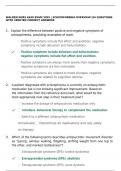
WALDEN NURS 6630 EXAM 2025 | SCHIZOPHRENIA OVERVIEW |94 QUESTIONS
WITH VERIFIED CORRECT ANSWERS
1. Explain the difference between positive and negative symptoms of
schizophrenia, providing examples of each.
Positive symptoms include flat affect and avolition; negative
symptoms include delusions and hallucinations.
Positive symptoms include delusions and hallucinations;
negative symptoms include flat affect and avolition.
Positive symptoms are always more severe than negative symptoms;
negative symptoms are less noticeable.
Positive symptoms are related to mood changes; negative
symptoms are related to cognitive decline.
2. A patient diagnosed with schizophrenia is currently on antipsychotic
medication but is not showing significant improvement. Based on
the information from the reference document, what would be the
most appropriate next step in their treatment plan?
Increase the dosage of antipsychotic medication only
Introduce behavioral therapy to complement the medication
Switch to a different antipsychotic medication
immediately Discontinue all medications and rely solely
on therapy
3. Which of the following terms describes antipsychotic movement disorder
as "pacing, aimless walking, fidgeting, shifting weight from one leg to
the other, and marked restlessness"?
Extrapyramidal syndrome (EPS): tardive dyskinesia
Extrapyramidal syndrome (EPS): akathisia
Extrapyramidal syndrome (EPS): acute dystonia
,Extrapyramidal syndrome (EPS): parkinsonian symptoms
, 4. Which treatment for schizophrenia targets dopamine receptors to
alleviate positive symptoms?
Antidepressants
Typical Antipsychotic medications
Electroconvulsive Therapy (ECT)
Cognitive-Behavioral Therapy (CBT)
5. What are the two main symptoms that characterize
schizophrenia? Anxiety and depression
Hallucinations and
delusions Obsessions and
compulsions Mood swings
and irritability
6. Which school of thought proposes that schizophrenia occurs when the
hypofunction of NMDA receptors results in increases in glutamate and
downstream increases in dopamine?
hypofrontality
dopamine theory
glutamate theory
aberrant salience hypothesis
7. What is the primary role of antipsychotic medications in the treatment
of schizophrenia?
To cure schizophrenia completely
To alleviate positive symptoms
To enhance cognitive function
To prevent the onset of the disorder
WITH VERIFIED CORRECT ANSWERS
1. Explain the difference between positive and negative symptoms of
schizophrenia, providing examples of each.
Positive symptoms include flat affect and avolition; negative
symptoms include delusions and hallucinations.
Positive symptoms include delusions and hallucinations;
negative symptoms include flat affect and avolition.
Positive symptoms are always more severe than negative symptoms;
negative symptoms are less noticeable.
Positive symptoms are related to mood changes; negative
symptoms are related to cognitive decline.
2. A patient diagnosed with schizophrenia is currently on antipsychotic
medication but is not showing significant improvement. Based on
the information from the reference document, what would be the
most appropriate next step in their treatment plan?
Increase the dosage of antipsychotic medication only
Introduce behavioral therapy to complement the medication
Switch to a different antipsychotic medication
immediately Discontinue all medications and rely solely
on therapy
3. Which of the following terms describes antipsychotic movement disorder
as "pacing, aimless walking, fidgeting, shifting weight from one leg to
the other, and marked restlessness"?
Extrapyramidal syndrome (EPS): tardive dyskinesia
Extrapyramidal syndrome (EPS): akathisia
Extrapyramidal syndrome (EPS): acute dystonia
,Extrapyramidal syndrome (EPS): parkinsonian symptoms
, 4. Which treatment for schizophrenia targets dopamine receptors to
alleviate positive symptoms?
Antidepressants
Typical Antipsychotic medications
Electroconvulsive Therapy (ECT)
Cognitive-Behavioral Therapy (CBT)
5. What are the two main symptoms that characterize
schizophrenia? Anxiety and depression
Hallucinations and
delusions Obsessions and
compulsions Mood swings
and irritability
6. Which school of thought proposes that schizophrenia occurs when the
hypofunction of NMDA receptors results in increases in glutamate and
downstream increases in dopamine?
hypofrontality
dopamine theory
glutamate theory
aberrant salience hypothesis
7. What is the primary role of antipsychotic medications in the treatment
of schizophrenia?
To cure schizophrenia completely
To alleviate positive symptoms
To enhance cognitive function
To prevent the onset of the disorder