

TRANSACTIONAL WRITING
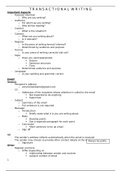
Important Aspects
- Purpose/ intention
o Why are you writing?
- Audience
o For whom ae you writing?
o Who will be reading?
- Context
o What is the situation?
- Content
o What are you writing about?
o Is it relevant?
- Register
o Is the piece of writing formal/ informal?
o Determined by audience and purpose
- Format
o Is your piece of writing correctly laid out?
- Style
o Have you used appropriate
Diction
Sentence structure
Tone
o Determined audience and purpose
- Language
o Is your spelling and grammar correct
Email
Needed
- Recipient’s address
o
- CC
o Addresses of the recipients whose attention is called to the email
Not expected to do anything
Supervisor
- Subject
o Summary of the email
o Full sentence is not required
- Message
o Introduction
Briefly state what it is you are writing about
o Body
Develop points
Use a separate paragraph for each point
o Conclusion
Short sentence to tie up email
o Sign off
NB
- The sender’s address reflects automatically when the email is received
- The sender may choose to provide other contact details at the endAlways be polite
o Signature
Other
- Register and tone
o Differ depending on
relationship between sender and receiver
subject/ content of email
1
, FORMAT
TO:
CC: ;
SUBJECT: Outstanding reports
MESSAGE
Dear All NO COMMA
You are reminded to submit all the outstanding reports by the set date. 20 April 2019. A mid-
erm report template will be sent to you hereafter to facilitate uniformity. You are advised to
consult Mr Sandburg if you encounter any problem with the template.
Kind Regards NO COMMA
Solumzi Yam
Business/ formal letter
Examples
- application letter
- letter of complaint
- letter requesting sponsorship
- letter of dismissal
- formal letter of apology
Remember
- formal register
- indicate whether you are writing in a personal capacity or on behalf of an
organisation/ group
- Indicate if your letter is a follow up to any previous correspondence
- Provide specifics where people
o Dates
o Names
o Times
o Locations
- Language must be simple and direct
o Be concise
Without omitting any necessary information
- Do not get emotional/ personal
- Do not make grammar, punctuation and spelling mistakes
- Indicate whether you would like a response or any action to be taken
- If writing an application letter
o Indicate availability for interviews
- Refer to any accompanying documentation
NB
- The word count for letters includes only content
o Introduction
o Body
o Conclusion
2
Important Aspects
- Purpose/ intention
o Why are you writing?
- Audience
o For whom ae you writing?
o Who will be reading?
- Context
o What is the situation?
- Content
o What are you writing about?
o Is it relevant?
- Register
o Is the piece of writing formal/ informal?
o Determined by audience and purpose
- Format
o Is your piece of writing correctly laid out?
- Style
o Have you used appropriate
Diction
Sentence structure
Tone
o Determined audience and purpose
- Language
o Is your spelling and grammar correct
Needed
- Recipient’s address
o
- CC
o Addresses of the recipients whose attention is called to the email
Not expected to do anything
Supervisor
- Subject
o Summary of the email
o Full sentence is not required
- Message
o Introduction
Briefly state what it is you are writing about
o Body
Develop points
Use a separate paragraph for each point
o Conclusion
Short sentence to tie up email
o Sign off
NB
- The sender’s address reflects automatically when the email is received
- The sender may choose to provide other contact details at the endAlways be polite
o Signature
Other
- Register and tone
o Differ depending on
relationship between sender and receiver
subject/ content of email
1
, FORMAT
TO:
CC: ;
SUBJECT: Outstanding reports
MESSAGE
Dear All NO COMMA
You are reminded to submit all the outstanding reports by the set date. 20 April 2019. A mid-
erm report template will be sent to you hereafter to facilitate uniformity. You are advised to
consult Mr Sandburg if you encounter any problem with the template.
Kind Regards NO COMMA
Solumzi Yam
Business/ formal letter
Examples
- application letter
- letter of complaint
- letter requesting sponsorship
- letter of dismissal
- formal letter of apology
Remember
- formal register
- indicate whether you are writing in a personal capacity or on behalf of an
organisation/ group
- Indicate if your letter is a follow up to any previous correspondence
- Provide specifics where people
o Dates
o Names
o Times
o Locations
- Language must be simple and direct
o Be concise
Without omitting any necessary information
- Do not get emotional/ personal
- Do not make grammar, punctuation and spelling mistakes
- Indicate whether you would like a response or any action to be taken
- If writing an application letter
o Indicate availability for interviews
- Refer to any accompanying documentation
NB
- The word count for letters includes only content
o Introduction
o Body
o Conclusion
2


