8.1-8.3
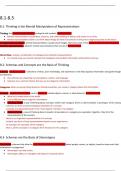
8.1- Thinking is the Mental Manipulation of Representations
Thinking- the mental manipulations of analogical and symbolic representations
● Mental representation include ideas, theories, and understanding of objects and events in our lives
● Mental representations allow us to think about things we have encountered in the past or might encounter in the future
Analogical Representations- mental representations, usually visual images, that have some of the physical characteristics of objects
Symbolic Representations- abstract mental representations that consist of words or ideas
Mental Map- include a combination of analogical and symbolic representations
● In a mental map, you cannot represent all analogical and symbolic information with perfect accuracy
8.2- Schemas and Concepts are the Basis of Thinking
Schemas- mental structures- collections of ideas, prior knowledge, and experiences- that help organize information and guide thought
and behavior
● Our schemas are shaped by our perceptions, culture, and language
● Schemas are a common theme that we use to categorize information
Categories- when you group things based on shared properties, you create a category about the information
Concepts- mental representation used to categorize related objects, events, or ideas based on shared features
● Allow us to make sense of the world
● A very efficient way to organize information
● Prototype Model- a way of thinking about concepts: within each category, there is a best example- a prototype- of the concep
-schemas are built around prototypical examples of a concept
-concepts are organized based on the "most typical" member of a category
● Exemplar Model- a way of thinking about concepts: all examples in a category are exemplars; together, they form the
representation of the concept
-there is no single best representation of a concept
-instead, you form a fuzzy representation based on your experiences
-all concepts are examples of the category
-that is, all the concepts in a category form the basis for the category
8.3- Schemas are the Basis of Stereotypes
Stereotypes- schemas that allow for easy, fast processing of information about people, events, or objects, based on how much that
information is categorized
● Stereotypes can lead to bias
● Stereotypes affect our thoughts and behaviors towards others
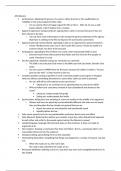
, 1. Reasoning
● Using information to determine if a conclusion is valid or reasonable
-Informal Reasoning- relying on opinions, familiarity, and knowledge
-Formal Reasoning- relying on the standardized and objective procedures of the scientific method to collect empirical evidence
and to test whether hypotheses are valid
● Biased reasoning can lead people to unreliable conclusions
-Confirmation Bias- people show a strong tendency to pay greater attention to evidence that supports their beliefs; people also
ignore or downplay evidence that does not
-Illusory Correlations- the misperception that two chance events that happen at the same time are somehow related
-Hindsight Bias- the tendency to believe you could have predicted something after you know the outcome
1. Decision Making
● Attempting to select the best alternative among several options
● Decision making involves identifying important criteria and determining how well each alternative satisfies these criteria
● Ideally, an algorithm or a systematic set of procedures to follow when we make a decision, but this is time-consuming and
energy
● Reality, "rule of thumb"- decisions are generally fine- they are good enough in our daily life
● Heuristic- a shortcut used to reduce the amount of thinking that is needed to make decisions
-Availability Heuristic- the tendency to make a decision based on information that comes to mind most easily
-Representativeness Heuristic- the tendency to place people or objects in a category if they are similar to the concept that is the
prototype; can lead to faulty reasoning, if we fail to take other information into account
-Affective Heuristic- the tendency to over-project how something will us feel; typically we are less sad and less happy than we
expect something to make us feel
● Framing- how information is presented affects how that information is perceived and influences decisions; framing can
specifically influence decision-making in various situation
● The Paradox if Choice- when too many options are available, especially when all of them are attractive, we experience conflict
and indecision; some choice is better than none, but too much choice can be frustrating and unsatisfying, and ultimately can
impair your thinking
● Maximizers- try to make the perfect choice; typically choose the "best option", but are less satisfied
● Satisfiers- seek to find a "good enough" choice; tend to be happy with their decisions
1. Problem-Solving
● Finding a way around an obstacle to reach a goal
● Problem Solving Strategies:
-Subgoals- breaking the task into subgoals; reaching each subgoal will result in achieving the main goal of solving the problem
-Working Backwards- proceeding from the goal state to the initial state; can be helpful when the appropriate steps for solving a
problem are not clear
-Reasoning by Analogy- finding an appropriate analogy for a problem can help achieve goals
-Insight- when you suddenly realize the solution to a problem
● Obstacles- when we attempt to solve problems, how we think about that specific situation or a past experience can hinder ou
ability to solve the problem
-Mental Sets- established ways of thinking- how its always been done; a tendency to approach a problem in the same way that h
worked for you in the past, which may make it harder to solve
-Functional Fixedness- a tendency to think of things based on their typical functions
8.1- Thinking is the Mental Manipulation of Representations
Thinking- the mental manipulations of analogical and symbolic representations
● Mental representation include ideas, theories, and understanding of objects and events in our lives
● Mental representations allow us to think about things we have encountered in the past or might encounter in the future
Analogical Representations- mental representations, usually visual images, that have some of the physical characteristics of objects
Symbolic Representations- abstract mental representations that consist of words or ideas
Mental Map- include a combination of analogical and symbolic representations
● In a mental map, you cannot represent all analogical and symbolic information with perfect accuracy
8.2- Schemas and Concepts are the Basis of Thinking
Schemas- mental structures- collections of ideas, prior knowledge, and experiences- that help organize information and guide thought
and behavior
● Our schemas are shaped by our perceptions, culture, and language
● Schemas are a common theme that we use to categorize information
Categories- when you group things based on shared properties, you create a category about the information
Concepts- mental representation used to categorize related objects, events, or ideas based on shared features
● Allow us to make sense of the world
● A very efficient way to organize information
● Prototype Model- a way of thinking about concepts: within each category, there is a best example- a prototype- of the concep
-schemas are built around prototypical examples of a concept
-concepts are organized based on the "most typical" member of a category
● Exemplar Model- a way of thinking about concepts: all examples in a category are exemplars; together, they form the
representation of the concept
-there is no single best representation of a concept
-instead, you form a fuzzy representation based on your experiences
-all concepts are examples of the category
-that is, all the concepts in a category form the basis for the category
8.3- Schemas are the Basis of Stereotypes
Stereotypes- schemas that allow for easy, fast processing of information about people, events, or objects, based on how much that
information is categorized
● Stereotypes can lead to bias
● Stereotypes affect our thoughts and behaviors towards others
, 1. Reasoning
● Using information to determine if a conclusion is valid or reasonable
-Informal Reasoning- relying on opinions, familiarity, and knowledge
-Formal Reasoning- relying on the standardized and objective procedures of the scientific method to collect empirical evidence
and to test whether hypotheses are valid
● Biased reasoning can lead people to unreliable conclusions
-Confirmation Bias- people show a strong tendency to pay greater attention to evidence that supports their beliefs; people also
ignore or downplay evidence that does not
-Illusory Correlations- the misperception that two chance events that happen at the same time are somehow related
-Hindsight Bias- the tendency to believe you could have predicted something after you know the outcome
1. Decision Making
● Attempting to select the best alternative among several options
● Decision making involves identifying important criteria and determining how well each alternative satisfies these criteria
● Ideally, an algorithm or a systematic set of procedures to follow when we make a decision, but this is time-consuming and
energy
● Reality, "rule of thumb"- decisions are generally fine- they are good enough in our daily life
● Heuristic- a shortcut used to reduce the amount of thinking that is needed to make decisions
-Availability Heuristic- the tendency to make a decision based on information that comes to mind most easily
-Representativeness Heuristic- the tendency to place people or objects in a category if they are similar to the concept that is the
prototype; can lead to faulty reasoning, if we fail to take other information into account
-Affective Heuristic- the tendency to over-project how something will us feel; typically we are less sad and less happy than we
expect something to make us feel
● Framing- how information is presented affects how that information is perceived and influences decisions; framing can
specifically influence decision-making in various situation
● The Paradox if Choice- when too many options are available, especially when all of them are attractive, we experience conflict
and indecision; some choice is better than none, but too much choice can be frustrating and unsatisfying, and ultimately can
impair your thinking
● Maximizers- try to make the perfect choice; typically choose the "best option", but are less satisfied
● Satisfiers- seek to find a "good enough" choice; tend to be happy with their decisions
1. Problem-Solving
● Finding a way around an obstacle to reach a goal
● Problem Solving Strategies:
-Subgoals- breaking the task into subgoals; reaching each subgoal will result in achieving the main goal of solving the problem
-Working Backwards- proceeding from the goal state to the initial state; can be helpful when the appropriate steps for solving a
problem are not clear
-Reasoning by Analogy- finding an appropriate analogy for a problem can help achieve goals
-Insight- when you suddenly realize the solution to a problem
● Obstacles- when we attempt to solve problems, how we think about that specific situation or a past experience can hinder ou
ability to solve the problem
-Mental Sets- established ways of thinking- how its always been done; a tendency to approach a problem in the same way that h
worked for you in the past, which may make it harder to solve
-Functional Fixedness- a tendency to think of things based on their typical functions