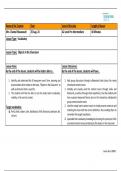
Name of the Teacher Date Level of the class Length of lesson
Mrs. Chantal Nieuwoudt 25 Aug. 24 A2 Level Pre-Intermediate 60 Minutes
Lesson Type: Vocabulary
Lesson Topic: Objects in the Classroom
Lesson Aims: Lesson Outcomes:
By the end of the lesson, students will be better able to… By the end of the lesson, students will have…
1. Identify, and understand the 10 new given nouns’ form, meaning, and 1. Had group discussions through collaborated tasks about the newly
pronunciation which relates to the topic, “Objects in the Classroom” as introduced content nouns.
well as what each item is used for. 2. Verbally and visually used the content nouns through realia and
2. The students will then be able to use the newly learnt vocabulary, flashcards, as well as through choral repetitions, thus the students will
verbally, in the correct context. have acquired improved fluency due to the interactive collaborated
group communication tasks.
Target vocabulary: 3. Used the newly learnt content nouns in simple present sentences and
Pencil, desk, rubber, ruler, blackboard, shelf, dictionary, bookcase, bin, matching the noun with the correct definition, thus enabling them to
scissors. remember the taught vocabulary.
4. Expanded their vocabulary knowledge by learning the synonyms of the
associated content nouns pertaining to the objects in the classroom.
Lesson plan 150823
,Anticipated difficulties: Suggested solutions:
Include one relating to L1/age/level of the students and one for the
10 words (meaning, form, or pronunciation). 1. When starting the English Lesson, the teacher will need to present
descriptive (describing how the language is actually used) and prescriptive
- L1 – Chinese / Mandarin Native Language (Fig. 6 – 8): (defining preferred usage) linguistic rules which covers orthography
One of the most obvious things teachers relate too when teaching English (spelling), pronunciation, vocabulary, morphology, syntax, semantics,
to Foreign students, in this instance; A2 pre-intermediate Chinese pragmatics, phonetics and phonology, sentence structures, and basic
students aged 11-12; is the pronunciation mistakes they make when word order. The teacher will have to continually remind the students to
speaking English. Thus, the students’ native tongue (L1) may lead to use the target vocabulary in the event they revert to their native tongue
interference regarding orthography (study of the correct spelling) (L1). The students subconsciously revert to their native tongue (L1) when
pronunciation (how a word is pronounced), vocabulary (words or struggling to pronounce the target vocabulary, thus, the teacher needs to
terminology of a language), morphology (focuses on the form of words), explain and highlight the importance pertaining to the differences between
syntax (combining words into clauses and phrases), semantics (meanings their native tongue (L1) and English language (L2). Should this persist, the
of words and sentences), pragmatics (language use), phonetics and teacher will have to elaborate further with relevant examples on how to
phonology (all sounds and system sounds), sentence structures, and overcome these language barriers. The teacher will also need to explicitly
basic word order (Subject-Verb-Order) when learning English (L2). explain the differences and emphasise the importance of “stress” in English
pronunciation. Once the students fully grasp and understand these
- Age – 11-12 years of age: concepts, the teacher can encourage them to practice regularly and to
Students, aged 11-12, have an attention span which can range between reinforce the correct language usage through guided and targeted
15 – 30 minutes. Ideally, you are to add 5 minutes to a child’s age, which exercises.
will then provide you with the “correct study time” that are to be
allocated to each student, for example: if a child is aged 11 years, it will 2. As some of the students may have short attention spans, alternatively,
be tabulated as follows: 11y + 5 minutes = 16 study minutes. A “5-minute struggle to focus on the target vocabulary’s content; the teacher assists the
break” needs to be taken after each “16-minute study”, thus helping the students by letting them engage through social learning by means of:
student to reach his/her full potential and “resting their brain” (mainly the active participation, interactive activities, frequent breaks, short and
right hemisphere of the brain which forms part of the brain network that focused sessions, mindfulness exercises, and visual aids.
supports social language learning [Lee and Jeone]). Therefore, this can
also be a possible hinderance during a teachers’ lesson – short attention 3. The teacher can assess his/her students to identify any anticipated
span. The students might struggle to focus on the target terminology difficulties the students might face whereafter same can provide ample
Lesson plan 150823
, during the given lesson. Furthermore, there can also be additional issues opportunities for controlled practice and progressively establish
such as classroom environment, teaching methods, just to name a few. challenging tasks. After establishing anticipated difficulties the students
might face, the teacher can: create a supportive class environment,
- Level – A2 Level Pre-Intermediate: encourage peer collaboration, identify grammatical challenges, provide
The students may face common trials/obstacles at this level when using clarity on given instructions, offer scaffolded support, offer positive
descriptive (describing how the language is actually used) and prescriptive corroboration, as well as offering regular feedback on completed tasks,
(defining preferred usage) linguistic rules and therefore might lack the thus boosting students’ morale and self-confidence.
necessary confidence when using the English Language (L2) with
confidence. Other challenges students may also encounter may be: 4. The teacher can implement “SMART” (S = Specific, M = Measurable, A =
Anticipating pronunciation problems, Grammatical issues, Intonation and Attainable, R = Relevant, T = Timed) goals for the students as this will be
Stress on the correct syllables, Limitation on vocabulary, listening beneficial to their learning experience when acquiring their English
comprehension, Reading and Writing problems, Speaking confidently, Language (L2). Moreso, the teacher can activate the students:
and Word order problems. Visual and auditory channels through the “Cooperative Groups”
(which incorporates Learner-directed learning), “Integrated
- Target Vocabulary – Form, Meaning, and Pronunciation of - pencil, desk, Learning Approach”, “Multisensory Method”, “Regular Review
rubber, ruler, blackboard, shelf, dictionary, bookcase, bin, scissors and Assessments”, “Rotation Method”, “Sensory Motor Skills”
- (Fig. 8 – 10): (inclusive of Leveraging digital platforms, Utilizing multimedia
The students may undoubtedly encounter hindrances when wanting to resources, Community and Social media, and Language exchange
communicate in the English language (L2) due to their native tongue (L1), platforms [HelloTalk]), “Social Cultural Theory”, “Story-Telling”,
for example, their verbal pronunciation may impede their ability to be and by using “Structured Activities / Tasks”.
understood by their fellow students. This is derived from the differences This will aid the students to grasp the form, meaning and (improved)
between L1 and L2’s grammar, lexis, pronunciation of certain consonants pronunciation skills of the taught English Language (L2) in a fun and
and vowels, unfamiliar stress patterns (segmental- and suprasegmental interactive way, thus, increasing their subsequent recognition of the
aspects with English pronunciation), and syntax’s form and meaning. target vocabulary whereafter it will be easier for them to make
Therefore, they might struggle with the English Language (L2) in the connections between the target vocabulary and their definitions.
following linguistic aspects, as set out below: Students can be put into groups whereby they can assist one-
The “Initial Sound” (/ʃ/) “sh” pertaining to the word “Shelf” isn’t another, for example, to differentiate between “sh” (/ʃ/) and “f” (/f/)
present in the student’s native language (L1) and therefore can be in the word “Shelf” or the in the difficulty of pronouncing “r” (/r/)
replaced by the student with a similar sound from their native and “l” (/l/) sounds which are present in the word “Ruler”.
language (L1).
Lesson plan 150823
, Words ending in “Final Consonants” (/f/) (except for “n” and “ng”) Lastly, the teacher can incorporate the use of “Written Activities” as
such as with “Shelf” can be problematic because the student’s this will also be beneficial towards the students learning experience,
native language (L1) normally ends in either a nasal- or vowel thus increasing their hand-eye coordination recognition when writing
sound. the target vocabulary in “Subject-Verb-Order” sentence activities
The word “Ruler” wherein the “R” (/r/) and “L” (/l/) Sounds are whereafter the teacher can regularly review their written activities
present, can be difficult to pronounce because it is not present, and provide the relevant feedback thereon to them, making this a
alternatively, does not have an comparable sound in the students’ versatile collaborating lesson, advantageous to both parties
native language (L1) and this can be particularly difficult for them involved.
as they may confuse/substitute these sounds with similar sounds
from their native language (L1).
The “Consonant Cluster sounds”, for example “p” (/p/) and
“n” (/n/) in “Pencil” or “ct” and “nary” in the word “Dictionary”
might also pose a degree of pronunciation difficulty for the
students, as it is not used together and aren’t common in any
of their native dialects (L1).
Another possible hindrance that students may be unfamiliar
with is the “Vowel Sound” of the short vowel “e” (/ɜ/) sound
in “Pen”.
The “Ending Sound” “l” (/l/) at the end of “Pencil” can also
pose pronunciation difficulty.
Students may also be unaccustomed to the visible “Stress
Patterns” in the word “Dictionary”.
The students may find it confusing, and/ or, struggle to differentiate
between a “Short and Long Vowel”, for example “i” (/i/) in “Bin” and
“ea” (/ɪ/) in “Bean”.
Additionally, the “Silent Letter Sounds and Sibilant Sounds” “s”
(/s/) and “z” (/z/) presented in “Scissors” can also hinder the
students understanding of the fricative resonances, as they aren’t
used to these silent letters in the English Language (L2), thus
pronouncing the word incorrectly.
Lesson plan 150823
Mrs. Chantal Nieuwoudt 25 Aug. 24 A2 Level Pre-Intermediate 60 Minutes
Lesson Type: Vocabulary
Lesson Topic: Objects in the Classroom
Lesson Aims: Lesson Outcomes:
By the end of the lesson, students will be better able to… By the end of the lesson, students will have…
1. Identify, and understand the 10 new given nouns’ form, meaning, and 1. Had group discussions through collaborated tasks about the newly
pronunciation which relates to the topic, “Objects in the Classroom” as introduced content nouns.
well as what each item is used for. 2. Verbally and visually used the content nouns through realia and
2. The students will then be able to use the newly learnt vocabulary, flashcards, as well as through choral repetitions, thus the students will
verbally, in the correct context. have acquired improved fluency due to the interactive collaborated
group communication tasks.
Target vocabulary: 3. Used the newly learnt content nouns in simple present sentences and
Pencil, desk, rubber, ruler, blackboard, shelf, dictionary, bookcase, bin, matching the noun with the correct definition, thus enabling them to
scissors. remember the taught vocabulary.
4. Expanded their vocabulary knowledge by learning the synonyms of the
associated content nouns pertaining to the objects in the classroom.
Lesson plan 150823
,Anticipated difficulties: Suggested solutions:
Include one relating to L1/age/level of the students and one for the
10 words (meaning, form, or pronunciation). 1. When starting the English Lesson, the teacher will need to present
descriptive (describing how the language is actually used) and prescriptive
- L1 – Chinese / Mandarin Native Language (Fig. 6 – 8): (defining preferred usage) linguistic rules which covers orthography
One of the most obvious things teachers relate too when teaching English (spelling), pronunciation, vocabulary, morphology, syntax, semantics,
to Foreign students, in this instance; A2 pre-intermediate Chinese pragmatics, phonetics and phonology, sentence structures, and basic
students aged 11-12; is the pronunciation mistakes they make when word order. The teacher will have to continually remind the students to
speaking English. Thus, the students’ native tongue (L1) may lead to use the target vocabulary in the event they revert to their native tongue
interference regarding orthography (study of the correct spelling) (L1). The students subconsciously revert to their native tongue (L1) when
pronunciation (how a word is pronounced), vocabulary (words or struggling to pronounce the target vocabulary, thus, the teacher needs to
terminology of a language), morphology (focuses on the form of words), explain and highlight the importance pertaining to the differences between
syntax (combining words into clauses and phrases), semantics (meanings their native tongue (L1) and English language (L2). Should this persist, the
of words and sentences), pragmatics (language use), phonetics and teacher will have to elaborate further with relevant examples on how to
phonology (all sounds and system sounds), sentence structures, and overcome these language barriers. The teacher will also need to explicitly
basic word order (Subject-Verb-Order) when learning English (L2). explain the differences and emphasise the importance of “stress” in English
pronunciation. Once the students fully grasp and understand these
- Age – 11-12 years of age: concepts, the teacher can encourage them to practice regularly and to
Students, aged 11-12, have an attention span which can range between reinforce the correct language usage through guided and targeted
15 – 30 minutes. Ideally, you are to add 5 minutes to a child’s age, which exercises.
will then provide you with the “correct study time” that are to be
allocated to each student, for example: if a child is aged 11 years, it will 2. As some of the students may have short attention spans, alternatively,
be tabulated as follows: 11y + 5 minutes = 16 study minutes. A “5-minute struggle to focus on the target vocabulary’s content; the teacher assists the
break” needs to be taken after each “16-minute study”, thus helping the students by letting them engage through social learning by means of:
student to reach his/her full potential and “resting their brain” (mainly the active participation, interactive activities, frequent breaks, short and
right hemisphere of the brain which forms part of the brain network that focused sessions, mindfulness exercises, and visual aids.
supports social language learning [Lee and Jeone]). Therefore, this can
also be a possible hinderance during a teachers’ lesson – short attention 3. The teacher can assess his/her students to identify any anticipated
span. The students might struggle to focus on the target terminology difficulties the students might face whereafter same can provide ample
Lesson plan 150823
, during the given lesson. Furthermore, there can also be additional issues opportunities for controlled practice and progressively establish
such as classroom environment, teaching methods, just to name a few. challenging tasks. After establishing anticipated difficulties the students
might face, the teacher can: create a supportive class environment,
- Level – A2 Level Pre-Intermediate: encourage peer collaboration, identify grammatical challenges, provide
The students may face common trials/obstacles at this level when using clarity on given instructions, offer scaffolded support, offer positive
descriptive (describing how the language is actually used) and prescriptive corroboration, as well as offering regular feedback on completed tasks,
(defining preferred usage) linguistic rules and therefore might lack the thus boosting students’ morale and self-confidence.
necessary confidence when using the English Language (L2) with
confidence. Other challenges students may also encounter may be: 4. The teacher can implement “SMART” (S = Specific, M = Measurable, A =
Anticipating pronunciation problems, Grammatical issues, Intonation and Attainable, R = Relevant, T = Timed) goals for the students as this will be
Stress on the correct syllables, Limitation on vocabulary, listening beneficial to their learning experience when acquiring their English
comprehension, Reading and Writing problems, Speaking confidently, Language (L2). Moreso, the teacher can activate the students:
and Word order problems. Visual and auditory channels through the “Cooperative Groups”
(which incorporates Learner-directed learning), “Integrated
- Target Vocabulary – Form, Meaning, and Pronunciation of - pencil, desk, Learning Approach”, “Multisensory Method”, “Regular Review
rubber, ruler, blackboard, shelf, dictionary, bookcase, bin, scissors and Assessments”, “Rotation Method”, “Sensory Motor Skills”
- (Fig. 8 – 10): (inclusive of Leveraging digital platforms, Utilizing multimedia
The students may undoubtedly encounter hindrances when wanting to resources, Community and Social media, and Language exchange
communicate in the English language (L2) due to their native tongue (L1), platforms [HelloTalk]), “Social Cultural Theory”, “Story-Telling”,
for example, their verbal pronunciation may impede their ability to be and by using “Structured Activities / Tasks”.
understood by their fellow students. This is derived from the differences This will aid the students to grasp the form, meaning and (improved)
between L1 and L2’s grammar, lexis, pronunciation of certain consonants pronunciation skills of the taught English Language (L2) in a fun and
and vowels, unfamiliar stress patterns (segmental- and suprasegmental interactive way, thus, increasing their subsequent recognition of the
aspects with English pronunciation), and syntax’s form and meaning. target vocabulary whereafter it will be easier for them to make
Therefore, they might struggle with the English Language (L2) in the connections between the target vocabulary and their definitions.
following linguistic aspects, as set out below: Students can be put into groups whereby they can assist one-
The “Initial Sound” (/ʃ/) “sh” pertaining to the word “Shelf” isn’t another, for example, to differentiate between “sh” (/ʃ/) and “f” (/f/)
present in the student’s native language (L1) and therefore can be in the word “Shelf” or the in the difficulty of pronouncing “r” (/r/)
replaced by the student with a similar sound from their native and “l” (/l/) sounds which are present in the word “Ruler”.
language (L1).
Lesson plan 150823
, Words ending in “Final Consonants” (/f/) (except for “n” and “ng”) Lastly, the teacher can incorporate the use of “Written Activities” as
such as with “Shelf” can be problematic because the student’s this will also be beneficial towards the students learning experience,
native language (L1) normally ends in either a nasal- or vowel thus increasing their hand-eye coordination recognition when writing
sound. the target vocabulary in “Subject-Verb-Order” sentence activities
The word “Ruler” wherein the “R” (/r/) and “L” (/l/) Sounds are whereafter the teacher can regularly review their written activities
present, can be difficult to pronounce because it is not present, and provide the relevant feedback thereon to them, making this a
alternatively, does not have an comparable sound in the students’ versatile collaborating lesson, advantageous to both parties
native language (L1) and this can be particularly difficult for them involved.
as they may confuse/substitute these sounds with similar sounds
from their native language (L1).
The “Consonant Cluster sounds”, for example “p” (/p/) and
“n” (/n/) in “Pencil” or “ct” and “nary” in the word “Dictionary”
might also pose a degree of pronunciation difficulty for the
students, as it is not used together and aren’t common in any
of their native dialects (L1).
Another possible hindrance that students may be unfamiliar
with is the “Vowel Sound” of the short vowel “e” (/ɜ/) sound
in “Pen”.
The “Ending Sound” “l” (/l/) at the end of “Pencil” can also
pose pronunciation difficulty.
Students may also be unaccustomed to the visible “Stress
Patterns” in the word “Dictionary”.
The students may find it confusing, and/ or, struggle to differentiate
between a “Short and Long Vowel”, for example “i” (/i/) in “Bin” and
“ea” (/ɪ/) in “Bean”.
Additionally, the “Silent Letter Sounds and Sibilant Sounds” “s”
(/s/) and “z” (/z/) presented in “Scissors” can also hinder the
students understanding of the fricative resonances, as they aren’t
used to these silent letters in the English Language (L2), thus
pronouncing the word incorrectly.
Lesson plan 150823