1
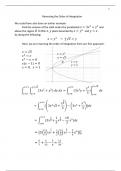
Reversing the Order of Integration
We could have also done an earlier example:
Find the volume of the solid under the paraboloid 𝑧 = 3𝑥 2 + 𝑦 2 and
above the region 𝐷 in the 𝑥, 𝑦 plane bounded by 𝑥 = 𝑦 2 and 𝑦 = 𝑥.
by doing the following:
𝑥 = 𝑦 2 → ±√𝑥 = 𝑦
Here, we are reversing the order of integration from our first approach.
𝑥 = √𝑥
𝑥 = 𝑦2
𝑥2 = 𝑥 𝑦 = √𝑥
𝑥2 − 𝑥 = 0
𝐷 𝑥=𝑦
𝑥(𝑥 − 1) = 0 𝑦=𝑥
𝑥 = 0, 𝑥 = 1
𝑥=1 𝑦=√𝑥 𝑥=1 𝑦=√𝑥
𝑦3
∫ ∫ (3𝑥 2 + 𝑦 2 ) 𝑑𝑦 𝑑𝑥 = ∫ 2
(3𝑥 𝑦 + )] 𝑑𝑥
𝑥=0 𝑦=𝑥 𝑥=0 3 𝑦=𝑥
3
𝑥=1 3
𝑥2 𝑥
=∫ [(3𝑥 2 √𝑥 + ) − (3𝑥 3 + )]𝑑𝑥
𝑥=0 3 3
𝑥=1 5 1 3 10 3
=∫ (3𝑥 2 + 𝑥2 − 𝑥 )𝑑𝑥
𝑥=0 3 3
7 5
2 1 2 5
= [3 (7) 𝑥 + 3 (5) 𝑥 − 6 𝑥 4 ]|10
2 2
6 2 5 11
= 7 + 15 − 6 = 70 .
, 2
Ex. Find the volume of the tetrahedron bounded by the planes:
𝑧 = 𝑥, 𝑦 = 2𝑥, 𝑥 + 𝑦 = 3, 𝑧 = 0.
Draw the 3 dimensional solid and the region 𝐷, which lies below the solid
in the 𝑥𝑦 plane. But first let’s draw 𝐷:
To find 𝐷 , we need to find where each of the four planes intersects the 𝑥𝑦
plane.
𝑧 = 0 is the 𝑥𝑦 plane.
𝑦 = 2𝑥 and 𝑥 + 𝑦 = 3 are the intersections with the 𝑥𝑦 plane
𝑧 = 𝑥 intersects the 𝑥𝑦 plane when 𝑧 = 0:
i.e. when 𝑥 = 0 ; 𝑦- axis
We need to find the intersections of the lines: 𝑦 = 2𝑥, 𝑥 + 𝑦 = 3,
and 𝑥 = 0.
𝑦 =3−𝑥
𝑦 = 2𝑥
𝑥+𝑦 =3
𝑥 + 2𝑥 = 3 (1,2)
𝐷
3𝑥 = 3
𝑥 = 1, 𝑦 = 2.
𝑦 = 2𝑥
(1,2,1)
(0,3,0)
(1,2,0)
(0,0,0)
𝐷
Reversing the Order of Integration
We could have also done an earlier example:
Find the volume of the solid under the paraboloid 𝑧 = 3𝑥 2 + 𝑦 2 and
above the region 𝐷 in the 𝑥, 𝑦 plane bounded by 𝑥 = 𝑦 2 and 𝑦 = 𝑥.
by doing the following:
𝑥 = 𝑦 2 → ±√𝑥 = 𝑦
Here, we are reversing the order of integration from our first approach.
𝑥 = √𝑥
𝑥 = 𝑦2
𝑥2 = 𝑥 𝑦 = √𝑥
𝑥2 − 𝑥 = 0
𝐷 𝑥=𝑦
𝑥(𝑥 − 1) = 0 𝑦=𝑥
𝑥 = 0, 𝑥 = 1
𝑥=1 𝑦=√𝑥 𝑥=1 𝑦=√𝑥
𝑦3
∫ ∫ (3𝑥 2 + 𝑦 2 ) 𝑑𝑦 𝑑𝑥 = ∫ 2
(3𝑥 𝑦 + )] 𝑑𝑥
𝑥=0 𝑦=𝑥 𝑥=0 3 𝑦=𝑥
3
𝑥=1 3
𝑥2 𝑥
=∫ [(3𝑥 2 √𝑥 + ) − (3𝑥 3 + )]𝑑𝑥
𝑥=0 3 3
𝑥=1 5 1 3 10 3
=∫ (3𝑥 2 + 𝑥2 − 𝑥 )𝑑𝑥
𝑥=0 3 3
7 5
2 1 2 5
= [3 (7) 𝑥 + 3 (5) 𝑥 − 6 𝑥 4 ]|10
2 2
6 2 5 11
= 7 + 15 − 6 = 70 .
, 2
Ex. Find the volume of the tetrahedron bounded by the planes:
𝑧 = 𝑥, 𝑦 = 2𝑥, 𝑥 + 𝑦 = 3, 𝑧 = 0.
Draw the 3 dimensional solid and the region 𝐷, which lies below the solid
in the 𝑥𝑦 plane. But first let’s draw 𝐷:
To find 𝐷 , we need to find where each of the four planes intersects the 𝑥𝑦
plane.
𝑧 = 0 is the 𝑥𝑦 plane.
𝑦 = 2𝑥 and 𝑥 + 𝑦 = 3 are the intersections with the 𝑥𝑦 plane
𝑧 = 𝑥 intersects the 𝑥𝑦 plane when 𝑧 = 0:
i.e. when 𝑥 = 0 ; 𝑦- axis
We need to find the intersections of the lines: 𝑦 = 2𝑥, 𝑥 + 𝑦 = 3,
and 𝑥 = 0.
𝑦 =3−𝑥
𝑦 = 2𝑥
𝑥+𝑦 =3
𝑥 + 2𝑥 = 3 (1,2)
𝐷
3𝑥 = 3
𝑥 = 1, 𝑦 = 2.
𝑦 = 2𝑥
(1,2,1)
(0,3,0)
(1,2,0)
(0,0,0)
𝐷