Self-Determination and Minority Rights
1. The Concept of Self-Determination
I. Essential Taxonomy and Development in the First Part of the
20th Century
Fukuyama’s Perspective (1992)
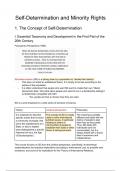
Self-determination (SD) is a strong claim by a population to “decide their destiny”
- This does not entail an established future. It is simply to be free according to the
wishes of the population.
- It is often understood that people who want SD want to create their own “liberal
democratic state.” But what about people who want to live in a dictatorship willingly?
Is dictatorship compatible with SD?
- Yes, people are free to choose how they are ruled.
SD is a word employed in a wide series of domains of science.
History Juridical perspective Philosophy
It is employed to describe The concept of SD is mostly The meaning is partially
specific events that involved used to solve international different and deals with the
a community of people, that juridical issues, in particular claims of people to plan
relating to claims of their lives as they prefer.
led to the establishment of a
communities of people to Thus, SD deals with
State, or also to explain establish their State or other individuals (and not
what distinguished a specific forms of self-government. communities), but it is
historical era (e.g. the Age always linked with a broad
of Decolonization). idea of autonomy and
independence.
This course focuses on SD from the juridical perspective, specifically, its theoretical
systematization and practical implications according to International Law, its possible next
evolutions, and some of its implications for the Theory of International Relations.
,According to the Oxford Dictionary, SD is “the right of a country or a region and its people to
be independent and to choose their own government and political system.” Does this
definition comprehensively explain SD in the international legal context?
- Is SD a right universally recognized by all peoples/communities seeking to organize
in a country?
- Is it sufficient for a group of people to claim SD to be allowed by the international
community to establish its state?
Article 2 of the Charter of the UN discusses a different form of SD. It implies that SD is when
a state can protect itself from external interference.
The two sides of SD:
1. To protect the way the state is running currently
2. To achieve a new way of governing the state
The case of the UK and Mauritius, particularly concerning the Chagos Archipelago, is a
significant example of the complex interplay between SD and international law.
- Background
- The Chagos Archipelago was a part of Mauritius, which was a British colony
until its independence in 1968.
- In the 1960s, the UK separated the Chagos Archipelago from Mauritius and
established a military base on Diego Garcia, which is strategically important
for the U.S. and UK.
- Even when Mauritius gained independence from the UK in 1968, the Chagos
Archipelago was not returned to Mauritius, despite it being part of its territory.
- The UK expelled the indigenous Chagossian people from the islands to make
way for the military base. This displacement and the subsequent conditions
have been a major source of controversy and legal battles.
- Legal and Political Developments
- The ICJ issued an advisory opinion in 2019 stating that the UK’s
administration of the Chagos Archipelago was illegal and that the UK should
end its control over the territory as quickly as possible.
- The ICJ's opinion was based on the fact that the decolonization of
Mauritius was incomplete without the return of the Chagos
Archipelago.
- Following the ICJ’s opinion, the UNGA passed a resolution calling on the UK
to end its administration of the Chagos Archipelago and to return it to
Mauritius.
- 2024 Development of Chagos Case
- On October 3, 2024, the UK announced an agreement to return the Chagos
Archipelago to Mauritius, ending decades of dispute.
, - Negotiations began in 2022 following ICJ and UNGA rulings in 2019 and
2021.
- The UK and US retain control of the military base on Diego Garcia.
- The Chagossian community was not consulted, sparking frustration over
being excluded from the process.
- The agreement marks a significant step in resolving colonial disputes and
affirming self-determination.
The SD problem
- There are some cases in which an SD right is acknowledged by most of the
international community and/or supported by international case law (e.g. former
colonies, Kosovo).
- In other circumstances, the issue is more slippery. For example:
- The 2014 referendum in Scotland was held with the consent of the British
government.
- A referendum on Scottish independence from the United Kingdom
was held in Scotland on 18 September 2014. The referendum
question was "Should Scotland be an independent country?", which
voters answered with "Yes" or "No". The "No" side won with 2,001,926
voting against independence and 1,617,989 voting in favor.
- The 2017 secession process in Catalonia, which included a referendum, was
considered against the Spanish rule of law.
- Finally, the SD right claimed by groups of people aiming to establish their new own
State seems different from the one addressed by Art. 2(4) UN Charter (protection of
existing States from external interferences). There are specific legal justifications for
such differences.
- For instance, the different reactions of public powers relating to the Scottish
and the Catalan referendum
- A unitary and rigid definition of the right to SD is unlikely to be able to cover the
whole phenomenon.
- There are different forms of SD, with different meanings. At the same time, a
more generic concept of (juridical) SD is used in many treaties, official acts,
scientific books, etc.
- Is it possible to reconduct all these elements to a unitary logical order?
An essential taxonomy
- The relationship between the more generic concept of SD (without further
specifications) and its specific forms emerged in real practice and, thus, can be
organized along the criterion (one) genus-(many)species.
- Genus: a group into which items that have similar characteristics are divided,
larger than a species.
, - Species: a group into which items with the same features are divided, smaller
than a genus.
- This is the criterion adopted by the most advanced international legal doctrine on SD.
- It does not exclude that other classifications exist (objective/subjective SD;
internal/external SD). They are alternatives to the main one.
- The more generic concept of SD, the genus, can be defined as “The claim of a group
of people, usually possessing a certain degree of national consciousness, to rule
their own state and choose their own government.”
- The genus SD can be subdivided into four different species. They add, to SD, a
qualifying adjective: (i) Polity-based SD; (ii) Secessionary SD; (iii) Remedial SD; (IV)
Colonial SD.
“Species” of SD
1. Polity-based SD
- It is the longest-established form of SD resulting from the political principle of
nationalities.
- Origins: American Declaration of Independence (1776), French
Declaration of the Rights of Man and of the Citizen (1789)
- It was further refined in the 2nd part of the 20th century by the UN
Charter, some UN Resolutions, and the ICJ.
- The current meaning of polity-based SD can be summarized as: “The
peremptory status attached to the people of a recognized political entity – that
is to say, of a State that presently exists – and which guarantees (i) the right
of that polity to make core decisions concerning its governance (ii) without
external interference.”
- The definition reported above has two main implications:
- In communities of people assembled into political entities, authority
must have a legitimate source (usually, the population).
- Internal implication: Authority cannot be self-explanatory (e.g.
the government exists because it exists) or justified by external
factors (e.g. divine right)
- External implication: Therefore, the unwanted exercise of
power over the internal affairs of such a community (that is, a
nation), by entities (States) external to it, is illegitimate, as this
authority does not have a legitimate source within the
community (principle of non-intervention).
- Polity-based SD and the principle of non-intervention are acknowledged by
International Law as customary international law.
2. Secessionary SD
- It relies on the conviction that people have an absolute right to determine how
they are governed.
- It would imply the right of a group of people to secede just because
they want to separate from their previous community.
- People entitled to secessionary SD should have some specific
features. According to a widely accepted definition: “People having a
common history, ethnic identity, language, culture or religion, coupled
with a ‘belief of being a distinct people distinguishable from any other
people.”
1. The Concept of Self-Determination
I. Essential Taxonomy and Development in the First Part of the
20th Century
Fukuyama’s Perspective (1992)
Self-determination (SD) is a strong claim by a population to “decide their destiny”
- This does not entail an established future. It is simply to be free according to the
wishes of the population.
- It is often understood that people who want SD want to create their own “liberal
democratic state.” But what about people who want to live in a dictatorship willingly?
Is dictatorship compatible with SD?
- Yes, people are free to choose how they are ruled.
SD is a word employed in a wide series of domains of science.
History Juridical perspective Philosophy
It is employed to describe The concept of SD is mostly The meaning is partially
specific events that involved used to solve international different and deals with the
a community of people, that juridical issues, in particular claims of people to plan
relating to claims of their lives as they prefer.
led to the establishment of a
communities of people to Thus, SD deals with
State, or also to explain establish their State or other individuals (and not
what distinguished a specific forms of self-government. communities), but it is
historical era (e.g. the Age always linked with a broad
of Decolonization). idea of autonomy and
independence.
This course focuses on SD from the juridical perspective, specifically, its theoretical
systematization and practical implications according to International Law, its possible next
evolutions, and some of its implications for the Theory of International Relations.
,According to the Oxford Dictionary, SD is “the right of a country or a region and its people to
be independent and to choose their own government and political system.” Does this
definition comprehensively explain SD in the international legal context?
- Is SD a right universally recognized by all peoples/communities seeking to organize
in a country?
- Is it sufficient for a group of people to claim SD to be allowed by the international
community to establish its state?
Article 2 of the Charter of the UN discusses a different form of SD. It implies that SD is when
a state can protect itself from external interference.
The two sides of SD:
1. To protect the way the state is running currently
2. To achieve a new way of governing the state
The case of the UK and Mauritius, particularly concerning the Chagos Archipelago, is a
significant example of the complex interplay between SD and international law.
- Background
- The Chagos Archipelago was a part of Mauritius, which was a British colony
until its independence in 1968.
- In the 1960s, the UK separated the Chagos Archipelago from Mauritius and
established a military base on Diego Garcia, which is strategically important
for the U.S. and UK.
- Even when Mauritius gained independence from the UK in 1968, the Chagos
Archipelago was not returned to Mauritius, despite it being part of its territory.
- The UK expelled the indigenous Chagossian people from the islands to make
way for the military base. This displacement and the subsequent conditions
have been a major source of controversy and legal battles.
- Legal and Political Developments
- The ICJ issued an advisory opinion in 2019 stating that the UK’s
administration of the Chagos Archipelago was illegal and that the UK should
end its control over the territory as quickly as possible.
- The ICJ's opinion was based on the fact that the decolonization of
Mauritius was incomplete without the return of the Chagos
Archipelago.
- Following the ICJ’s opinion, the UNGA passed a resolution calling on the UK
to end its administration of the Chagos Archipelago and to return it to
Mauritius.
- 2024 Development of Chagos Case
- On October 3, 2024, the UK announced an agreement to return the Chagos
Archipelago to Mauritius, ending decades of dispute.
, - Negotiations began in 2022 following ICJ and UNGA rulings in 2019 and
2021.
- The UK and US retain control of the military base on Diego Garcia.
- The Chagossian community was not consulted, sparking frustration over
being excluded from the process.
- The agreement marks a significant step in resolving colonial disputes and
affirming self-determination.
The SD problem
- There are some cases in which an SD right is acknowledged by most of the
international community and/or supported by international case law (e.g. former
colonies, Kosovo).
- In other circumstances, the issue is more slippery. For example:
- The 2014 referendum in Scotland was held with the consent of the British
government.
- A referendum on Scottish independence from the United Kingdom
was held in Scotland on 18 September 2014. The referendum
question was "Should Scotland be an independent country?", which
voters answered with "Yes" or "No". The "No" side won with 2,001,926
voting against independence and 1,617,989 voting in favor.
- The 2017 secession process in Catalonia, which included a referendum, was
considered against the Spanish rule of law.
- Finally, the SD right claimed by groups of people aiming to establish their new own
State seems different from the one addressed by Art. 2(4) UN Charter (protection of
existing States from external interferences). There are specific legal justifications for
such differences.
- For instance, the different reactions of public powers relating to the Scottish
and the Catalan referendum
- A unitary and rigid definition of the right to SD is unlikely to be able to cover the
whole phenomenon.
- There are different forms of SD, with different meanings. At the same time, a
more generic concept of (juridical) SD is used in many treaties, official acts,
scientific books, etc.
- Is it possible to reconduct all these elements to a unitary logical order?
An essential taxonomy
- The relationship between the more generic concept of SD (without further
specifications) and its specific forms emerged in real practice and, thus, can be
organized along the criterion (one) genus-(many)species.
- Genus: a group into which items that have similar characteristics are divided,
larger than a species.
, - Species: a group into which items with the same features are divided, smaller
than a genus.
- This is the criterion adopted by the most advanced international legal doctrine on SD.
- It does not exclude that other classifications exist (objective/subjective SD;
internal/external SD). They are alternatives to the main one.
- The more generic concept of SD, the genus, can be defined as “The claim of a group
of people, usually possessing a certain degree of national consciousness, to rule
their own state and choose their own government.”
- The genus SD can be subdivided into four different species. They add, to SD, a
qualifying adjective: (i) Polity-based SD; (ii) Secessionary SD; (iii) Remedial SD; (IV)
Colonial SD.
“Species” of SD
1. Polity-based SD
- It is the longest-established form of SD resulting from the political principle of
nationalities.
- Origins: American Declaration of Independence (1776), French
Declaration of the Rights of Man and of the Citizen (1789)
- It was further refined in the 2nd part of the 20th century by the UN
Charter, some UN Resolutions, and the ICJ.
- The current meaning of polity-based SD can be summarized as: “The
peremptory status attached to the people of a recognized political entity – that
is to say, of a State that presently exists – and which guarantees (i) the right
of that polity to make core decisions concerning its governance (ii) without
external interference.”
- The definition reported above has two main implications:
- In communities of people assembled into political entities, authority
must have a legitimate source (usually, the population).
- Internal implication: Authority cannot be self-explanatory (e.g.
the government exists because it exists) or justified by external
factors (e.g. divine right)
- External implication: Therefore, the unwanted exercise of
power over the internal affairs of such a community (that is, a
nation), by entities (States) external to it, is illegitimate, as this
authority does not have a legitimate source within the
community (principle of non-intervention).
- Polity-based SD and the principle of non-intervention are acknowledged by
International Law as customary international law.
2. Secessionary SD
- It relies on the conviction that people have an absolute right to determine how
they are governed.
- It would imply the right of a group of people to secede just because
they want to separate from their previous community.
- People entitled to secessionary SD should have some specific
features. According to a widely accepted definition: “People having a
common history, ethnic identity, language, culture or religion, coupled
with a ‘belief of being a distinct people distinguishable from any other
people.”