

Respiratory
system
• Organs that supply the body cells with
oxygen and remove carbon dioxide.
Pleural Cavity Ribs
Bronchi
Epiglottis
Lungs
, Functions
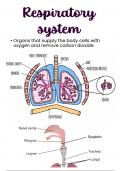
• Nasal cavity à the space in the nose and deeper inside the
skull, allowing air to be drawn into the trachea. Connected
to the mouth.
• Pharynx à carries air, food and fluid down from the nose
and mouth.
• Epiglottis à the flap that closes the trachea when we
swallow.
• Larynx à the voice box that contains the vocal cords.
• Trachea à a tube that carries air down into the lungs.
• Bronchus à a branch of the trachea that takes the air into
each lung.
• Bronchiole à the smallest branch of the tubes in the lungs
that takes air to the alveoli.
• Alveoli à the air sacs where gaseous exchange takes
place. Oxygen diffuses from the alveoli into the blood.
Carbon dioxide diffuses from the blood into the alveoli to be
exhaled.
• Ribs and Sternum à bones in the chest that offer protection
for the heart and lungs.
• Pleural cavities/membranes à two membranes that
surround the lungs. In between the membranes is a fluid
which helps to prevent friction when the lungs and heart are
moving.
• Diaphragm à the diaphragm contracts and flattens and
the chest cavity enlarges. This contraction creates a
vacuum, which pulls air into the lungs.
system
• Organs that supply the body cells with
oxygen and remove carbon dioxide.
Pleural Cavity Ribs
Bronchi
Epiglottis
Lungs
, Functions
• Nasal cavity à the space in the nose and deeper inside the
skull, allowing air to be drawn into the trachea. Connected
to the mouth.
• Pharynx à carries air, food and fluid down from the nose
and mouth.
• Epiglottis à the flap that closes the trachea when we
swallow.
• Larynx à the voice box that contains the vocal cords.
• Trachea à a tube that carries air down into the lungs.
• Bronchus à a branch of the trachea that takes the air into
each lung.
• Bronchiole à the smallest branch of the tubes in the lungs
that takes air to the alveoli.
• Alveoli à the air sacs where gaseous exchange takes
place. Oxygen diffuses from the alveoli into the blood.
Carbon dioxide diffuses from the blood into the alveoli to be
exhaled.
• Ribs and Sternum à bones in the chest that offer protection
for the heart and lungs.
• Pleural cavities/membranes à two membranes that
surround the lungs. In between the membranes is a fluid
which helps to prevent friction when the lungs and heart are
moving.
• Diaphragm à the diaphragm contracts and flattens and
the chest cavity enlarges. This contraction creates a
vacuum, which pulls air into the lungs.


