

Strategies for industrial
Information from
development Focus Geography
Grade 12
Apartheid industrial development strategies
The apartheid government’s planners used the apartheid policy of separate development as
a way to turn South Africa into a republic of white people where black people could not be
citizens. To help this policy succeed, hundreds of thousands of black South Africans were
forced out of their homes and farms in ‘white’ South Africa and placed in one of the
homelands.
From the 1960s the strategies had the following intentions:
• to provide employment in or just outside the borders of the new homelands
• to help the poorest parts of South Africa develop economically by opening factories in
or near the homeland
• to define a white South Africa as distinct from the ten self-governing black
homelands.
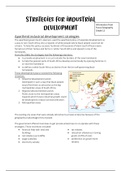
These development plans involved the following
initiatives:
1. Industrial development points
Developed in such a way that black people
would find them as attractive as the big
metropolitan areas of South Africa.
2. Regional deconcentration points
Points close to the metropolitan areas
towards which future industrial growth could
be developed to reduce overconcentration.
3. Metropolitan areas
The existing city areas that were already attractive to private enterprise because of the
geographical advantages they enjoyed.
The government offered incentives to get private enterprises to co-operate with these
strategies. These incentives included:
• financial help with land and • tax rebates
buildings • relocation allowances training
• rail rebates (up to 60%) grants (125% of cost)
• wage subsidies • preference on government
• electricity subsidy tenders.
Information from
development Focus Geography
Grade 12
Apartheid industrial development strategies
The apartheid government’s planners used the apartheid policy of separate development as
a way to turn South Africa into a republic of white people where black people could not be
citizens. To help this policy succeed, hundreds of thousands of black South Africans were
forced out of their homes and farms in ‘white’ South Africa and placed in one of the
homelands.
From the 1960s the strategies had the following intentions:
• to provide employment in or just outside the borders of the new homelands
• to help the poorest parts of South Africa develop economically by opening factories in
or near the homeland
• to define a white South Africa as distinct from the ten self-governing black
homelands.
These development plans involved the following
initiatives:
1. Industrial development points
Developed in such a way that black people
would find them as attractive as the big
metropolitan areas of South Africa.
2. Regional deconcentration points
Points close to the metropolitan areas
towards which future industrial growth could
be developed to reduce overconcentration.
3. Metropolitan areas
The existing city areas that were already attractive to private enterprise because of the
geographical advantages they enjoyed.
The government offered incentives to get private enterprises to co-operate with these
strategies. These incentives included:
• financial help with land and • tax rebates
buildings • relocation allowances training
• rail rebates (up to 60%) grants (125% of cost)
• wage subsidies • preference on government
• electricity subsidy tenders.


