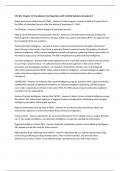
STS 402- Chapter 13 (Vocabulary) Test Questions with Verified Solutions (Graded A+)
Department of Homeland Security (DHS) - Answers A federal agency created in 2003 by Congress from
the Office of Homeland Security after the attacks of September 11, 2001.
Civil Defense - Answers Citizens engaged in homeland security.
Federal Law Enforcement Training Center (FLETC) - Answers A law enforcement training academy for
federal agencies. Operating in Glencoe, Georgia, FLETC trains agents and police officers for agencies that
do not operate their own academy.
National Security Intelligence - Answers A system of agencies and networks that gather information
about threats to the country. Any threat or potential threat is examined under the auspices of national
defense intelligence. Unlike criminal intelligence, people and agencies gathering defense information do
not need to suspect any criminal activity. The FBI is empowered to gather defense intelligence.
Criminal Intelligence - Answers Information gathered on the reasonable suspicion that a criminal activity
is occurring or about to occur. It is collected by law enforcement agencies in the course of their
preventive and investigative functions. It is shared on information networks such as the Regional
Information Sharing System (RISS). Unlike national defense intelligence, criminal intelligence applies only
under criminal law. Agencies must suspect some violation of criminal law before they can collect
intelligence.
COINTELPRO - Answers An infamous FBI counterintelligence program started in 1956. Agents involved in
COINTELPRO violated constitutional limitations on domestic intelligence gathering, and the program
came under congressional criticism in the early 1970s. The FBI's abuse of power eventually resulted in
restrictions on the organization.
National Criminal Intelligence Sharing Plan (NCISP) - Answers A plan to share criminal intelligence among
the nation's law enforcement agencies. It suggests minimum standards for establishing and managing
intelligence operations within police agencies.
Regional Information Sharing System (RISS) - Answers A law enforcement network that allows law
enforcement agencies to share information about criminal investigations.
Fusion Centers - Answers Operations set up to fuse information from multiple sources, analyze the data,
turn it into usable intelligence, and distribute intelligence to agencies needing the information.
Regional Intelligence Center (RIC) - Answers Originally established to gather drug trafficking intelligence,
RICs helped provide the basis for fusion centers.
High-Intensity Drug Trafficking Area (HIDTA) - Answers Specialized RICs in regions experiencing a high
level of drug trafficking and drug-related crimes. They evolved from RICs and were the direct
predecessor to fusion centers. Some HIDTAs simply expanded to become full fusion centers.
Department of Homeland Security (DHS) - Answers A federal agency created in 2003 by Congress from
the Office of Homeland Security after the attacks of September 11, 2001.
Civil Defense - Answers Citizens engaged in homeland security.
Federal Law Enforcement Training Center (FLETC) - Answers A law enforcement training academy for
federal agencies. Operating in Glencoe, Georgia, FLETC trains agents and police officers for agencies that
do not operate their own academy.
National Security Intelligence - Answers A system of agencies and networks that gather information
about threats to the country. Any threat or potential threat is examined under the auspices of national
defense intelligence. Unlike criminal intelligence, people and agencies gathering defense information do
not need to suspect any criminal activity. The FBI is empowered to gather defense intelligence.
Criminal Intelligence - Answers Information gathered on the reasonable suspicion that a criminal activity
is occurring or about to occur. It is collected by law enforcement agencies in the course of their
preventive and investigative functions. It is shared on information networks such as the Regional
Information Sharing System (RISS). Unlike national defense intelligence, criminal intelligence applies only
under criminal law. Agencies must suspect some violation of criminal law before they can collect
intelligence.
COINTELPRO - Answers An infamous FBI counterintelligence program started in 1956. Agents involved in
COINTELPRO violated constitutional limitations on domestic intelligence gathering, and the program
came under congressional criticism in the early 1970s. The FBI's abuse of power eventually resulted in
restrictions on the organization.
National Criminal Intelligence Sharing Plan (NCISP) - Answers A plan to share criminal intelligence among
the nation's law enforcement agencies. It suggests minimum standards for establishing and managing
intelligence operations within police agencies.
Regional Information Sharing System (RISS) - Answers A law enforcement network that allows law
enforcement agencies to share information about criminal investigations.
Fusion Centers - Answers Operations set up to fuse information from multiple sources, analyze the data,
turn it into usable intelligence, and distribute intelligence to agencies needing the information.
Regional Intelligence Center (RIC) - Answers Originally established to gather drug trafficking intelligence,
RICs helped provide the basis for fusion centers.
High-Intensity Drug Trafficking Area (HIDTA) - Answers Specialized RICs in regions experiencing a high
level of drug trafficking and drug-related crimes. They evolved from RICs and were the direct
predecessor to fusion centers. Some HIDTAs simply expanded to become full fusion centers.