Bioethics
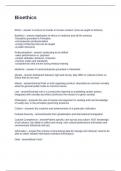
Ethics - answer A science of morals in human conduct. (how we aught to behave)
Bioethics - answer-Application of ethics to medicine and all life sciences
-Discipline grounded in Principles
-encompasses professionalism
-a body of theories that can be taught
-a public discourse
Professionalism - answer ‘professing to be skilled'
-value performance vs. payment
-central: attitudes, behavior, character
-involves codes and standards
-competencies that evolve during medical training
Medicine - answer A moral enterprise grounded in Standards
Morals - answer distinguish between right and wrong. May differ in cultural context vs.
Ethics that do not vary
Maxim - answerGeneral Rule or truth regarding conduct; described as common morality
what the general public holds as common sense
Law - answerEnacted rule in a community enjoining or prohibiting certain actions.
Integrated with morality and ethics (Enforces the morals of a given society)
Philosophy - answeris the use of reason and argument in seeking truth and knowledge
of reality esp. in the principles governing existence
Culture - answeris the customs and achievements of a particular civilization
Cultural Diversity - answerResults from gloabilzation and international immigration
Cultural Competence - answerPatient specific care across any culture. NOT knowledge
of all cultures, but ability to reflect and recog. own cultural preferences and biases and
communicate effectively with pts.
Informatics - answerThe science of processing data for storage and retrieval; need to be
able to obtain reliable information (medical informatics)
Data - answerBasic Facts
, Information - answerData that has additional meaning in different contexts
Knowledge - answerinformation that is understood and defines relationships between
different data
Telehealth - answerProvision of healthcare from a distance
Bioethical concerns of telehealth - answer-reduce pts. to data
-websites with unreliable info
-pts. may not understand or info could be misleading
Beneficence - answer-act in a patient's interest
-prevent injury, illness
-provide comfort
-cure when poss
Nonmaleficence - answer-Do no harm
-balance risk, side effects
-patient utility vs. social utility
Professional Behaviours - answer-Alturism
-Honor and integrity
-Caring and compassion
-Respectfulness
-Accountability
Self-Discipline essential to developing what 7 behaviours? - answer-Present
Presentable
Punctual
Prepared
Positive
Proficient
Proactive
Communication Techniques - answer-Active listening
-Adaptive questioning (following open ended Q's with directed Q's)
-Nonverbal Communication
-Facilitation (mmhmm, go on, I'm listening)
-Echoing
-Empathetic Response
-Validation
-Reassurance
-Summarization
-HIghlighting transitions: making clear the change from one section of the interview to
another or from the interview to the examination
Ethics - answer A science of morals in human conduct. (how we aught to behave)
Bioethics - answer-Application of ethics to medicine and all life sciences
-Discipline grounded in Principles
-encompasses professionalism
-a body of theories that can be taught
-a public discourse
Professionalism - answer ‘professing to be skilled'
-value performance vs. payment
-central: attitudes, behavior, character
-involves codes and standards
-competencies that evolve during medical training
Medicine - answer A moral enterprise grounded in Standards
Morals - answer distinguish between right and wrong. May differ in cultural context vs.
Ethics that do not vary
Maxim - answerGeneral Rule or truth regarding conduct; described as common morality
what the general public holds as common sense
Law - answerEnacted rule in a community enjoining or prohibiting certain actions.
Integrated with morality and ethics (Enforces the morals of a given society)
Philosophy - answeris the use of reason and argument in seeking truth and knowledge
of reality esp. in the principles governing existence
Culture - answeris the customs and achievements of a particular civilization
Cultural Diversity - answerResults from gloabilzation and international immigration
Cultural Competence - answerPatient specific care across any culture. NOT knowledge
of all cultures, but ability to reflect and recog. own cultural preferences and biases and
communicate effectively with pts.
Informatics - answerThe science of processing data for storage and retrieval; need to be
able to obtain reliable information (medical informatics)
Data - answerBasic Facts
, Information - answerData that has additional meaning in different contexts
Knowledge - answerinformation that is understood and defines relationships between
different data
Telehealth - answerProvision of healthcare from a distance
Bioethical concerns of telehealth - answer-reduce pts. to data
-websites with unreliable info
-pts. may not understand or info could be misleading
Beneficence - answer-act in a patient's interest
-prevent injury, illness
-provide comfort
-cure when poss
Nonmaleficence - answer-Do no harm
-balance risk, side effects
-patient utility vs. social utility
Professional Behaviours - answer-Alturism
-Honor and integrity
-Caring and compassion
-Respectfulness
-Accountability
Self-Discipline essential to developing what 7 behaviours? - answer-Present
Presentable
Punctual
Prepared
Positive
Proficient
Proactive
Communication Techniques - answer-Active listening
-Adaptive questioning (following open ended Q's with directed Q's)
-Nonverbal Communication
-Facilitation (mmhmm, go on, I'm listening)
-Echoing
-Empathetic Response
-Validation
-Reassurance
-Summarization
-HIghlighting transitions: making clear the change from one section of the interview to
another or from the interview to the examination