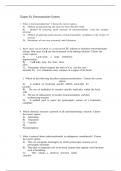
Chapter Six Neurotransmitter Systems
1. What is microiontophoresis? Choose the correct option.
A) Method of miniaturizing the brain for more efficient study
B) Method of removing small amounts of neurotransmitter from the synaptic
terminal
C) Method of applying small amounts of neurotransmitter candidates to the surface of
neurons
D) Movement of ions over extremely small distances
2. Brain slices can be bathed in a concentrated K solution to stimulate neurotransmitter
release. Why must Caions also be present in the bathing solution? Choose the
correct option.
A) Cacauses a large membrane
depolarization.
B) Cahelps keep the brain slices
alive.
C) Transmitter release requires the entry of Ca into the axon
terminal. D) Ca? stimulates many synapses in a region of the brain.
3. Which of the following describes immunocytochemistry? Choose the correct
option.
A) A method of localizing specific mRNA transcripts for
proteins
B) The use of antibodies to visualize specific molecules within the brain
cells
C) The use of radioactivity to localize neurotransmitters and their
synthesizing enzymes
D) A method used to assess the postsynaptic actions of a transmitter
candidate
4. Which chemical structure is present in all catecholaminergic neurons? Choose
the correct option.
A) Adrenaline
B) Dopamine
C) Catechol
D)
Norepinephrine
5. What is unusual about endocannabinoids or endogenous cannabinoids? Choose
the correct option.
A) They are retrograde messengers by which postsynaptic neurons act on
presynaptic terminals.
B) They play an important role in the brain systems that regulate vital functions
such as breathing.
C) They contain a chemical structure called
catechol.
, D) They float in the membrane-like adenylyl
cyclase.
Page 1
1. What is microiontophoresis? Choose the correct option.
A) Method of miniaturizing the brain for more efficient study
B) Method of removing small amounts of neurotransmitter from the synaptic
terminal
C) Method of applying small amounts of neurotransmitter candidates to the surface of
neurons
D) Movement of ions over extremely small distances
2. Brain slices can be bathed in a concentrated K solution to stimulate neurotransmitter
release. Why must Caions also be present in the bathing solution? Choose the
correct option.
A) Cacauses a large membrane
depolarization.
B) Cahelps keep the brain slices
alive.
C) Transmitter release requires the entry of Ca into the axon
terminal. D) Ca? stimulates many synapses in a region of the brain.
3. Which of the following describes immunocytochemistry? Choose the correct
option.
A) A method of localizing specific mRNA transcripts for
proteins
B) The use of antibodies to visualize specific molecules within the brain
cells
C) The use of radioactivity to localize neurotransmitters and their
synthesizing enzymes
D) A method used to assess the postsynaptic actions of a transmitter
candidate
4. Which chemical structure is present in all catecholaminergic neurons? Choose
the correct option.
A) Adrenaline
B) Dopamine
C) Catechol
D)
Norepinephrine
5. What is unusual about endocannabinoids or endogenous cannabinoids? Choose
the correct option.
A) They are retrograde messengers by which postsynaptic neurons act on
presynaptic terminals.
B) They play an important role in the brain systems that regulate vital functions
such as breathing.
C) They contain a chemical structure called
catechol.
, D) They float in the membrane-like adenylyl
cyclase.
Page 1