B1 CELL STRUCTURE AND FUNCTION
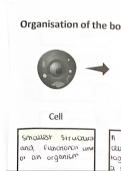
● Cell theory - Unifying concept that all living things are made of cells. Includes the idea of:
- All organisms that are living are made of one or more cells
- Pre-existing cells are used to produce new cells
- Cells are fundamental for structure, organisation and function
● Differentiation - Process where cells become specialised from stem cells for a specific
function.
● Tissues - Group of specialised cells similar to each other that perform a specific function/
functions. Can include nervous tissue epithelial tissue and skeletal muscle.
● Organs - Group of tissues that perform specific physiological functions.
● Organ System - Organs working together to perform a specific function. Can include
respiratory system, nervous system and cardiovascular system.
MICROSCOPES:
Total Magnification = eyepiece lens magnification x objective lens magnification
Light Microscopes:
● How Light Microscope Works - specimen placed on slide and cover slip placed on top to
make specimen flat. To allow light to pass through specimen should be thin. Different
features can be seen with the use of stains like iodine.
● Advantages:
- No special training needed
- Cheaper than electron microscope
- Can examine live specimen as well as dead specimen
- Useful for looking at whole cells, tissues in organs such as leaves or skin and small
plant or animal organisms
● Limitations:
- Lower magnification and resolution compared to electron microscope
,Electron Microscopes:
● How Electron Microscope Works - Beam of electrons fired at specimen. Electrons detected
and computer produces image from the way electrons are scattered by specimen.
● Advantages:
- Higher magnification than light microscopes
- Higher resolution than light microscopes as electrons have smaller wavelength
than visible light
- Can see structures/ organelles inside cells
● Limitations:
- Very expensive
- Can only examine dead specimens
- Need special training to use
GRAM STAINING:
Gram Staining Procedure:
1) Bacteria smeared onto slide and heat applied to fix bacteria onto slide.
2) Crystal violet stain applied which stains Gram+ and Gram - similarly.
3) Iodine and potassium iodide solution (mordant) fixes crystal violet stain and both grams
remain purple.
4) Mixture of alcohol and acetone applied to decolourise and rinse off excess stain from slide.
Gram - becomes destained and gram + retains purple colour.
5) Counterstaining with fuchsin (pink) or safranin (red). Gram + not affected by counterstain
and remains purple. Colourless Gram - becomes coloured pink or red depending on which
stain is used.
Gram Positive Bacteria:
Bacteria wall is made of thick layer of peptidoglycan and has no outer lipopolysaccharide
membrane. Susceptible to some antibiotics like penicillin that can damage peptidoglycan layer.
Gram Negative Bacteria:
Bacteria wall made of thin layer of peptidoglycan and has an outer lipopolysaccharide membrane.
Not susceptible to some antibiotics like penicillin as outer lipopolysaccharide membrane isn’t
susceptible to antibiotics like penicillin and protects peptidoglycan layer.
, EUKARYOTIC AND PROKARYOTIC CELLS:
Difference between Eukaryotic and Prokaryotic Cells:
EUKARYOTIC PROKARYOTIC
- Up to 100 micrometres diameter - 0.5 - 5 micrometre diameter
- Has 80s ribosomes - No membrane bound organelles
- Has membrane bound organelles - Has 70s ribosomes
Organelles of Prokaryotic Cells:
● Nucleoid - Controls reproduction and activity of cell. Where transcription and replication of
DNA takes place.
● Plasmids - Contain genes that can be passed between prokaryotes like antibiotic
resistance.
● 70 s Ribosomes - Required for protein synthesis.
● Capsule - Also called slime capsule. Outer layer surrounding bacterial cell to protect
bacteria from drying out and from attack by cells from immune system. Stickiness of
capsule promotes cell adhesion to surfaces.
● Cell Wall - Protects and supports cell. Prokaryotic cells are surrounded by cell wall made of
peptidoglycan (murein).
Organelles of Eukaryotic Cells [ANIMAL]:
● Plasma Membrane - Controls exchange of materials between internal and external cell
environment. Partially permeable. Composed of phospholipid bilayer with proteins
embedded in the layer.
● Cytoplasm - Thick, gelatinous, semi-transparent fluid with dissolved proteins (enzymes)
where chemical reactions take place.
● Nucleus - Controls/ regulates cellular activity amd contains chromatin which is what
chromosomes are made of. Contains DNA. surrounded by nuclear envelope (a double
membrane) which has many pores to allow mRNA and ribosomes to travel out and enzymes
to travel in. contains nucleolus where ribosomes are produced.
● Nucleolus - Dense spherical structure in middle of nucleus. Site of ribosome production.
Makes RNA as well. Protein synthesis.
● Smooth Endoplasmic Reticulum - Lacks ribosomes on surface and more tubular in
appearance. Involved in synthesis, transport and storage of lipids, carbohydrates and
steroids.
● Rough Endoplasmic Reticulum - Surface is covered in ribosomes. Provide large surface
area for synthesis of proteins and glycoproteins. Provide pathway for transport of materials
throughout cell, especially proteins.
● Golgi Apparatus - Consists of stack of membranes that make up flattened sac (cristernae)
with small rounded hollow structures called vesicles. Newly made proteins received here
● Cell theory - Unifying concept that all living things are made of cells. Includes the idea of:
- All organisms that are living are made of one or more cells
- Pre-existing cells are used to produce new cells
- Cells are fundamental for structure, organisation and function
● Differentiation - Process where cells become specialised from stem cells for a specific
function.
● Tissues - Group of specialised cells similar to each other that perform a specific function/
functions. Can include nervous tissue epithelial tissue and skeletal muscle.
● Organs - Group of tissues that perform specific physiological functions.
● Organ System - Organs working together to perform a specific function. Can include
respiratory system, nervous system and cardiovascular system.
MICROSCOPES:
Total Magnification = eyepiece lens magnification x objective lens magnification
Light Microscopes:
● How Light Microscope Works - specimen placed on slide and cover slip placed on top to
make specimen flat. To allow light to pass through specimen should be thin. Different
features can be seen with the use of stains like iodine.
● Advantages:
- No special training needed
- Cheaper than electron microscope
- Can examine live specimen as well as dead specimen
- Useful for looking at whole cells, tissues in organs such as leaves or skin and small
plant or animal organisms
● Limitations:
- Lower magnification and resolution compared to electron microscope
,Electron Microscopes:
● How Electron Microscope Works - Beam of electrons fired at specimen. Electrons detected
and computer produces image from the way electrons are scattered by specimen.
● Advantages:
- Higher magnification than light microscopes
- Higher resolution than light microscopes as electrons have smaller wavelength
than visible light
- Can see structures/ organelles inside cells
● Limitations:
- Very expensive
- Can only examine dead specimens
- Need special training to use
GRAM STAINING:
Gram Staining Procedure:
1) Bacteria smeared onto slide and heat applied to fix bacteria onto slide.
2) Crystal violet stain applied which stains Gram+ and Gram - similarly.
3) Iodine and potassium iodide solution (mordant) fixes crystal violet stain and both grams
remain purple.
4) Mixture of alcohol and acetone applied to decolourise and rinse off excess stain from slide.
Gram - becomes destained and gram + retains purple colour.
5) Counterstaining with fuchsin (pink) or safranin (red). Gram + not affected by counterstain
and remains purple. Colourless Gram - becomes coloured pink or red depending on which
stain is used.
Gram Positive Bacteria:
Bacteria wall is made of thick layer of peptidoglycan and has no outer lipopolysaccharide
membrane. Susceptible to some antibiotics like penicillin that can damage peptidoglycan layer.
Gram Negative Bacteria:
Bacteria wall made of thin layer of peptidoglycan and has an outer lipopolysaccharide membrane.
Not susceptible to some antibiotics like penicillin as outer lipopolysaccharide membrane isn’t
susceptible to antibiotics like penicillin and protects peptidoglycan layer.
, EUKARYOTIC AND PROKARYOTIC CELLS:
Difference between Eukaryotic and Prokaryotic Cells:
EUKARYOTIC PROKARYOTIC
- Up to 100 micrometres diameter - 0.5 - 5 micrometre diameter
- Has 80s ribosomes - No membrane bound organelles
- Has membrane bound organelles - Has 70s ribosomes
Organelles of Prokaryotic Cells:
● Nucleoid - Controls reproduction and activity of cell. Where transcription and replication of
DNA takes place.
● Plasmids - Contain genes that can be passed between prokaryotes like antibiotic
resistance.
● 70 s Ribosomes - Required for protein synthesis.
● Capsule - Also called slime capsule. Outer layer surrounding bacterial cell to protect
bacteria from drying out and from attack by cells from immune system. Stickiness of
capsule promotes cell adhesion to surfaces.
● Cell Wall - Protects and supports cell. Prokaryotic cells are surrounded by cell wall made of
peptidoglycan (murein).
Organelles of Eukaryotic Cells [ANIMAL]:
● Plasma Membrane - Controls exchange of materials between internal and external cell
environment. Partially permeable. Composed of phospholipid bilayer with proteins
embedded in the layer.
● Cytoplasm - Thick, gelatinous, semi-transparent fluid with dissolved proteins (enzymes)
where chemical reactions take place.
● Nucleus - Controls/ regulates cellular activity amd contains chromatin which is what
chromosomes are made of. Contains DNA. surrounded by nuclear envelope (a double
membrane) which has many pores to allow mRNA and ribosomes to travel out and enzymes
to travel in. contains nucleolus where ribosomes are produced.
● Nucleolus - Dense spherical structure in middle of nucleus. Site of ribosome production.
Makes RNA as well. Protein synthesis.
● Smooth Endoplasmic Reticulum - Lacks ribosomes on surface and more tubular in
appearance. Involved in synthesis, transport and storage of lipids, carbohydrates and
steroids.
● Rough Endoplasmic Reticulum - Surface is covered in ribosomes. Provide large surface
area for synthesis of proteins and glycoproteins. Provide pathway for transport of materials
throughout cell, especially proteins.
● Golgi Apparatus - Consists of stack of membranes that make up flattened sac (cristernae)
with small rounded hollow structures called vesicles. Newly made proteins received here