Understanding prejudice
Setup:
1. Attend lecture on Thursday
2. Read the literature and work on assignment
3. Attend lecture on Tuesday and finish assignment
4. Submit assignment on Thursday 9am
Knowledge clips:
1. https://video.uu.nl/
2. Login and search ‘’Understanding Prejudice’’
College 1: Social Identity Theory
Minimal Group Experiments
Group formation = categorization process is a central component of Social Identity Theory
- Evolutionary perspective = necessary to distinguish friend and enemy
- Cognitive perspective = necessary to process large amount of information
Categorization
- People search actively for information
- People simplify processing all the information by ignoring certain differences and emphasizing (or even
exaggerating) certain similarities of that information
SIT experiment 1: non-social stimuli
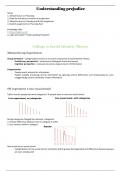
Tajfel: how do people deal with categories? → people have to rate non-social stimuli
Giving categories changed the outcome. Categories:
1. Greater difference between lines in category A and B
2. Less variance within a category
Non-social versus social stimuli:
- Categorization of non-social stimuli: similarities within groups (homogeneity) and differences between groups
are over-emphasized
,SIT experiment 2: minimal group experiment
Goal: manipulate social categorization as an independent variable
- Step 1: Generate social categorization on basis of a trivial criterion
- Step 2: Let participants give rewards to members of their own and the other group
Part 1: How many dots do you estimate are in this picture?
Part 2: Rewarding people
You can choose different strategies (S1, S2, etc.). If you choose S1, the people who underestimate get 7 dollars and
the people who overestimate get 1 dollar.
This strategy compares MIP vs. MJP
This strategy compares MD vs. MJP
Conclusion:
- Group formation leads to discriminatory behaviour (in-group favouritism)
- Even if groups are formed on basis of a trivial category
- Tajfel: ‘’Social categorization per se is a sufficient condition for the development of intergroup bias’’
(discrimination in favour of the own group)
Social Identity Theory
Social Identity Theory has four central concepts:
1. Social categorization
2. Social identity
3. Social comparison
4. Psychological group distinctiveness
Social categorization = process of bringing together social objects or events in groups which are equivalent with regard
to an individual’s actions, intentions and system of beliefs
- Similar to categorization of non-social stimuli:
- Use of any characteristic available
- Perceive more similarity within and more difference between categories
- Not just the basis of how we perceive the world, but also how we perceive ourselves…
,Social identity = the realization that one belongs to a social category and the positive or negative evaluation associated
with this membership
- Are divisive and exclusive
- Are context dependent
- Have a cultural component: this turns a category into an identity
- Include a judgment of the nature of people in a certain category
➔ This is more than a minimal group. Social identities may thus have even more powerful consequences in
intergroup interaction
Ascribed identities = you categorize a person in a group
Self-identification = how someone sees themselves
Social comparison
- Through social comparison with other groups, people try to evaluate their group’s relative status
- People strive for a positive social identity
- People are motivated to belong to a positively evaluated group
- They value their own group more than other groups (social identification versus contra-identification)
Psychological group distinctiveness
- Need for belonging to a positively evaluated group but also need to be distinct from others
- People thus try to achieve a position of their group that is distinct and positive
Understanding behaviour
Application to real life
Roma adolescents in Hungary (low status) → Boda & Neray (2015, Journal: Social Networks)
- How does the social position of Roma affect their social relationships? = disliking of classmates (negative
relationships)
Social competition: Roma may challenge majority group to establish higher status
- H1: disliking nominations are more inter-ethnic than intra-ethnic
, Individual mobility: Individual Roma may try to leave their group and join the majority
- H2: self-ascribed Roma students dislike those who they perceive to be Roma but who identify as member of
the majority group (‘’’traitors’’)
Results:
- Non-Rama make negative nominations mainly of Roma. Roma make negative nominations of non-Roma. H1
supported
- Roma are most likely to make negative nominations of students who they perceive to be Roma but who
identify with the majority. H2 supported
Summary:
- Social identity theory:
- Helps understand positive and negative social relationships
- Explains behaviour of dominant and subordinate group
- Allows clear hypothesis about group members’ behaviour if they face negative social identity
- Is broadly applicable
Minority strategy = social competition = minority groups challenge dominant position of majority on cultural
dimension
Majority reaction = attempt to retain superiority = people react negatively to threats to their positive social identity
Reaction = the Dutch reach harshly to accusations that one of their traditions is racist
College 2: Social Identity Theory
Applying Social Identity Theory
Exam question: The Black Lives Matter (BLM) movement in the U.S. really took off in 2021 after police officers killed
the African American man George Floyd during an arrest in Minneapolis. Hundreds of thousands of (mostly) Black
Americans have since demonstrated against police violence. Some of these protests even led to riots and looting. Use
the concepts included in Social Identity Theory to explain why so many Black Americans responded in these ways to
the shooting of George Floyd. [10 points]
The dominant group perspective = Why and how do dominant groups maintain/extend their superiority?
Outgroup homogeneity
Setup:
1. Attend lecture on Thursday
2. Read the literature and work on assignment
3. Attend lecture on Tuesday and finish assignment
4. Submit assignment on Thursday 9am
Knowledge clips:
1. https://video.uu.nl/
2. Login and search ‘’Understanding Prejudice’’
College 1: Social Identity Theory
Minimal Group Experiments
Group formation = categorization process is a central component of Social Identity Theory
- Evolutionary perspective = necessary to distinguish friend and enemy
- Cognitive perspective = necessary to process large amount of information
Categorization
- People search actively for information
- People simplify processing all the information by ignoring certain differences and emphasizing (or even
exaggerating) certain similarities of that information
SIT experiment 1: non-social stimuli
Tajfel: how do people deal with categories? → people have to rate non-social stimuli
Giving categories changed the outcome. Categories:
1. Greater difference between lines in category A and B
2. Less variance within a category
Non-social versus social stimuli:
- Categorization of non-social stimuli: similarities within groups (homogeneity) and differences between groups
are over-emphasized
,SIT experiment 2: minimal group experiment
Goal: manipulate social categorization as an independent variable
- Step 1: Generate social categorization on basis of a trivial criterion
- Step 2: Let participants give rewards to members of their own and the other group
Part 1: How many dots do you estimate are in this picture?
Part 2: Rewarding people
You can choose different strategies (S1, S2, etc.). If you choose S1, the people who underestimate get 7 dollars and
the people who overestimate get 1 dollar.
This strategy compares MIP vs. MJP
This strategy compares MD vs. MJP
Conclusion:
- Group formation leads to discriminatory behaviour (in-group favouritism)
- Even if groups are formed on basis of a trivial category
- Tajfel: ‘’Social categorization per se is a sufficient condition for the development of intergroup bias’’
(discrimination in favour of the own group)
Social Identity Theory
Social Identity Theory has four central concepts:
1. Social categorization
2. Social identity
3. Social comparison
4. Psychological group distinctiveness
Social categorization = process of bringing together social objects or events in groups which are equivalent with regard
to an individual’s actions, intentions and system of beliefs
- Similar to categorization of non-social stimuli:
- Use of any characteristic available
- Perceive more similarity within and more difference between categories
- Not just the basis of how we perceive the world, but also how we perceive ourselves…
,Social identity = the realization that one belongs to a social category and the positive or negative evaluation associated
with this membership
- Are divisive and exclusive
- Are context dependent
- Have a cultural component: this turns a category into an identity
- Include a judgment of the nature of people in a certain category
➔ This is more than a minimal group. Social identities may thus have even more powerful consequences in
intergroup interaction
Ascribed identities = you categorize a person in a group
Self-identification = how someone sees themselves
Social comparison
- Through social comparison with other groups, people try to evaluate their group’s relative status
- People strive for a positive social identity
- People are motivated to belong to a positively evaluated group
- They value their own group more than other groups (social identification versus contra-identification)
Psychological group distinctiveness
- Need for belonging to a positively evaluated group but also need to be distinct from others
- People thus try to achieve a position of their group that is distinct and positive
Understanding behaviour
Application to real life
Roma adolescents in Hungary (low status) → Boda & Neray (2015, Journal: Social Networks)
- How does the social position of Roma affect their social relationships? = disliking of classmates (negative
relationships)
Social competition: Roma may challenge majority group to establish higher status
- H1: disliking nominations are more inter-ethnic than intra-ethnic
, Individual mobility: Individual Roma may try to leave their group and join the majority
- H2: self-ascribed Roma students dislike those who they perceive to be Roma but who identify as member of
the majority group (‘’’traitors’’)
Results:
- Non-Rama make negative nominations mainly of Roma. Roma make negative nominations of non-Roma. H1
supported
- Roma are most likely to make negative nominations of students who they perceive to be Roma but who
identify with the majority. H2 supported
Summary:
- Social identity theory:
- Helps understand positive and negative social relationships
- Explains behaviour of dominant and subordinate group
- Allows clear hypothesis about group members’ behaviour if they face negative social identity
- Is broadly applicable
Minority strategy = social competition = minority groups challenge dominant position of majority on cultural
dimension
Majority reaction = attempt to retain superiority = people react negatively to threats to their positive social identity
Reaction = the Dutch reach harshly to accusations that one of their traditions is racist
College 2: Social Identity Theory
Applying Social Identity Theory
Exam question: The Black Lives Matter (BLM) movement in the U.S. really took off in 2021 after police officers killed
the African American man George Floyd during an arrest in Minneapolis. Hundreds of thousands of (mostly) Black
Americans have since demonstrated against police violence. Some of these protests even led to riots and looting. Use
the concepts included in Social Identity Theory to explain why so many Black Americans responded in these ways to
the shooting of George Floyd. [10 points]
The dominant group perspective = Why and how do dominant groups maintain/extend their superiority?
Outgroup homogeneity