Cognitive Approach
Assumptions
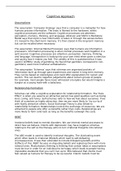
The assumption ‘Computer Analogy’ says that a computer is a metaphor for how
humans process information. The brain is likened to the hardware, whilst
cognitive processes are the software. Cognitive processes are attention,
perception, memory, thinking, and language. Atkinson and Shifrin’s Multistore
Model says that input is how information is taken in through the senses before
it’s moved to the short-term memory. It’s then stored in the long-term memory
but can be recalled when necessary.
The assumption ‘Internal Mental Processes’ says that humans are information
processors. Information processing is when mental processes work together in a
split second. Cognitive processes are attention, perception, memory, thinking,
and language. Introspection is looking into your own mind when given a stimulus
and saying how it makes you feel. The validity of this is questioned but it was
used in Griffiths’ study of gambling. He found that gamblers (compared to non-
gamblers) used more irrational verbalisations.
The assumption ‘Schemas’ says that schemas are organised packets of
information built up through past experiences and stored in long-term memory.
They can be based on stereotypes and could offer explanations for racism and
sexism. This can lead to negative judgements about certain groups of people.
For example, most people have never witnessed a burglary but would imagine a
burglar as a young male with a balaclava.
Relationship Formation
Schemas can offer a cognitive explanation for relationship formation. The ‘Halo
Effect’ is when you assume an attractive person has good qualities such as being
kind, caring, and funny. Self-schemas refer to how we feel about ourselves. If we
think of ourselves as highly attractive, then we are more likely to ‘try our luck’
with highly attractive others. Social Exchange Theory is also linked to
relationship formation. Relationships involve the exchange of resources. We are
attracted to people who offer us benefits rather than costs. Relationships are
more likely to form (and last) as long as the benefits outweigh the costs.
REBT
Irrational beliefs lead to mental disorders. We use internal mental processes to
direct how we behave. Clients with depression may have negative schemas
relating to the self so the therapy aims to turn irrational thoughts into rational
ones.
The ABC model is used to identify irrational thoughts. The (A)ctivating event
which often leads to irrational (B)eliefs which lead to self-defeating
(C)onsequences. It was then extended to include (D)isputing beliefs and the
(E)ffects of this. REBT focuses on disputing beliefs and replacing them with more
rational ones. Musturbatory thinking is thinking that certain ideas or assumptions
must be true in order for an individual to be happy which leads to people having
impossible standards that you can’t live up to. Ellis believed that clients must
feel valued as humans for therapy to be successful. Clients’ beliefs must be
Assumptions
The assumption ‘Computer Analogy’ says that a computer is a metaphor for how
humans process information. The brain is likened to the hardware, whilst
cognitive processes are the software. Cognitive processes are attention,
perception, memory, thinking, and language. Atkinson and Shifrin’s Multistore
Model says that input is how information is taken in through the senses before
it’s moved to the short-term memory. It’s then stored in the long-term memory
but can be recalled when necessary.
The assumption ‘Internal Mental Processes’ says that humans are information
processors. Information processing is when mental processes work together in a
split second. Cognitive processes are attention, perception, memory, thinking,
and language. Introspection is looking into your own mind when given a stimulus
and saying how it makes you feel. The validity of this is questioned but it was
used in Griffiths’ study of gambling. He found that gamblers (compared to non-
gamblers) used more irrational verbalisations.
The assumption ‘Schemas’ says that schemas are organised packets of
information built up through past experiences and stored in long-term memory.
They can be based on stereotypes and could offer explanations for racism and
sexism. This can lead to negative judgements about certain groups of people.
For example, most people have never witnessed a burglary but would imagine a
burglar as a young male with a balaclava.
Relationship Formation
Schemas can offer a cognitive explanation for relationship formation. The ‘Halo
Effect’ is when you assume an attractive person has good qualities such as being
kind, caring, and funny. Self-schemas refer to how we feel about ourselves. If we
think of ourselves as highly attractive, then we are more likely to ‘try our luck’
with highly attractive others. Social Exchange Theory is also linked to
relationship formation. Relationships involve the exchange of resources. We are
attracted to people who offer us benefits rather than costs. Relationships are
more likely to form (and last) as long as the benefits outweigh the costs.
REBT
Irrational beliefs lead to mental disorders. We use internal mental processes to
direct how we behave. Clients with depression may have negative schemas
relating to the self so the therapy aims to turn irrational thoughts into rational
ones.
The ABC model is used to identify irrational thoughts. The (A)ctivating event
which often leads to irrational (B)eliefs which lead to self-defeating
(C)onsequences. It was then extended to include (D)isputing beliefs and the
(E)ffects of this. REBT focuses on disputing beliefs and replacing them with more
rational ones. Musturbatory thinking is thinking that certain ideas or assumptions
must be true in order for an individual to be happy which leads to people having
impossible standards that you can’t live up to. Ellis believed that clients must
feel valued as humans for therapy to be successful. Clients’ beliefs must be