Summary Advanced Financial
Management
Finance: financial management 2024
Lecture 1 Corporate Governance
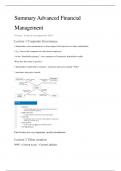
• Shareholder value maximization is often aligned with objectives of other stakeholders.
• E.g.: Successful companies are often better employers!
• In the “shareholder primacy” view, managers will maximize shareholder wealth
What does this mean in practice?
• Shareholder wealth hard to estimate maximize share price instead • Why?
maximize share price instead.
First lecture not very important, mostly introduction
Lecture 2 Value creation
NWC = Current Assets – Current Liabilities
,NWC = Cash requirements + ΔInventories + ΔReceivables – ΔPayables
Normal people think in nominal terms for example, the amount of money we get. However,
inflation means that, in the future, the nominal amount will be worth less in real terms.
k:= nominal interest rate (5%) i := expected inflation (10%) r := real interest rate
Rule: discount nominal CF with k and discount real CF with r
If available capital is infinite invest in all positive NPV projects. In reality, this is seldom the
case. Solution:
1) Create all combinations.
2) Eliminate not realistic combinations.
3) Choose the combination with the highest NPV
Important
To compare project, we should look at them in the same time frame:
However, the time is not equal, so we must make them equal.
,For example, when you need to buy a new machine, we need to double the investment and double
the timeframe.
Annuity:
P = profitability index = PV of cash flows! (so npv – investments) / investments
You can’t tell which investment is better.
IRR = internal rate of return
, Generally, if irr is greater than the cost of capital then accepts the project.
A changing IRR is difficult, in case of changing cash flows this is the case.
Internal rate of return is not scalable. Highest IRR does not have to be the best project, because
the npv might still be lower.
IRR is only useful in combination with the NPV.
Management
Finance: financial management 2024
Lecture 1 Corporate Governance
• Shareholder value maximization is often aligned with objectives of other stakeholders.
• E.g.: Successful companies are often better employers!
• In the “shareholder primacy” view, managers will maximize shareholder wealth
What does this mean in practice?
• Shareholder wealth hard to estimate maximize share price instead • Why?
maximize share price instead.
First lecture not very important, mostly introduction
Lecture 2 Value creation
NWC = Current Assets – Current Liabilities
,NWC = Cash requirements + ΔInventories + ΔReceivables – ΔPayables
Normal people think in nominal terms for example, the amount of money we get. However,
inflation means that, in the future, the nominal amount will be worth less in real terms.
k:= nominal interest rate (5%) i := expected inflation (10%) r := real interest rate
Rule: discount nominal CF with k and discount real CF with r
If available capital is infinite invest in all positive NPV projects. In reality, this is seldom the
case. Solution:
1) Create all combinations.
2) Eliminate not realistic combinations.
3) Choose the combination with the highest NPV
Important
To compare project, we should look at them in the same time frame:
However, the time is not equal, so we must make them equal.
,For example, when you need to buy a new machine, we need to double the investment and double
the timeframe.
Annuity:
P = profitability index = PV of cash flows! (so npv – investments) / investments
You can’t tell which investment is better.
IRR = internal rate of return
, Generally, if irr is greater than the cost of capital then accepts the project.
A changing IRR is difficult, in case of changing cash flows this is the case.
Internal rate of return is not scalable. Highest IRR does not have to be the best project, because
the npv might still be lower.
IRR is only useful in combination with the NPV.