Samenvatting Leerdoelen
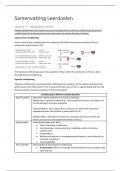
Lecture 7 – Acquisition of fear
Explain [paraphrase] and compare early learning approaches (classical conditioning and operant
conditioning) to the development and maintenance of anxiety disorders [analyse].
Classical fear conditioning
Due to classical fear conditioning a fear response (UR) shifts from aversive stimulus (US) to a
previously neutral stimulus (CS)
This classical conditioning causes the acquisition of fear, while the maintenance of fear is done
through operant conditioning.
Operant conditioning
Operant conditioning is learning through reinforcement; avoidance of fear objects decreases fear
which causes the reinforcement. This is because the decrease of fear is a good feeling and thus the
decrease of fear increases avoidance of the feared objects.
Conditioning in different anxiety disorders
Specific phobia Acquisition: direct experience or vicarious learning
Maintenance: operant conditioning -> decreased fear because of avoidance of
the feared object increases avoidance
Latent inhibition: prior exposure to a stimulus can reduce the amount of
conditioning when the stimulus is paired with the US
Inflation effect: information transfer can reevaluate the process of the US,
which can result in an increased level of fear to the CS.
Social phobia Social phobia might arise from:
• Direct traumatic conditioning
• Social learning: vicarious learning, modelling, verbal instruction,
cultural rules
• Preparedness
• Behavioral inhibition as a temperamental diathesis: may influence the
outcome of exposure
• Uncontrollability
Panic disorder Exteroceptive & interoceptive conditioning
• Exteroceptive: where CS impinge on the external sensory receptors like
eyes and ears
, • Interoceptive: fear of fear, the CSs are the body's own internal
sensations
Vulnerability factors
Conditioned anxiety serves to increase startle responses: CSs for anxiety lower
the threshold for panic reactions
Agoraphobia Exteroceptive conditioning
Classical conditioning: other similar situations are also avoided because
interoceptive cues created by these activities resemble those experienced at
the beginning of a panic attack
PTSS Traumatic event; classical conditioning
GAD Worry is reinforced through operant conditioning; when people with GAD
worry their emotional and phyiosological responses to aversive imagery are
suppressed
It may also be reinforced because most of the things that people worry about
never happen
OCD Verbal conditioning and social learning; parents are important here, thought-
action fusion, culturally transmitted beliefs and norms
There is learned avoidance here as well; rituals are seen as avoidance
responses and these are resistant to extinction
Describe the underlying neurobiological processes of fear learning [paraphrase].
Studying fear conditioning in the brain
• The amygdala is more active during the presentation of the CS
• There is no difference in activity for the CS+ compared to the CS-
• The amygdala is crucil for fear learning in animals, but in humans it's more complex
,Describe [paraphrase] and compare [analyse] research methods for studying fear learning in animals
and humans.
In both animals and humans you can study the acquisition of fear:
• In animals: a sound (neutral -> CS) followed by a shock (US). The CR is freezing behavior
• In humans: picture of an aversive stimulus followed by a shock. The CR is the expectancy of
the shock (US) when seeing the CS and a startle response & skin conductance (sweating) \
o Startle response can be measured under the eye: EMG
A differential fear response is measured; this is the difference between the CS+ and CS- response.
• The CS+ is a stimulus that is always followed by the aversive outcome (the shock)
• The CS- is never followed by an aversive outcome; this might be a picture of the same spider
in a different context.
o As the CR is generalized to similar objects this should be sufficient to still get the CR
Indicatives of fear learning:
• Higher US-expectancy for the CS+ than for the CS-
• Stronger startle response to the CS+ than for the CS-
Describe the criticisms of classical conditioning [paraphrase] and explain how these criticisms are
addressed by a contemporary learning theory approach [analyse].
Criticsm of traditional learning theory Contemporary learning theory approach
Direct US experience is not necessary for fear There are three pathways of fear learning:
learning 1. Trauma: direct learning
The traditional learning theory poses that direct 2. Vicarious learning:
US experience is necessary for fear learning, observational/modelling (indirect)
however this is NOT the case: 3. Information transfer: learning by
instruction (indirect)
There are many phobics that can't remember a -> Parents have an important role here
traumatic event or fear a stimulus they have
never encounters
US is not sufficient for fear learning Differences in genetic predispositions/traits
-> Many people who undergo a traumatic and differences in learning history
experience do not develop a phobia or anxiety Individual differences affect experiences and
disorder the learning process involved in traumatic
events
Genetics: low expression of 5-HTT gene
Traits: High trait anxiety
, Learning history: latent inhibition = Prior
neutral learning experiences reduces the
amount of fear conditioning
Selectivity of phobias Belongingness and preparedness
-> Fear of spiders/heights is more common Preparedness = fear of prepared stimuli (which
than fear of cars are important for evolution) are easier to learn
and more difficult to extinguish
Belongingness: a natural/evolutionary relevant
link causes a stronger response/easier to learn
because it's more likely to actually be
associated
The CR does not always equal to the UR CS-US association
CS-US association is learned, because the CS
predicts the US occurrence
The CS prepares the body for US = fear memory
The UR = pain, while the CR = freezing Example of panic disorder:
Explain [paraphrase] and compare [analyse] principles (phenomena) of a contemporary learning
theory approach to fear learning (e.g., observational learning, safety learning).
In the original view of classic fear conditioning the individual learns the association between the CS
and the CR during conditioning.
• CS is a stimulus which was neutral before the conditioning and where the individual first had
a orientation response to.
• The CR is a response to the US, a aversive stimulus during the conditioning process.
• After conditioning, the CS is not a neutral stimulus anymore but it's linked to the response to
an aversive stimulus (UR) which is now the CR.
The contemporary view on conditioning states that not the CS-CR association is learned, but rather
the CS-US association. This is an association between the, at first, neutral stimulus which becomes
the CS and the aversive stimulus, the US. This US causes the aversive response, UR.
Assess the role of contemporary learning theory principles (phenomena) in various anxiety disorders
[evaluate] and apply them to a clinical case [analyse].
Lecture 8 – Deconstructing fear memory
Explain how modern learning theory explains reduction of fear during exposure (inhibition learning)
[analyse].
Characteristics of fear memory: it's strong, generalizes over time, context and stimuli from the same
semantic category -> this is because generalisation gives you better prediction of the feared stimulus
Lecture 7 – Acquisition of fear
Explain [paraphrase] and compare early learning approaches (classical conditioning and operant
conditioning) to the development and maintenance of anxiety disorders [analyse].
Classical fear conditioning
Due to classical fear conditioning a fear response (UR) shifts from aversive stimulus (US) to a
previously neutral stimulus (CS)
This classical conditioning causes the acquisition of fear, while the maintenance of fear is done
through operant conditioning.
Operant conditioning
Operant conditioning is learning through reinforcement; avoidance of fear objects decreases fear
which causes the reinforcement. This is because the decrease of fear is a good feeling and thus the
decrease of fear increases avoidance of the feared objects.
Conditioning in different anxiety disorders
Specific phobia Acquisition: direct experience or vicarious learning
Maintenance: operant conditioning -> decreased fear because of avoidance of
the feared object increases avoidance
Latent inhibition: prior exposure to a stimulus can reduce the amount of
conditioning when the stimulus is paired with the US
Inflation effect: information transfer can reevaluate the process of the US,
which can result in an increased level of fear to the CS.
Social phobia Social phobia might arise from:
• Direct traumatic conditioning
• Social learning: vicarious learning, modelling, verbal instruction,
cultural rules
• Preparedness
• Behavioral inhibition as a temperamental diathesis: may influence the
outcome of exposure
• Uncontrollability
Panic disorder Exteroceptive & interoceptive conditioning
• Exteroceptive: where CS impinge on the external sensory receptors like
eyes and ears
, • Interoceptive: fear of fear, the CSs are the body's own internal
sensations
Vulnerability factors
Conditioned anxiety serves to increase startle responses: CSs for anxiety lower
the threshold for panic reactions
Agoraphobia Exteroceptive conditioning
Classical conditioning: other similar situations are also avoided because
interoceptive cues created by these activities resemble those experienced at
the beginning of a panic attack
PTSS Traumatic event; classical conditioning
GAD Worry is reinforced through operant conditioning; when people with GAD
worry their emotional and phyiosological responses to aversive imagery are
suppressed
It may also be reinforced because most of the things that people worry about
never happen
OCD Verbal conditioning and social learning; parents are important here, thought-
action fusion, culturally transmitted beliefs and norms
There is learned avoidance here as well; rituals are seen as avoidance
responses and these are resistant to extinction
Describe the underlying neurobiological processes of fear learning [paraphrase].
Studying fear conditioning in the brain
• The amygdala is more active during the presentation of the CS
• There is no difference in activity for the CS+ compared to the CS-
• The amygdala is crucil for fear learning in animals, but in humans it's more complex
,Describe [paraphrase] and compare [analyse] research methods for studying fear learning in animals
and humans.
In both animals and humans you can study the acquisition of fear:
• In animals: a sound (neutral -> CS) followed by a shock (US). The CR is freezing behavior
• In humans: picture of an aversive stimulus followed by a shock. The CR is the expectancy of
the shock (US) when seeing the CS and a startle response & skin conductance (sweating) \
o Startle response can be measured under the eye: EMG
A differential fear response is measured; this is the difference between the CS+ and CS- response.
• The CS+ is a stimulus that is always followed by the aversive outcome (the shock)
• The CS- is never followed by an aversive outcome; this might be a picture of the same spider
in a different context.
o As the CR is generalized to similar objects this should be sufficient to still get the CR
Indicatives of fear learning:
• Higher US-expectancy for the CS+ than for the CS-
• Stronger startle response to the CS+ than for the CS-
Describe the criticisms of classical conditioning [paraphrase] and explain how these criticisms are
addressed by a contemporary learning theory approach [analyse].
Criticsm of traditional learning theory Contemporary learning theory approach
Direct US experience is not necessary for fear There are three pathways of fear learning:
learning 1. Trauma: direct learning
The traditional learning theory poses that direct 2. Vicarious learning:
US experience is necessary for fear learning, observational/modelling (indirect)
however this is NOT the case: 3. Information transfer: learning by
instruction (indirect)
There are many phobics that can't remember a -> Parents have an important role here
traumatic event or fear a stimulus they have
never encounters
US is not sufficient for fear learning Differences in genetic predispositions/traits
-> Many people who undergo a traumatic and differences in learning history
experience do not develop a phobia or anxiety Individual differences affect experiences and
disorder the learning process involved in traumatic
events
Genetics: low expression of 5-HTT gene
Traits: High trait anxiety
, Learning history: latent inhibition = Prior
neutral learning experiences reduces the
amount of fear conditioning
Selectivity of phobias Belongingness and preparedness
-> Fear of spiders/heights is more common Preparedness = fear of prepared stimuli (which
than fear of cars are important for evolution) are easier to learn
and more difficult to extinguish
Belongingness: a natural/evolutionary relevant
link causes a stronger response/easier to learn
because it's more likely to actually be
associated
The CR does not always equal to the UR CS-US association
CS-US association is learned, because the CS
predicts the US occurrence
The CS prepares the body for US = fear memory
The UR = pain, while the CR = freezing Example of panic disorder:
Explain [paraphrase] and compare [analyse] principles (phenomena) of a contemporary learning
theory approach to fear learning (e.g., observational learning, safety learning).
In the original view of classic fear conditioning the individual learns the association between the CS
and the CR during conditioning.
• CS is a stimulus which was neutral before the conditioning and where the individual first had
a orientation response to.
• The CR is a response to the US, a aversive stimulus during the conditioning process.
• After conditioning, the CS is not a neutral stimulus anymore but it's linked to the response to
an aversive stimulus (UR) which is now the CR.
The contemporary view on conditioning states that not the CS-CR association is learned, but rather
the CS-US association. This is an association between the, at first, neutral stimulus which becomes
the CS and the aversive stimulus, the US. This US causes the aversive response, UR.
Assess the role of contemporary learning theory principles (phenomena) in various anxiety disorders
[evaluate] and apply them to a clinical case [analyse].
Lecture 8 – Deconstructing fear memory
Explain how modern learning theory explains reduction of fear during exposure (inhibition learning)
[analyse].
Characteristics of fear memory: it's strong, generalizes over time, context and stimuli from the same
semantic category -> this is because generalisation gives you better prediction of the feared stimulus