

FLG 332 Copyright Micaela de Jager
Unit 3 – Respiratory Physiology
LECTURE 1 – RESPIRATORY SYSTEM
BASICS OF THE RESPIRATORY SYSTEM
FUNCTIONS
▪ Respiratory functions
Provide extensive surface area for gas exchange between air & circulating blood
Move air to and from exchange surfaces of lungs
▪ Non-respiratory functions
Immune fxns – protect resp. surfaces from dehydration, temp. changes & inhaled pathogens
⇒ RESPIRATORY DEFENSE SYSTEM (filtering out foreign substances)
Respiratory system is lined with:
Mucous membranes that contain mucosal-associated lymphoid tissue
Mucosal-associated lymphoid tissue secrete:
i. Secretory
ii. Collectins
iii. Defensins
Olfaction – detection of odours
Reg. of pH – dependent on rate of CO2 release
Produce sounds – phonation/vocalisation
Blood reservoir
Metabolic fxns – Produce & remove substances
Reg. of BP and volume – convert angiotensin I to angiotensin II
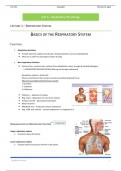
Anatomical
ORGANISATION OF RESPIRATORY SYSTEM
Upper respiratory system
➢ structures above the larynx
Lower respiratory system
➢ includes larynx & structures inferior to the larynx
MICAELA DE JAGER 1
,FLG 332 Copyright Micaela de Jager
FUNCTIONAL ANATOMY
Upper Resp. Tract
Warm
Humidify
Filter
Lower Resp. Tract
Exchange of gases - Huge surface area = 1x10⁵ m2 of type I alveolar cells
- Associated network of pulmonary capillaries
- Exchange distance is approx 1um from alveoli → blood
Protection - Free alveolar macrophages ⇒ dust cells
- Surfactant prod. by type II alveolar cells ⇒ septal cells
Vocalisation - Larynx
Functions of Bones, Muscles & Membranes:
Create and transmit a pressure gradient, relying on:
- Attachments of muscles to ribs
- Attachment of diaphragm to base of lungs
- Expansion & recoil of the lungs
- Cohesion of parietal- to visceral pleural membrane
Pleural Membrane:
• Cohesion between parietal and visceral layers is due to serous fluid in the pleural cavity
• Fluid (30 ml) creates attraction between 2 sheets of membrane
• As parietal membrane expands due to expansion of thoracic cavity it “pulls” the visceral membrane with it
• Then pulls underlying structures which expand as well
• Disrupt integrity of pleural membrane ⇒ rapid equalization of pressure & loss of ventilation fxn
= collapsed lung or pneumothorax Collection of air outside lung but within pleural cavity
MICAELA DE JAGER 2
, FLG 332 Copyright Micaela de Jager
RESPIRATORY TREE
Upper respiratory tract → single large conductive tube
Lower respiratory tract → after larynx and divides (exchange membranes)
• Trachea
• Primary bronchi
• Secondary bronchi
Conductive portion
• Tertiary bronchi
• Bronchioles
• Terminal bronchioles
• Respiratory bronchioles Exchange portion
• Alveoli
MICAELA DE JAGER 3
Unit 3 – Respiratory Physiology
LECTURE 1 – RESPIRATORY SYSTEM
BASICS OF THE RESPIRATORY SYSTEM
FUNCTIONS
▪ Respiratory functions
Provide extensive surface area for gas exchange between air & circulating blood
Move air to and from exchange surfaces of lungs
▪ Non-respiratory functions
Immune fxns – protect resp. surfaces from dehydration, temp. changes & inhaled pathogens
⇒ RESPIRATORY DEFENSE SYSTEM (filtering out foreign substances)
Respiratory system is lined with:
Mucous membranes that contain mucosal-associated lymphoid tissue
Mucosal-associated lymphoid tissue secrete:
i. Secretory
ii. Collectins
iii. Defensins
Olfaction – detection of odours
Reg. of pH – dependent on rate of CO2 release
Produce sounds – phonation/vocalisation
Blood reservoir
Metabolic fxns – Produce & remove substances
Reg. of BP and volume – convert angiotensin I to angiotensin II
Anatomical
ORGANISATION OF RESPIRATORY SYSTEM
Upper respiratory system
➢ structures above the larynx
Lower respiratory system
➢ includes larynx & structures inferior to the larynx
MICAELA DE JAGER 1
,FLG 332 Copyright Micaela de Jager
FUNCTIONAL ANATOMY
Upper Resp. Tract
Warm
Humidify
Filter
Lower Resp. Tract
Exchange of gases - Huge surface area = 1x10⁵ m2 of type I alveolar cells
- Associated network of pulmonary capillaries
- Exchange distance is approx 1um from alveoli → blood
Protection - Free alveolar macrophages ⇒ dust cells
- Surfactant prod. by type II alveolar cells ⇒ septal cells
Vocalisation - Larynx
Functions of Bones, Muscles & Membranes:
Create and transmit a pressure gradient, relying on:
- Attachments of muscles to ribs
- Attachment of diaphragm to base of lungs
- Expansion & recoil of the lungs
- Cohesion of parietal- to visceral pleural membrane
Pleural Membrane:
• Cohesion between parietal and visceral layers is due to serous fluid in the pleural cavity
• Fluid (30 ml) creates attraction between 2 sheets of membrane
• As parietal membrane expands due to expansion of thoracic cavity it “pulls” the visceral membrane with it
• Then pulls underlying structures which expand as well
• Disrupt integrity of pleural membrane ⇒ rapid equalization of pressure & loss of ventilation fxn
= collapsed lung or pneumothorax Collection of air outside lung but within pleural cavity
MICAELA DE JAGER 2
, FLG 332 Copyright Micaela de Jager
RESPIRATORY TREE
Upper respiratory tract → single large conductive tube
Lower respiratory tract → after larynx and divides (exchange membranes)
• Trachea
• Primary bronchi
• Secondary bronchi
Conductive portion
• Tertiary bronchi
• Bronchioles
• Terminal bronchioles
• Respiratory bronchioles Exchange portion
• Alveoli
MICAELA DE JAGER 3


