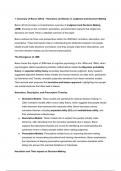
1. Summary of Baron (2014) - Heuristics and Biases in Judgment and Decision Making
Baron (2014) provides a comprehensive overview of Judgment and Decision Making
(JDM), focusing on the normative, descriptive, and prescriptive aspects that shape how
decisions are made. Here's a detailed summary of the paper:
Baron outlines the three core perspectives within the JDM field: normative, descriptive, and
prescriptive. These frameworks help in understanding the distinction between how people
ideally should make decisions (normative), how they actually make them (descriptive), and
how their decision-making can be improved (prescriptive).
The Emergence of JDM
Baron traces the origins of JDM back to cognitive psychology in the 1950s and 1960s, when
psychologists started questioning whether mathematical models like Bayesian probability
theory or expected utility theory accurately described human judgment. Early research
suggested alignment between these models and human behavior, but later work, particularly
by Kahneman and Tversky, revealed systematic deviations from these normative models.
Their seminal work proposed the heuristics-and-biases approach, highlighting how people
use mental shortcuts that often lead to biases.
Normative, Descriptive, and Prescriptive Theories
● Normative Models: These models set standards for rational decision-making. In
JDM, normative models often involve utility theory, which suggests that people should
make decisions that maximize their expected utility. Baron discusses various
normative theories, including expected utility (EU) and multiattribute utility, and
their philosophical underpinnings.
● Descriptive Models: These models aim to explain how people actually make
decisions, often deviating from the normative standards due to biases. Baron
explains that descriptive theories are crucial for identifying and understanding the
systematic errors or biases people exhibit when making judgments.
● Prescriptive Models: Prescriptive models focus on improving decision-making
processes by incorporating educational and training interventions. Baron emphasizes
the importance of aligning prescriptive approaches with normative standards while
taking into account the practical limitations of individuals.
Heuristics and Their Impact on Decision-Making
,Baron expands on several heuristics proposed by Kahneman and Tversky:
● Representativeness Heuristic: People judge the probability of an event based on
how similar it is to a stereotype, often neglecting base rate information. For example,
individuals may assume a person belongs to a particular profession based on
appearance rather than statistical likelihood.
● Availability Heuristic: Decisions are influenced by how easily examples come to
mind. This heuristic can lead to overestimation of the frequency of vivid events, like
accidents or natural disasters.
● Anchoring: Initial information (the anchor) influences subsequent judgments. Even
irrelevant or arbitrary anchors can skew decision outcomes.
These heuristics demonstrate that people often rely on simplified mental processes, which
can be efficient but frequently result in systematic biases when applied inappropriately.
Prescriptive Models and Debiasing Strategies
Baron discusses approaches to mitigate biases, focusing on educational interventions and
decision architecture:
● Training Programs: Teaching statistical reasoning and normative models can
improve judgment. For instance, teaching about base rates can reduce errors
associated with the representativeness heuristic.
● Decision Architecture: Techniques like framing decisions in ways that highlight
important information can help individuals make better choices. An example is setting
wise defaults in retirement plans to counteract the status quo bias.
Gigerenzer’s Critique: Heuristics as Adaptive Tools
Baron addresses criticisms from Gigerenzer, who argues that heuristics are not inherently
biased but are rather adaptive tools that evolved to function well in real-world environments.
According to this perspective, heuristics are efficient and often lead to accurate judgments in
everyday contexts, challenging the negative view presented by the heuristics-and-biases
framework.
Dual-Process Theory
Baron touches on the dual-process theory, popularized by Kahneman, which distinguishes
between System 1 (fast, automatic, and heuristic-based) and System 2 (slow, deliberate,
and analytical). The theory suggests that while System 1 is efficient, it often leads to biased
, outcomes. System 2 can override these biases, but only if individuals are motivated and
capable of engaging in more deliberate thinking.
Conclusion
Baron emphasizes the importance of understanding the interplay between heuristics and
decision-making and developing effective strategies to improve judgment. By distinguishing
between normative, descriptive, and prescriptive models, researchers can design
interventions to reduce biases and align human behavior more closely with rational
decision-making standards.
This summary captures the essence of Baron’s discussion on heuristics, biases, and the
different theoretical perspectives in JDM, as well as strategies for improving decision-making
accuracy.
2. Li et al. (2018) - The Evolutionary Mismatch Hypothesis: Implications for
Psychological Science
Li, van Vugt, and Colarelli (2018) examine the concept of evolutionary mismatch, proposing
that many psychological mechanisms that evolved to solve survival and reproductive
challenges are now misaligned with the demands of modern environments. This evolutionary
mismatch can result in maladaptive behaviors and psychological outcomes that were once
advantageous in ancestral contexts but are no longer suitable in today's world.
Evolutionary Mismatch Hypothesis
The evolutionary mismatch hypothesis suggests that psychological mechanisms, which
developed during the majority of human history when humans were hunter-gatherers, may
not function optimally in modern environments. These mechanisms were adaptive to
ancestral environments characterized by small kin-based groups, scarce resources, and
physical risks. However, the modern world, with its urbanized, high-density populations and
abundance of artificial stimuli, creates discrepancies between these mechanisms and the
environment.
Types and Causes of Mismatch
Li et al. classify mismatches into two primary types:
1. Forced Mismatches: Occur when individuals are placed in novel environments or
situations that diverge significantly from ancestral conditions. An example includes
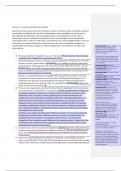
Baron (2014) provides a comprehensive overview of Judgment and Decision Making
(JDM), focusing on the normative, descriptive, and prescriptive aspects that shape how
decisions are made. Here's a detailed summary of the paper:
Baron outlines the three core perspectives within the JDM field: normative, descriptive, and
prescriptive. These frameworks help in understanding the distinction between how people
ideally should make decisions (normative), how they actually make them (descriptive), and
how their decision-making can be improved (prescriptive).
The Emergence of JDM
Baron traces the origins of JDM back to cognitive psychology in the 1950s and 1960s, when
psychologists started questioning whether mathematical models like Bayesian probability
theory or expected utility theory accurately described human judgment. Early research
suggested alignment between these models and human behavior, but later work, particularly
by Kahneman and Tversky, revealed systematic deviations from these normative models.
Their seminal work proposed the heuristics-and-biases approach, highlighting how people
use mental shortcuts that often lead to biases.
Normative, Descriptive, and Prescriptive Theories
● Normative Models: These models set standards for rational decision-making. In
JDM, normative models often involve utility theory, which suggests that people should
make decisions that maximize their expected utility. Baron discusses various
normative theories, including expected utility (EU) and multiattribute utility, and
their philosophical underpinnings.
● Descriptive Models: These models aim to explain how people actually make
decisions, often deviating from the normative standards due to biases. Baron
explains that descriptive theories are crucial for identifying and understanding the
systematic errors or biases people exhibit when making judgments.
● Prescriptive Models: Prescriptive models focus on improving decision-making
processes by incorporating educational and training interventions. Baron emphasizes
the importance of aligning prescriptive approaches with normative standards while
taking into account the practical limitations of individuals.
Heuristics and Their Impact on Decision-Making
,Baron expands on several heuristics proposed by Kahneman and Tversky:
● Representativeness Heuristic: People judge the probability of an event based on
how similar it is to a stereotype, often neglecting base rate information. For example,
individuals may assume a person belongs to a particular profession based on
appearance rather than statistical likelihood.
● Availability Heuristic: Decisions are influenced by how easily examples come to
mind. This heuristic can lead to overestimation of the frequency of vivid events, like
accidents or natural disasters.
● Anchoring: Initial information (the anchor) influences subsequent judgments. Even
irrelevant or arbitrary anchors can skew decision outcomes.
These heuristics demonstrate that people often rely on simplified mental processes, which
can be efficient but frequently result in systematic biases when applied inappropriately.
Prescriptive Models and Debiasing Strategies
Baron discusses approaches to mitigate biases, focusing on educational interventions and
decision architecture:
● Training Programs: Teaching statistical reasoning and normative models can
improve judgment. For instance, teaching about base rates can reduce errors
associated with the representativeness heuristic.
● Decision Architecture: Techniques like framing decisions in ways that highlight
important information can help individuals make better choices. An example is setting
wise defaults in retirement plans to counteract the status quo bias.
Gigerenzer’s Critique: Heuristics as Adaptive Tools
Baron addresses criticisms from Gigerenzer, who argues that heuristics are not inherently
biased but are rather adaptive tools that evolved to function well in real-world environments.
According to this perspective, heuristics are efficient and often lead to accurate judgments in
everyday contexts, challenging the negative view presented by the heuristics-and-biases
framework.
Dual-Process Theory
Baron touches on the dual-process theory, popularized by Kahneman, which distinguishes
between System 1 (fast, automatic, and heuristic-based) and System 2 (slow, deliberate,
and analytical). The theory suggests that while System 1 is efficient, it often leads to biased
, outcomes. System 2 can override these biases, but only if individuals are motivated and
capable of engaging in more deliberate thinking.
Conclusion
Baron emphasizes the importance of understanding the interplay between heuristics and
decision-making and developing effective strategies to improve judgment. By distinguishing
between normative, descriptive, and prescriptive models, researchers can design
interventions to reduce biases and align human behavior more closely with rational
decision-making standards.
This summary captures the essence of Baron’s discussion on heuristics, biases, and the
different theoretical perspectives in JDM, as well as strategies for improving decision-making
accuracy.
2. Li et al. (2018) - The Evolutionary Mismatch Hypothesis: Implications for
Psychological Science
Li, van Vugt, and Colarelli (2018) examine the concept of evolutionary mismatch, proposing
that many psychological mechanisms that evolved to solve survival and reproductive
challenges are now misaligned with the demands of modern environments. This evolutionary
mismatch can result in maladaptive behaviors and psychological outcomes that were once
advantageous in ancestral contexts but are no longer suitable in today's world.
Evolutionary Mismatch Hypothesis
The evolutionary mismatch hypothesis suggests that psychological mechanisms, which
developed during the majority of human history when humans were hunter-gatherers, may
not function optimally in modern environments. These mechanisms were adaptive to
ancestral environments characterized by small kin-based groups, scarce resources, and
physical risks. However, the modern world, with its urbanized, high-density populations and
abundance of artificial stimuli, creates discrepancies between these mechanisms and the
environment.
Types and Causes of Mismatch
Li et al. classify mismatches into two primary types:
1. Forced Mismatches: Occur when individuals are placed in novel environments or
situations that diverge significantly from ancestral conditions. An example includes