100% satisfaction guarantee Immediately available after payment Both online and in PDF No strings attached 4.2 TrustPilot
logo-home
Exam (elaborations)

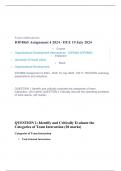
RSK4802 Assignment 2(Detailed Answers) Semester 2 Due 28 October 2024.

Rating
-
Sold
2
Pages
7
Grade
A+
Uploaded on
01-10-2024
Written in
2024/2025

Question 1 22 marks 1.1 In a management meeting, it was decided that the company needs to establish the risk management function. However, there were different views about the main objective of risk management. Choose the correct view about the responsibility of risk management. a. The chief executive officer held that the responsibility of risk management would be to assess, control and finance critical risks facing the organisation and report the outcomes to the board. b. The chief financial officer stated that the responsibility of risk management would be to assess critical risks facing the organisation and communicate the assessment to management and the board. c. The human resources director argued that the responsibility of risk management would be to compile a report on all risk exposures of the organisation for reporting to the board. d. The compliance officer emphasised that the responsibility of risk management would be to provide assurance about the management of risks to stakeholders of the organisation. 1.2 Eskom, South Africa’s largest electricity provider, navigates a challenging and promising environment in its mission to deliver reliable and sustainable energy to the nation. The utility’s handling of debts is crucial for its financial stability, operational efficiency, and environmental impact. Despite these factors, Eskom’s decisions regarding liabilities play a pivotal role in its financial stability. Eskom's total liabilities increased from R77,000 million in 2006 to R480,000 million in 2016. Given that the liabilities in 2012 were 50% higher than that in 2006, the total liabilities for 2012 would be calculated as follows: a. R115,500 million b. R480,000 million c. R38,500 million d. R557,000 million 1.3 Which of the following is not an example of unreimbursed losses? a. Underinsurance b. Franchise deductibles. c. Losses resulting from risks with available insurance cover d. Uninsured Losses, either intentionally or unintentionally Page 2 of 7 RSK4803 Tutorial Letter 102 © UNISA 2023 1.4 Comair Limited, a South African airline, operated scheduled services domestically as a British Airways franchisee and under its own budget brand, K. The airline faced various challenges, including fluctuating fuel prices, regulatory requirements, weather disruptions, and passenger demand variability. These challenges directly affected flight schedules, operational costs, and customer experiences. During a particular disruption, around 191,000 passengers were affected by flight cancellations and 78,000 passengers experienced delays at Comair during the disruption. If Comair had initially scheduled flights for 300,000 passengers, what percentage of passengers were not directly affected by cancellations or delays? a. 10% b. 11% c. 31% d. 32% 1.5 In terms of funding the organisation’s strategy, the job of the risk manager is to … a. provide adequate funds for managing risks and select an appropriate funding ratio between capital and debt. b. provide adequate funds for managing risks and guide management to use less costly sources of funds. c. develop an appropriate budget for risk financing and present it to management and the board for approval. d. Ensure that management and the board understand the probabilities associated with the possible outcomes of the firm’s strategy before resources are allocated. 1.6 What is the difference between moral hazard and criminal hazard in the context of insurance contracts? a. Both terms are interchangeable and refer to the same behaviour. b. Moral hazard refers to the intentional misrepresentation of facts by the insured, whereas criminal hazard refers to the insured failing to intentionally report incidents. c. Inherent problem of moral hazard refers to insured individuals not reporting the size and circumstances of an accident or loss truthfully, while the inherent problem of criminal hazard refers to the insured intentionally misrepresenting facts. d. Criminal hazard is about insured individuals reporting the size and circumstances of an accident or loss truthfully, while moral hazard is about the insured intentionally misrepresenting facts. Page 3 of 7 RSK4803 Tutorial Letter 102 © UNISA 2023 1.7 A global bank was found to have been involved in collusion and other unethical practices. After this finding was made public, the bank’s board requested the risk manager to quantify the overall financial impact on the group. The risk manager found the following losses resulting from the unethical behaviour in terms of the South African currency: Regulatory penalties R1 billion Loss on sale of investment R2 billion Default on repayment of home loans R5 billion Default on repayment of other credit products R8 billion The deadweight loss is … a. R16 billion. b. R11 billion. c. R5 billion. d. R3 billion. 1.8 The foundation of classical economics, finance and decision theory is the abstract view that human beings … a. act rationally and maximise some measure of utility by optimally weighing and integrating all relevant information. b. use simple but ecologically rational strategies to make sound and robust decisions. c. solve complex problems by employing complex tools and solutions. d. make decisions under uncertainty conditions using outcome probabilities. . 1.9 One of the weaknesses of traditional risk management is … a. an inability to integrate all types of risks and balance sheet protection. b. reliance on traditional risk mitigation, risk transfer and risk hedging opportunities. c. that it considers the accounting, regulatory and rating agency treatment of financial instruments, etc. d. that it requires the chief risk officer to have substantial knowledge of various business areas. 1.10 Integrated solutions refer to… a. the development of consolidated risk mitigations for financial, operational and strategic risks. b. the domain of reinsurers rather than industrial insurance companies, which involves the structuring of financial, finite and retro covers. c. an emphasis on custom designed, comprehensive and longer-term risk financial needs. d. disregarding of traditional lines of insurance and focusing on the financial risks of a business. Page 4 of 7 RSK4803 Tutorial Letter 102 © UNISA 2023 1.11 Contingent capital … a. provides adequate financial resources to mitigate business risks. b. facilitates the diversification of risks and stabilises the cashflows of a business. c. is a risk liquidity instrument available to business. d. smoothens earnings and achieves stability for future cash flows. Page 5 of 7 RSK4803 Tutorial Letter 102 © UNISA 2023 Question 2 20 marks Discuss the types of risk management failures in Matola Foods Limited. Background Matola Foods Limited is a company listed on the JSE Ltd under the agriculture industry. Matola Foods Limited is a leading distributor of perishable goods based in Mozambique. The company specialises in sourcing high-quality fruits and vegetables from South Africa to supply the local markets in Mozambique. With a focus on freshness and reliability, Matola Foods Limited has built a strong reputation as a trusted supplier among retailers, wholesalers, and restaurants in Mozambique. In pursuit of cost-cutting measures and increased profitability, Matola Foods Limited made the strategic decision to rely heavily on a single logistics provider for transporting perishable goods from South Africa to Mozambique. According to the Department of Public Service and Administration (DPSA), the border post between South Africa and Mozambique is one of the busiest in the country and is managed by the Border Management Authority (BMA), which was officially launched in October 2023. The authority is responsible for executing frontline border law enforcement functions related to, inter alia, port health, immigration control, access control, biosecurity, food safety, phytosanitary control, land border infrastructure development and maintenance, border information, and risk management. In addition, the BMA cooperates with the South African Revenue Service (SARS) to fast-track the movement of trucks. Report on Risk Management Failures The Matola Foods Limited primary import route involves transporting fruits and vegetables through the Lebombo border (also called the Komatipoort Border) in Mpumalanga, South Africa. In June 2023, Matola Foods Limited faced unexpected delays in transporting freshly produced fruits and vegetables from the Lebombo border to Mozambique, despite meticulous planning One critical oversight was the lack of contingency planning for disruptions in transportation routes, such as the high volume of logistic trucks attempting to enter the border post, as well as truck drivers not obeying the rules of the roads and blocking lanes. This was compounded by unanticipated customs inspections and administrative bottlenecks. The perishable goods remained stranded at the border for an extended period of 60 hours, exposing them to unfavourable environmental conditions. The traffic backlog was due to

Show more Read less


Whoops! We can’t load your doc right now. Try again or contact support.

Document information

Uploaded on
October 1, 2024
Number of pages
7
Written in
2024/2025
Type
Exam (elaborations)
Contains
Questions & answers

Subjects

Content preview

RSK4802

Assignment 2

Semester 2

DUE 28 October 2024

, Introduction
The Financial Advisory and Intermediary Services (FAIS) Act, implemented in South
Africa in 2002, plays a critical role in regulating financial services to protect consumers
and ensure fair treatment within the financial industry. Central to the effective functioning
of this Act is the role of the Compliance Officer within Financial Services Providers
(FSPs). Compliance Officers are responsible for ensuring that their organizations
adhere to regulatory standards, thereby minimizing legal and financial risks associated
with non-compliance. To fulfill these responsibilities adequately, the FAIS Act stipulates
specific "fit and proper" requirements that these officers mu st meet. These
requirements—competence, honesty, integrity, financial soundness, and operational
ability—are designed to ensure that Compliance Officers are not only knowledgeable
but also ethical and reliable. This comprehensive framework aims to foster a culture of
compliance and good governance within the financial services sector, ultimately
benefiting both consumers and the industry at large. Understanding the significance of
each of these requirements provides insights into how organizations can better manage
compliance risks and enhance their operational integrity.


1. Competence
Competence means that the Compliance Officer must possess the necessary
knowledge, skills, and education to understand the complexities of financial services
and compliance laws. This includes familiarity with financial products, regulations, and
risk management practices.
Importance in Risk Management: Competence is crucial because a well-trained
Compliance Officer can identify potential compliance risks and regulatory changes that
may impact the organization. They can design effective compliance programs that
mitigate risks before they manifest into violations. For instance, a competent officer
would understand the legal consequences of non -compliance and can foster a culture of
adherence within the organization (FAIS Act, 2002).


2. Honesty and Integrity
Honesty and integrity denote the ethical standards of a Compliance Officer. This
requirement ensures that officers act truthfully and refrain from misleading practices.


Importance in Risk Management: When compliance is rooted in honesty, it cultivates
trust among clients and within the organization. An honest Compliance Officer is less
likely to conceal or ignore unethical practices. This transparency helps to prevent fraud
and corruption, which can lead to significant compliance violations and financial loss.
Compliance Officers who maintain integrity will also more effectively promote ethical
behavior among colleagues, thus creating a unified compliance culture (FAIS Act,
2002).

Get to know the seller

Seller avatar
Reputation scores are based on the amount of documents a seller has sold for a fee and the reviews they have received for those documents. There are three levels: Bronze, Silver and Gold. The better the reputation, the more your can rely on the quality of the sellers work.
LectureLab Teachme2-tutor
View profile
Follow You need to be logged in order to follow users or courses
Sold
626
Member since
1 year
Number of followers
188
Documents
1022
Last sold
1 month ago
LectureLab

LectureLab: Crafted Clarity for Academic Success Welcome to LectureLab, your go-to source for clear, concise, and expertly crafted lecture notes. Designed to simplify complex topics and boost your grades, our study materials turn lectures into actionable insights. Whether you’re prepping for exams or mastering coursework, LectureLab empowers your learning journey. Explore our resources and ace your studies today!

3,6

80 reviews

5
32
4
14
3
16
2
4
1
14

Recently viewed by you

Why students choose Stuvia

Created by fellow students, verified by reviews

Quality you can trust: written by students who passed their exams and reviewed by others who've used these notes.

Didn't get what you expected? Choose another document

No worries! You can immediately select a different document that better matches what you need.

Pay how you prefer, start learning right away

No subscription, no commitments. Pay the way you're used to via credit card or EFT and download your PDF document instantly.

Student with book image

“Bought, downloaded, and aced it. It really can be that simple.”

Alisha Student

Frequently asked questions