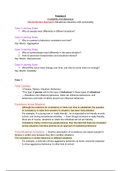
Problem 6
(In)stability And Behaviour
Interactionism Approach (Situational interaction with personality)
Case 1 Learning Goals:
1. Why do people react differently in different situations?
Case 2 Learning Goals:
1. Why is a person’s behaviour consistent over time?
Key Words: Aggregation
Case 3 Learning Goals:
1. Why do some people react differently in the same situation?
2. How do personal characteristics and situations interact?
Key Words: Interactionism
Case 4 Learning Goals:
1. Which/Why some traits change over time, and why do some traits not change?
Key Words: Instability.
Case 1:
Triple Typology:
- 3 Factors: Person, Situation, Behaviour
- “This type of person will do this type of behaviour in these types of situations.”
- → Situations can influence behaviour, traits can influence behaviours, and
behaviours and traits of others around can influence behaviour.
Consistency Across Situations:
- Although the evidence for consistency in traits over time is substantial, the question
of consistency in traits from situation to situation, has been hotly debated.
- For example, If a young man is “really friendly”, he is expected to be friendly at work,
school, and during recreational activities. → Even though someone is really friendly,
there are of course, situations in which the individual will not act friendly.
- If situations mainly control how people behave, then the idea that traits are consistent
across situations hold less promise as an approach to explaining behaviour.
Cross-Situational Consistency → Intuitive assumption of consistency (we expect people to
behave a certain way because they did in another situation).
The consistency in similar behaviour in different situations.
- For example, a child who shows aggressive behaviour at home, would be expected
to show aggressive behaviour to other kids at school.
, Hartshorn & May (1928) - The issue of cross-situational consistency:
- Studied a large group of elementary school students at summer camp; focusing
especially on the trait of honesty.
- Observed which children cheated while playing field games at summer camp, and
which children cheated during some written exams in school.
- The correlation between honesty measured in each of these two situations was
rather low.
- Knowing that a child cheated one night while playing ‘kick-the-can’ at summer camp
tells us very little about whether this child is likely to copy from a neighbour during a
test at school.
- Hartshorn & May reported similar low cross-situational correlations for the traits of
helpfulness and self-control.
Situationalism: → The emphasis on the power of situational variables, and the belief that
personality is less important than the situation.
Some psychologists argued that often the situation is so powerful that individual differences
and personality traits don’t make a difference.
- Mischel: The situation is more important to look at than personality.
- Behaviour shifting from situation to situation → Situational differences that cause
behaviour.
- Bem’s Personality Paradox → Contradiction between intuition and research data.
- The data from extensive research indicated low cross-situational consistency
of behaviour. The idea that people seem to behave much less consistently
than a trait conception would predict.
- Person vs. Situation Debate:
→ This debate consisted of a prolonged and heated controversy about personality
traits, consistency, and the role of the situation that consumed much of the agenda of
personality psychology in the 1970s and early 1980s.
The field of psychology was devoted to understanding the general effects and power of
situations regardless of individual differences. In that framing, in social psychology the
person became the “error variance” - the noise - that had to be removed. In contrast, in
personality psychology, it was believed that one had to remove the effects of situations - and
treat them as noise or error - in order to glimpse the true situations-free personality that
remained consistent.
The situations in which particular behaviours do and don’t occur can be informative. In both
people and machines, when the situation changed, so do the behaviours, but the
relationship between the situations and behaviours may be stable and informative. In the
case of people, it can tell us a lot about the underlying personality system. (E.g. Suppose
two professors on the whole, display the same average amount of sociability. However, the
first one is extremely sociable and warm with students, but unfriendly and cold with
colleagues - in contrast, the second professor displays opposite behaviour.) Such profiles
seem to constitute a sort of “signature of personality” that does reflect some of the essence
(In)stability And Behaviour
Interactionism Approach (Situational interaction with personality)
Case 1 Learning Goals:
1. Why do people react differently in different situations?
Case 2 Learning Goals:
1. Why is a person’s behaviour consistent over time?
Key Words: Aggregation
Case 3 Learning Goals:
1. Why do some people react differently in the same situation?
2. How do personal characteristics and situations interact?
Key Words: Interactionism
Case 4 Learning Goals:
1. Which/Why some traits change over time, and why do some traits not change?
Key Words: Instability.
Case 1:
Triple Typology:
- 3 Factors: Person, Situation, Behaviour
- “This type of person will do this type of behaviour in these types of situations.”
- → Situations can influence behaviour, traits can influence behaviours, and
behaviours and traits of others around can influence behaviour.
Consistency Across Situations:
- Although the evidence for consistency in traits over time is substantial, the question
of consistency in traits from situation to situation, has been hotly debated.
- For example, If a young man is “really friendly”, he is expected to be friendly at work,
school, and during recreational activities. → Even though someone is really friendly,
there are of course, situations in which the individual will not act friendly.
- If situations mainly control how people behave, then the idea that traits are consistent
across situations hold less promise as an approach to explaining behaviour.
Cross-Situational Consistency → Intuitive assumption of consistency (we expect people to
behave a certain way because they did in another situation).
The consistency in similar behaviour in different situations.
- For example, a child who shows aggressive behaviour at home, would be expected
to show aggressive behaviour to other kids at school.
, Hartshorn & May (1928) - The issue of cross-situational consistency:
- Studied a large group of elementary school students at summer camp; focusing
especially on the trait of honesty.
- Observed which children cheated while playing field games at summer camp, and
which children cheated during some written exams in school.
- The correlation between honesty measured in each of these two situations was
rather low.
- Knowing that a child cheated one night while playing ‘kick-the-can’ at summer camp
tells us very little about whether this child is likely to copy from a neighbour during a
test at school.
- Hartshorn & May reported similar low cross-situational correlations for the traits of
helpfulness and self-control.
Situationalism: → The emphasis on the power of situational variables, and the belief that
personality is less important than the situation.
Some psychologists argued that often the situation is so powerful that individual differences
and personality traits don’t make a difference.
- Mischel: The situation is more important to look at than personality.
- Behaviour shifting from situation to situation → Situational differences that cause
behaviour.
- Bem’s Personality Paradox → Contradiction between intuition and research data.
- The data from extensive research indicated low cross-situational consistency
of behaviour. The idea that people seem to behave much less consistently
than a trait conception would predict.
- Person vs. Situation Debate:
→ This debate consisted of a prolonged and heated controversy about personality
traits, consistency, and the role of the situation that consumed much of the agenda of
personality psychology in the 1970s and early 1980s.
The field of psychology was devoted to understanding the general effects and power of
situations regardless of individual differences. In that framing, in social psychology the
person became the “error variance” - the noise - that had to be removed. In contrast, in
personality psychology, it was believed that one had to remove the effects of situations - and
treat them as noise or error - in order to glimpse the true situations-free personality that
remained consistent.
The situations in which particular behaviours do and don’t occur can be informative. In both
people and machines, when the situation changed, so do the behaviours, but the
relationship between the situations and behaviours may be stable and informative. In the
case of people, it can tell us a lot about the underlying personality system. (E.g. Suppose
two professors on the whole, display the same average amount of sociability. However, the
first one is extremely sociable and warm with students, but unfriendly and cold with
colleagues - in contrast, the second professor displays opposite behaviour.) Such profiles
seem to constitute a sort of “signature of personality” that does reflect some of the essence