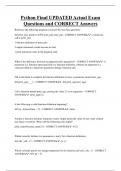
Python Final UPDATED Actual Exam
Questions and CORRECT Answers
Reference the following program to answer the next four questions:
def print_pi(): print(3.14159) print_pi() print_pi() - CORRECT ANSWER✔✔- 2 functions
call to print_pi()
1 function definition of print_pi()
2 output statements would execute in total
1 print statement exists in the program code
What is the difference between an argument and a parameter? - CORRECT ANSWER✔✔- A
parameter is a function input specified in a function definition, whereas an argument is a
value provided to a function's parameter during a function call.
Fill in the blank to complete the function definition to have a parameter named user_age.
def print_age(___): - CORRECT ANSWER✔✔- def print_age(user_age):
Call a function named print_age, passing the value 21 as an argument. - CORRECT
ANSWER✔✔- print_age(21)
Is the following a valid function definition beginning?
def my_fct(userNum + 5): - CORRECT ANSWER✔✔- False
Assume a function def print_num(user_num): simply prints the value of user_num without
any space or newline. What will the following code output?
print_num(43) print_num(21) - CORRECT ANSWER✔✔- 4321
Which correctly defines two parameters x and y for a function definition:
def calc_val(...):? - CORRECT ANSWER✔✔- (x, y)
Which correctly passes two integer arguments for the function call calc_val(...)? - CORRECT
ANSWER✔✔- (99, 44 + 5)
,Given a function definition:
def calc_val(a, b, c):
what value is assigned to b during this function call?
calc_val(42, 55, 77) - CORRECT ANSWER✔✔- 55
Given a function definition:
def calc_val(a, b, c):
and given variables i, j, and k, which answer shows valid arguments in the call
calc_val(...) - CORRECT ANSWER✔✔- (k, i + j, 99)
Add a print statement to the function definition to print the hours, given minutes. There are
60 minutes in one hour.
def print_minutes_as_hours(original_minutes): ... minutes = float(input())
print_minutes_as_hours(minutes) - CORRECT ANSWER✔✔- print(original_minutes / 60)
Add a return statement to the function definition that returns the result of adding num1 and
num2.
def sum(num1, num2): - CORRECT ANSWER✔✔- return num1 + num2
Given the following function, which statements are valid?
def square_root(x): return math.sqrt(x) def print_val(x): print(x) - CORRECT ANSWER✔✔-
y = square_root(49.0)
y = 1.0 + square_root(144.0)
y = square_root(square_root(16.0))
square_root(9.0)
y = print_val(9.0)
print_val(9.0)
Chapter 1 Statements that are true. - CORRECT ANSWER✔✔- Polymorphism refers to how
an operation depends on the involved object types.
,Static-typed languages require that the type of every variable is defined in the source code.
A dynamic-typed language like Python checks that an operation is valid when that operation
is executed by the interpreter. If the operation is invalid, a run-time error occurs.
If my_func1() and my_func2() are defined functions, then the expression
my_func1(my_func2) passes the my_func2 function object as an argument to my_func1.
Functions are compiled into bytecode when the function definition is evaluated by the
interpreter.
A benefit of functions is to reduce redundant code.
Incremental development may involve more frequent testing, but ultimately leads to faster
development of a program.
Forgetting to return a value from a function is a common error.
Returning the incorrect variable from a function is a common error.
Copying-and-pasting code can lead to common errors if all necessary changes are not made
to the pasted code.
A local variable is defined inside a function, while a global variable is defined outside any
function.
A function definition must be evaluated by the interpreter before the function can be called.
A programmer can protect mutable arguments from unwanted changes by passing a copy of
the object to a function.
Adding an element to a dictionary argument in a function might affect variables outside the
function that reference the same dictionary object.
, The statement return a, b, [c, d] is valid.
What is the output of the following program?
def dog(): print('woof') def cow(): print('moo') dog = cow dog() - CORRECT ANSWER✔✔-
moo
Define function print_teenager with parameter age.
If age is less than 13, print "Too young".
If greater than 19, print "Too old".
Otherwise, print "Has been a teenager for" followed by the result of computing age - 13
followed by "years.".
End with a newline.
Sample output with input: 14Has been a teenager for 1 years. - CORRECT ANSWER✔✔-
One possible answer is
def print_teenager(age): if age < 13: print("Too young") elif age > 19: print("Too old") else:
print("Has been a teenager for", age - 13, "years.")
Match the words - CORRECT ANSWER✔✔- scope resolution: The process of searching
namespaces for a name.
namespace: Maps the visible names in a scope to objects.
locals(): Returns a dictionary of the names found in the local namespace.
scope: The area of code where a name is visible.
For the next two questions, assume the function below is defined:
def split_check(amount, num_people, tax_percentage, tip_percentage): # ... - CORRECT
ANSWER✔✔- What value is passed as the tax_percentage argument in the following
function call?
split_check(60.52, 5, 0.07, tip_percentage=0.18) :
Questions and CORRECT Answers
Reference the following program to answer the next four questions:
def print_pi(): print(3.14159) print_pi() print_pi() - CORRECT ANSWER✔✔- 2 functions
call to print_pi()
1 function definition of print_pi()
2 output statements would execute in total
1 print statement exists in the program code
What is the difference between an argument and a parameter? - CORRECT ANSWER✔✔- A
parameter is a function input specified in a function definition, whereas an argument is a
value provided to a function's parameter during a function call.
Fill in the blank to complete the function definition to have a parameter named user_age.
def print_age(___): - CORRECT ANSWER✔✔- def print_age(user_age):
Call a function named print_age, passing the value 21 as an argument. - CORRECT
ANSWER✔✔- print_age(21)
Is the following a valid function definition beginning?
def my_fct(userNum + 5): - CORRECT ANSWER✔✔- False
Assume a function def print_num(user_num): simply prints the value of user_num without
any space or newline. What will the following code output?
print_num(43) print_num(21) - CORRECT ANSWER✔✔- 4321
Which correctly defines two parameters x and y for a function definition:
def calc_val(...):? - CORRECT ANSWER✔✔- (x, y)
Which correctly passes two integer arguments for the function call calc_val(...)? - CORRECT
ANSWER✔✔- (99, 44 + 5)
,Given a function definition:
def calc_val(a, b, c):
what value is assigned to b during this function call?
calc_val(42, 55, 77) - CORRECT ANSWER✔✔- 55
Given a function definition:
def calc_val(a, b, c):
and given variables i, j, and k, which answer shows valid arguments in the call
calc_val(...) - CORRECT ANSWER✔✔- (k, i + j, 99)
Add a print statement to the function definition to print the hours, given minutes. There are
60 minutes in one hour.
def print_minutes_as_hours(original_minutes): ... minutes = float(input())
print_minutes_as_hours(minutes) - CORRECT ANSWER✔✔- print(original_minutes / 60)
Add a return statement to the function definition that returns the result of adding num1 and
num2.
def sum(num1, num2): - CORRECT ANSWER✔✔- return num1 + num2
Given the following function, which statements are valid?
def square_root(x): return math.sqrt(x) def print_val(x): print(x) - CORRECT ANSWER✔✔-
y = square_root(49.0)
y = 1.0 + square_root(144.0)
y = square_root(square_root(16.0))
square_root(9.0)
y = print_val(9.0)
print_val(9.0)
Chapter 1 Statements that are true. - CORRECT ANSWER✔✔- Polymorphism refers to how
an operation depends on the involved object types.
,Static-typed languages require that the type of every variable is defined in the source code.
A dynamic-typed language like Python checks that an operation is valid when that operation
is executed by the interpreter. If the operation is invalid, a run-time error occurs.
If my_func1() and my_func2() are defined functions, then the expression
my_func1(my_func2) passes the my_func2 function object as an argument to my_func1.
Functions are compiled into bytecode when the function definition is evaluated by the
interpreter.
A benefit of functions is to reduce redundant code.
Incremental development may involve more frequent testing, but ultimately leads to faster
development of a program.
Forgetting to return a value from a function is a common error.
Returning the incorrect variable from a function is a common error.
Copying-and-pasting code can lead to common errors if all necessary changes are not made
to the pasted code.
A local variable is defined inside a function, while a global variable is defined outside any
function.
A function definition must be evaluated by the interpreter before the function can be called.
A programmer can protect mutable arguments from unwanted changes by passing a copy of
the object to a function.
Adding an element to a dictionary argument in a function might affect variables outside the
function that reference the same dictionary object.
, The statement return a, b, [c, d] is valid.
What is the output of the following program?
def dog(): print('woof') def cow(): print('moo') dog = cow dog() - CORRECT ANSWER✔✔-
moo
Define function print_teenager with parameter age.
If age is less than 13, print "Too young".
If greater than 19, print "Too old".
Otherwise, print "Has been a teenager for" followed by the result of computing age - 13
followed by "years.".
End with a newline.
Sample output with input: 14Has been a teenager for 1 years. - CORRECT ANSWER✔✔-
One possible answer is
def print_teenager(age): if age < 13: print("Too young") elif age > 19: print("Too old") else:
print("Has been a teenager for", age - 13, "years.")
Match the words - CORRECT ANSWER✔✔- scope resolution: The process of searching
namespaces for a name.
namespace: Maps the visible names in a scope to objects.
locals(): Returns a dictionary of the names found in the local namespace.
scope: The area of code where a name is visible.
For the next two questions, assume the function below is defined:
def split_check(amount, num_people, tax_percentage, tip_percentage): # ... - CORRECT
ANSWER✔✔- What value is passed as the tax_percentage argument in the following
function call?
split_check(60.52, 5, 0.07, tip_percentage=0.18) :