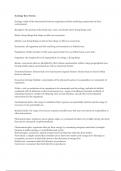
Ecology Key Terms
cology: study of the interactions between organisms and the nonliving components of their
E
environment
Biosphere: the portion of the Earth (air, water, and land) where living things exist
Biotic: living things that shape or affect an ecosystem
Abiotic: non-living things or factors that shape or affect an ecosystem
Ecosystem: all organisms and the nonliving environment in a defined area
Population: all the members of the same species that live in a defined area at one time
Organism: the simplest level of organization in ecology; a living thing
iome: ecosystems that are identified by their climax communities within a large geographical area
B
having similar plants and animals as well as consistent climate
errestrial biomes: biomes that cover land masses Aquatic biomes: biomes that are based within
T
fresh or saltwater
cosystem Ecology Habitat: a description of the physical location of a population or community of
E
organisms
iche: a role or profession of an organism in its community and in ecology; includes its habitat
N
combined with its behavior in that environment (i.e., range of conditions tolerated, methods of
obtaining resources, number of offspring, time of reproduction, and all other environmental
interactions for the organism)
undamental niche: the range of conditions that a species can potentially tolerate and the range of
F
resources it can potentially use
ealized niche: the range of resources a species actually uses; this may vary based on competition or
R
other interactions
hotoautotrophs: producers; green plants, algae, or cyanobacteria that convert light energy into food
P
that can be consumed via photosynthesis
hemoautotrophs: organisms that get their energy by consuming inorganic molecules (example:
C
bacteria in sulfur springs or on hydrothermal vents)
Heterotrophs: consumers; obtain energy from food that they take into their bodies
Food chain: a simple model that scientists use to show how matter and energy move through an
ecosystem; arrows in a food chain move in the direction of energy flow
Herbivores: consumers that feed directly on producers
Carnivores: consumers that feed directly on producers
, mnivores: consumers that eat both plants and animals; include humans, bears, raccoons, robins,
O
etc.
ecomposers: saprotrophs; heterotroph consumers that get their energy by breaking down dead
D
organisms without ingesting them
rophic level: the position that an organism occupies in a food chain (example: primary consumers)
T
Primary consumers: producers that use light directly
Secondary consumers: herbivores that feed directly on plants
Tertiary consumers: carnivores that feed on herbivores or other carnivores
ood web: a model that expresses all possible feeding relationships at each trophic level in a
F
community
iomass: the amount of dried, organic material in an organism Ecological pyramids: illustrate the
B
flow of energy, biomass, or numbers at each trophic level in an ecosystem; the highest level is the top
of the food chain
Pyramid of energy: illustrates the energy decrease at each trophic level
Pyramid of numbers: illustrates the population size at each trophic level
Pyramid of biomass: illustrates the biomass of living material at each trophic level
Primary productivity: the total amount of matter made by producers within an ecosystem
ater (hydrologic) cycle: the movement of water between different reservoirs on the earth,
W
underground and in the atmosphere
Evaporation: process of liquid converting to the gaseous state
Transpiration: loss of water through stomata underneath leaves
Condensation: transition from a gas to a liquid as vapor condenses
Precipitation: the falling to earth of any form of water (rain, snow, hail, sleet, or mist)
Runoff: precipitation that is not absorbed or used which flows into lakes, etc.
Groundwater: water below the surface of the soil, between soil pores, and in rock spaces
arbon cycle: process by which carbon in cycled through the biotic and abiotic environment in
C
various chemical forms
Photosynthesis: process of converting light energy, carbon dioxide, and water into sugar and oxygen
cology: study of the interactions between organisms and the nonliving components of their
E
environment
Biosphere: the portion of the Earth (air, water, and land) where living things exist
Biotic: living things that shape or affect an ecosystem
Abiotic: non-living things or factors that shape or affect an ecosystem
Ecosystem: all organisms and the nonliving environment in a defined area
Population: all the members of the same species that live in a defined area at one time
Organism: the simplest level of organization in ecology; a living thing
iome: ecosystems that are identified by their climax communities within a large geographical area
B
having similar plants and animals as well as consistent climate
errestrial biomes: biomes that cover land masses Aquatic biomes: biomes that are based within
T
fresh or saltwater
cosystem Ecology Habitat: a description of the physical location of a population or community of
E
organisms
iche: a role or profession of an organism in its community and in ecology; includes its habitat
N
combined with its behavior in that environment (i.e., range of conditions tolerated, methods of
obtaining resources, number of offspring, time of reproduction, and all other environmental
interactions for the organism)
undamental niche: the range of conditions that a species can potentially tolerate and the range of
F
resources it can potentially use
ealized niche: the range of resources a species actually uses; this may vary based on competition or
R
other interactions
hotoautotrophs: producers; green plants, algae, or cyanobacteria that convert light energy into food
P
that can be consumed via photosynthesis
hemoautotrophs: organisms that get their energy by consuming inorganic molecules (example:
C
bacteria in sulfur springs or on hydrothermal vents)
Heterotrophs: consumers; obtain energy from food that they take into their bodies
Food chain: a simple model that scientists use to show how matter and energy move through an
ecosystem; arrows in a food chain move in the direction of energy flow
Herbivores: consumers that feed directly on producers
Carnivores: consumers that feed directly on producers
, mnivores: consumers that eat both plants and animals; include humans, bears, raccoons, robins,
O
etc.
ecomposers: saprotrophs; heterotroph consumers that get their energy by breaking down dead
D
organisms without ingesting them
rophic level: the position that an organism occupies in a food chain (example: primary consumers)
T
Primary consumers: producers that use light directly
Secondary consumers: herbivores that feed directly on plants
Tertiary consumers: carnivores that feed on herbivores or other carnivores
ood web: a model that expresses all possible feeding relationships at each trophic level in a
F
community
iomass: the amount of dried, organic material in an organism Ecological pyramids: illustrate the
B
flow of energy, biomass, or numbers at each trophic level in an ecosystem; the highest level is the top
of the food chain
Pyramid of energy: illustrates the energy decrease at each trophic level
Pyramid of numbers: illustrates the population size at each trophic level
Pyramid of biomass: illustrates the biomass of living material at each trophic level
Primary productivity: the total amount of matter made by producers within an ecosystem
ater (hydrologic) cycle: the movement of water between different reservoirs on the earth,
W
underground and in the atmosphere
Evaporation: process of liquid converting to the gaseous state
Transpiration: loss of water through stomata underneath leaves
Condensation: transition from a gas to a liquid as vapor condenses
Precipitation: the falling to earth of any form of water (rain, snow, hail, sleet, or mist)
Runoff: precipitation that is not absorbed or used which flows into lakes, etc.
Groundwater: water below the surface of the soil, between soil pores, and in rock spaces
arbon cycle: process by which carbon in cycled through the biotic and abiotic environment in
C
various chemical forms
Photosynthesis: process of converting light energy, carbon dioxide, and water into sugar and oxygen