PHY1505 ASSIGNMENT 4 (COMPLETE ANSWERS) 2024 - DUE SEPTEMBER 2024
PHY1505 Assignment 4 (COMPLETE ANSWERS)
2024 - DUE September 2024
, PHY1505 ASSIGNMENT 4 (COMPLETE ANSWERS) 2024 - DUE SEPTEMBER 2024
PHY1505 Assignment 2024 - DUE September 2024
1. A ball drops some distance and loses 30 J of gravitational potential energy. Do NOT ignore air
resistance. How much kinetic energy did the ball gain? 2. The plot in the figure shows the potential
energy of a particle, due to the force exerted on it by another particle, as a function of distance. At
which of the three points labeled in the figure is the magnitude of the force on the particle
greatest? 3. An 8.0-kg block is released from rest, with v1 = 0.00 m/s, on a rough incline, as
shown in the figure. The block moves a distance of 1.6-m down the incline, in a time interval of
0.80 s, and acquires a velocity of v2 = 4.0 m/s. How much work does gravity do on the block
during this process? 4. You do 174 J of work while pulling your sister back on a swing, whose
chain is 5.10 m long. You start with the swing hanging vertically and pull it until the chain makes
an angle of 32.0° with the vertical with your sister at rest. What is your sister's mass, assuming
negligible friction? 5. A tennis ball bounces on the floor three times. If each time it loses 22.0% of
its energy due to heating, how high does it rise after the third bounce, provided we released it from
the floor? 6. A 60.0-kg person drops from rest a distance of 1.20 m to a platform of negligible mass
supported by an ideal stiff spring of negligible mass. The platform drops 6.00 cm before the person
comes to rest. What is the spring constant of the spring? 7. A block slides down a frictionless
inclined ramp. If the ramp angle is 17.0° and its length is find the speed of the block as it reaches
the bottom of the ramp, assuming it started sliding from rest at the top. 8. A projectile is fired from
ground level at an angle of 40.0° above horizontal at a speed of 30.0 m/s. What is the speed of
the projectile when it has reached a height equal to 50.0% of its maximum height? 9. An object is
attached to a hanging unstretched ideal and massless spring and slowly lowered to its equilibrium
position, a distance of 6.4 cm below the starting point. If instead of having been lowered slowly the
object was dropped from rest, how far then would it then stretch the spring at maximum
elongation? 10. A 5.00-kg object moves clockwise around a 50.0 cm radius circular path. At one
location, the speed of the object is 4.00 m/s. When the object next returns to this same location,
the speed is 3.00 m/s. 11. A 2.5-kg box, sliding on a rough horizontal surface, has a speed of 1.2
m/s when it makes contact with a spring (see the figure). The block comes to a momentary halt
when the compression of the spring is 5.0 cm. The work done by friction, from the instant the block
makes contact with the spring until it comes to a momentary halt, is -0.50 J. (a) What is the spring
constant of the spring? (b) What is the coefficient of kinetic friction between the box and the rough
surface? 12. A force on an object is given by F(x) = ( -4.00 N/m)x + ( 2.00 N/m3)x3. What is the
change in potential energy in moving from x = 1.00 m to x = 2.00 m? Physics for Scientists and
, PHY1505 ASSIGNMENT 4 (COMPLETE ANSWERS) 2024 - DUE SEPTEMBER 2024
Engineers, 4e (Knight) Chapter 11 Impulse and Momentum 13. A firecracker breaks up into
several pieces, one of which has a mass of 200 g and flies off along the x-axis with a speed of
82.0 m/s. A second piece has a mass of 300 g and flies off along the y-axis with a speed of 45.0
m/s. What are the magnitude and direction of the total momentum of these two pieces? 14. During
a collision with a wall, the velocity of a 0.200-kg ball changes from 20.0 m/s toward the wall to 12.0
m/s away from the wall. If the time the ball was in contact with the wall was 60.0 ms, what was the
magnitude of the average force applied to the ball? 15. A 620-g object traveling at 2.1 m/s collides
head-on with a 320-g object traveling in the opposite direction at 3.8 m/s. If the collision is perfectly
elastic, what is the change in the kinetic energy of the 620-g object? 16. A 2.3-kg object traveling
at 6.1 m/s collides head-on with a 3.5-kg object traveling in the opposite direction at 4.8 m/s. If the
collision is perfectly elastic, what is the final speed of the 2.3-kg object?
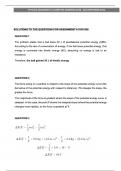
SOLUTIONS TO THE QUESTIONS FOR ASSIGNMENT 4 PHY1505
QUESTION 1
The problem states that a ball loses 30 J of gravitational potential energy (GPE).
According to the law of conservation of energy, if the ball loses potential energy, that
energy is converted into kinetic energy (KE), assuming no energy is lost to air
resistance.
Therefore, the ball gained 30 J of kinetic energy
QUESTION 2
The force acting on a particle is related to the slope of the potential energy curve (the
derivative of the potential energy with respect to distance). The steeper the slope, the
greater the force.
The magnitude of the force is greatest where the slope of the potential energy curve is
steepest. In this case, the point Y shows the steepest slope (where the potential energy
changes most rapidly), so the force is greatest at Y.
QUESTION 3
PHY1505 Assignment 4 (COMPLETE ANSWERS)
2024 - DUE September 2024
, PHY1505 ASSIGNMENT 4 (COMPLETE ANSWERS) 2024 - DUE SEPTEMBER 2024
PHY1505 Assignment 2024 - DUE September 2024
1. A ball drops some distance and loses 30 J of gravitational potential energy. Do NOT ignore air
resistance. How much kinetic energy did the ball gain? 2. The plot in the figure shows the potential
energy of a particle, due to the force exerted on it by another particle, as a function of distance. At
which of the three points labeled in the figure is the magnitude of the force on the particle
greatest? 3. An 8.0-kg block is released from rest, with v1 = 0.00 m/s, on a rough incline, as
shown in the figure. The block moves a distance of 1.6-m down the incline, in a time interval of
0.80 s, and acquires a velocity of v2 = 4.0 m/s. How much work does gravity do on the block
during this process? 4. You do 174 J of work while pulling your sister back on a swing, whose
chain is 5.10 m long. You start with the swing hanging vertically and pull it until the chain makes
an angle of 32.0° with the vertical with your sister at rest. What is your sister's mass, assuming
negligible friction? 5. A tennis ball bounces on the floor three times. If each time it loses 22.0% of
its energy due to heating, how high does it rise after the third bounce, provided we released it from
the floor? 6. A 60.0-kg person drops from rest a distance of 1.20 m to a platform of negligible mass
supported by an ideal stiff spring of negligible mass. The platform drops 6.00 cm before the person
comes to rest. What is the spring constant of the spring? 7. A block slides down a frictionless
inclined ramp. If the ramp angle is 17.0° and its length is find the speed of the block as it reaches
the bottom of the ramp, assuming it started sliding from rest at the top. 8. A projectile is fired from
ground level at an angle of 40.0° above horizontal at a speed of 30.0 m/s. What is the speed of
the projectile when it has reached a height equal to 50.0% of its maximum height? 9. An object is
attached to a hanging unstretched ideal and massless spring and slowly lowered to its equilibrium
position, a distance of 6.4 cm below the starting point. If instead of having been lowered slowly the
object was dropped from rest, how far then would it then stretch the spring at maximum
elongation? 10. A 5.00-kg object moves clockwise around a 50.0 cm radius circular path. At one
location, the speed of the object is 4.00 m/s. When the object next returns to this same location,
the speed is 3.00 m/s. 11. A 2.5-kg box, sliding on a rough horizontal surface, has a speed of 1.2
m/s when it makes contact with a spring (see the figure). The block comes to a momentary halt
when the compression of the spring is 5.0 cm. The work done by friction, from the instant the block
makes contact with the spring until it comes to a momentary halt, is -0.50 J. (a) What is the spring
constant of the spring? (b) What is the coefficient of kinetic friction between the box and the rough
surface? 12. A force on an object is given by F(x) = ( -4.00 N/m)x + ( 2.00 N/m3)x3. What is the
change in potential energy in moving from x = 1.00 m to x = 2.00 m? Physics for Scientists and
, PHY1505 ASSIGNMENT 4 (COMPLETE ANSWERS) 2024 - DUE SEPTEMBER 2024
Engineers, 4e (Knight) Chapter 11 Impulse and Momentum 13. A firecracker breaks up into
several pieces, one of which has a mass of 200 g and flies off along the x-axis with a speed of
82.0 m/s. A second piece has a mass of 300 g and flies off along the y-axis with a speed of 45.0
m/s. What are the magnitude and direction of the total momentum of these two pieces? 14. During
a collision with a wall, the velocity of a 0.200-kg ball changes from 20.0 m/s toward the wall to 12.0
m/s away from the wall. If the time the ball was in contact with the wall was 60.0 ms, what was the
magnitude of the average force applied to the ball? 15. A 620-g object traveling at 2.1 m/s collides
head-on with a 320-g object traveling in the opposite direction at 3.8 m/s. If the collision is perfectly
elastic, what is the change in the kinetic energy of the 620-g object? 16. A 2.3-kg object traveling
at 6.1 m/s collides head-on with a 3.5-kg object traveling in the opposite direction at 4.8 m/s. If the
collision is perfectly elastic, what is the final speed of the 2.3-kg object?
SOLUTIONS TO THE QUESTIONS FOR ASSIGNMENT 4 PHY1505
QUESTION 1
The problem states that a ball loses 30 J of gravitational potential energy (GPE).
According to the law of conservation of energy, if the ball loses potential energy, that
energy is converted into kinetic energy (KE), assuming no energy is lost to air
resistance.
Therefore, the ball gained 30 J of kinetic energy
QUESTION 2
The force acting on a particle is related to the slope of the potential energy curve (the
derivative of the potential energy with respect to distance). The steeper the slope, the
greater the force.
The magnitude of the force is greatest where the slope of the potential energy curve is
steepest. In this case, the point Y shows the steepest slope (where the potential energy
changes most rapidly), so the force is greatest at Y.
QUESTION 3