
Chapter 7: Human Memory
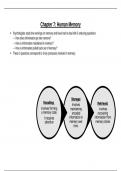
Psychologists study the workings on memory and have had to deal with 3 enduring questions
How does information get into memory?
How is information maintained in memory?
How is information pulled back out of memory?
These 3 questions correspond to 3 key processes involved in memory:
Storage:
Encoding: Retrieval:
Involves
involves forming maintaining involves
a memory code. encoded recovering
It requires information in information from
attention memory over memory stores
time.
, Encoding: getting information into memory
When you are often introduced to people you are often busy assessing them and thinking about what you are
going to say to them.
Encoding: involves forming a memory code from some stimulus.
Your attention is diverted, and names go in one ear and out of the other.
You don’t remember them because they were never encoded for storage.
Encoding is an IMPORTANT process for memory.
Memory is negatively affected by inattetion.
The role of attention
Attention: involves focussing awareness on a narrow range of stimuli or events.
Psychologists routinely refer to it “selective attention”
Attention is a selection of input.
Selective attention is critical to everyday functioning.
If attention were equally distributed among stimulus input, life would be CHAOS.
We need to filter out potential stimulation around us.
Divided attention can have a negative effect on the performance of variety of tasks, especially when the tasks
are complex/unfamiliar.
People think they can multitask without weakening in performance.
The human brain can only handle 1 attention consuming task at a time.
Psychologists study the workings on memory and have had to deal with 3 enduring questions
How does information get into memory?
How is information maintained in memory?
How is information pulled back out of memory?
These 3 questions correspond to 3 key processes involved in memory:
Storage:
Encoding: Retrieval:
Involves
involves forming maintaining involves
a memory code. encoded recovering
It requires information in information from
attention memory over memory stores
time.
, Encoding: getting information into memory
When you are often introduced to people you are often busy assessing them and thinking about what you are
going to say to them.
Encoding: involves forming a memory code from some stimulus.
Your attention is diverted, and names go in one ear and out of the other.
You don’t remember them because they were never encoded for storage.
Encoding is an IMPORTANT process for memory.
Memory is negatively affected by inattetion.
The role of attention
Attention: involves focussing awareness on a narrow range of stimuli or events.
Psychologists routinely refer to it “selective attention”
Attention is a selection of input.
Selective attention is critical to everyday functioning.
If attention were equally distributed among stimulus input, life would be CHAOS.
We need to filter out potential stimulation around us.
Divided attention can have a negative effect on the performance of variety of tasks, especially when the tasks
are complex/unfamiliar.
People think they can multitask without weakening in performance.
The human brain can only handle 1 attention consuming task at a time.


