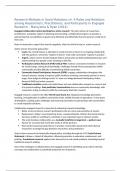
Research Methods in Social Relations ch. 4 Roles and Relations
among Researchers, Practitioners, and Participants in Engaged
Research – Maruyama & Ryan (2014)
Engaged/collaborative/action/participatory action research: The joint actions of researchers,
practitioners, and policy makers in planning and executing a collaborative project can produce a
partnership that accomplishes its goals more efficiently and effectively than the partners could do on
their own.
Roles of researchers: expert (less need to negotiate, often has the final say) vs. action research.
Action science (research) approaches:
Lewin: the central feature is attempts to create and test a theory in an ongoing relationship
with the partners. University “experts in theory” work with community “experts in practice”.
Argyris: action science should integrate theory and practice by both predicting behaviour and
understanding how people create meaning in daily life.
Participatory Action Research (PAR)/Critical PAR: Involves community members in research
for social change, valuing local knowledge. Challenges include diverse perspectives within
communities and the difficulty of maintaining skilled researchers.
Community-Based Participatory Research (CBPR): engages stakeholders throughout the
research process, aiming to improve public health by involving community partners in every
stage, from design to sharing results. It’s seen as a bridge between Participatory Action
Research (PAR) and action research.
Traditional scientists usually start with theory and see collaborative research as a way to test
it in practical settings. Post-positivists/constructivists focus on community knowledge, with
researchers acting as advisors while the community leads the research.
Engaged research, rooted in the 1862 Morrill Land Grant Act, integrates knowledge generation,
teaching, and application to address community needs. Initially focused on agriculture, it now spans
all disciplines, tackling urban challenges and involving universities in partnerships with communities
to create impactful solutions.
Collaborative engaged research is important in advancing research knowledge:
Better access to diverse research participants who are more representative of society.
Responsive to today’s most important issues, counteracting the criticism that social science
has been unable or unwilling to contribute in any important ways to improve society.
The work develops collaboration as a mutually beneficial arrangement, a quid pro quo
(favour for a favour) that meets the needs of all the partners.
Real-world research grounds theory in practice. Universities should work with external
researchers to bridge the gap between researchers and practitioners.
Social science research has historically shaped policy, including through the 1952 Social Science
Statement in Brown v. Board of Education, influencing practices in education, employment, and
policing. Translational research applies basic discoveries to real-world problems, extending beyond
traditional research settings.
One of the challenges of collaborations and engaged research is identifying areas where interests
converge and collaboration is potentially productive for all partners.
among Researchers, Practitioners, and Participants in Engaged
Research – Maruyama & Ryan (2014)
Engaged/collaborative/action/participatory action research: The joint actions of researchers,
practitioners, and policy makers in planning and executing a collaborative project can produce a
partnership that accomplishes its goals more efficiently and effectively than the partners could do on
their own.
Roles of researchers: expert (less need to negotiate, often has the final say) vs. action research.
Action science (research) approaches:
Lewin: the central feature is attempts to create and test a theory in an ongoing relationship
with the partners. University “experts in theory” work with community “experts in practice”.
Argyris: action science should integrate theory and practice by both predicting behaviour and
understanding how people create meaning in daily life.
Participatory Action Research (PAR)/Critical PAR: Involves community members in research
for social change, valuing local knowledge. Challenges include diverse perspectives within
communities and the difficulty of maintaining skilled researchers.
Community-Based Participatory Research (CBPR): engages stakeholders throughout the
research process, aiming to improve public health by involving community partners in every
stage, from design to sharing results. It’s seen as a bridge between Participatory Action
Research (PAR) and action research.
Traditional scientists usually start with theory and see collaborative research as a way to test
it in practical settings. Post-positivists/constructivists focus on community knowledge, with
researchers acting as advisors while the community leads the research.
Engaged research, rooted in the 1862 Morrill Land Grant Act, integrates knowledge generation,
teaching, and application to address community needs. Initially focused on agriculture, it now spans
all disciplines, tackling urban challenges and involving universities in partnerships with communities
to create impactful solutions.
Collaborative engaged research is important in advancing research knowledge:
Better access to diverse research participants who are more representative of society.
Responsive to today’s most important issues, counteracting the criticism that social science
has been unable or unwilling to contribute in any important ways to improve society.
The work develops collaboration as a mutually beneficial arrangement, a quid pro quo
(favour for a favour) that meets the needs of all the partners.
Real-world research grounds theory in practice. Universities should work with external
researchers to bridge the gap between researchers and practitioners.
Social science research has historically shaped policy, including through the 1952 Social Science
Statement in Brown v. Board of Education, influencing practices in education, employment, and
policing. Translational research applies basic discoveries to real-world problems, extending beyond
traditional research settings.
One of the challenges of collaborations and engaged research is identifying areas where interests
converge and collaboration is potentially productive for all partners.