🧭
Equilibrium:
if you want to know the equilibrium by using the equation:
you solve it as Qd=Qs to know the price
after you sub the price into the equations to know the quantity (ex: 100-
3P becomes 100-3x16)
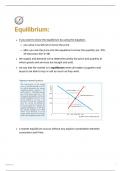
the supply and demand curve determine jointly the price and quantity at
which goods and services are bought and sold.
we say that the market is in equilibrium when all traders (suppliers and
buyers) are able to buy or sell as much as they want.
a market equilibrium occurs without any explicit coordination between
consumers and firms.
Equilibrium: 1
, 💡 Not all markets reach equilibrium through the independent actions of
many buyers or sellers. In institutionalized or formal markets, such as
the Chicago Mercantile Exchange (where agricultural commodities,
financial instruments, energy, and metals are traded) buyers and
sellers meet at a single location (or on a single Web site). In these
markets, certain individuals or firms, sometimes referred to as market
makers, act to adjust the price and bring the market into equilibrium
very quickly.
SHOCKING THE EQUILIBRIUM: COMPARATIVE STATICS.
Shocking the equilibrium could simply mean any significant event or
change that disrupts the existing equilibrium in a market or system. This
could be a sudden and large shift in supply or demand, a change in
government policy, or an unexpected event like a natural disaster.
Comparative statics is an economic method used to analyze how
consumer and producer-controlled variables, such as price and quantity,
respond to changes in environmental variables that are not under their
control.
exogenous variables: Exogenous variables in economics are external
factors or inputs that are determined outside of the economic model being
analyzed. They are considered as given and not influenced by the model
itself. Such as:
Taxes
Income
price of the substitute or complement
price of inputs
Comparative statics focuses on comparing the two equilibrium states:
Before the change in the exogenous variable (initial equilibrium).
After the change in the exogenous variable (new equilibrium).
Comparative statics is widely used in economics to analyze the impacts of:
1. Changes in tax rates
2. Government subsidies
Equilibrium: 2
Equilibrium:
if you want to know the equilibrium by using the equation:
you solve it as Qd=Qs to know the price
after you sub the price into the equations to know the quantity (ex: 100-
3P becomes 100-3x16)
the supply and demand curve determine jointly the price and quantity at
which goods and services are bought and sold.
we say that the market is in equilibrium when all traders (suppliers and
buyers) are able to buy or sell as much as they want.
a market equilibrium occurs without any explicit coordination between
consumers and firms.
Equilibrium: 1
, 💡 Not all markets reach equilibrium through the independent actions of
many buyers or sellers. In institutionalized or formal markets, such as
the Chicago Mercantile Exchange (where agricultural commodities,
financial instruments, energy, and metals are traded) buyers and
sellers meet at a single location (or on a single Web site). In these
markets, certain individuals or firms, sometimes referred to as market
makers, act to adjust the price and bring the market into equilibrium
very quickly.
SHOCKING THE EQUILIBRIUM: COMPARATIVE STATICS.
Shocking the equilibrium could simply mean any significant event or
change that disrupts the existing equilibrium in a market or system. This
could be a sudden and large shift in supply or demand, a change in
government policy, or an unexpected event like a natural disaster.
Comparative statics is an economic method used to analyze how
consumer and producer-controlled variables, such as price and quantity,
respond to changes in environmental variables that are not under their
control.
exogenous variables: Exogenous variables in economics are external
factors or inputs that are determined outside of the economic model being
analyzed. They are considered as given and not influenced by the model
itself. Such as:
Taxes
Income
price of the substitute or complement
price of inputs
Comparative statics focuses on comparing the two equilibrium states:
Before the change in the exogenous variable (initial equilibrium).
After the change in the exogenous variable (new equilibrium).
Comparative statics is widely used in economics to analyze the impacts of:
1. Changes in tax rates
2. Government subsidies
Equilibrium: 2